










































Sexual and Reproductive Health Framework
"The plan reflects the principles of national ownership and leadership of programming, strengthened policymaking, capacity development, continued advocacy, knowledge-sharing and South-South cooperation..."
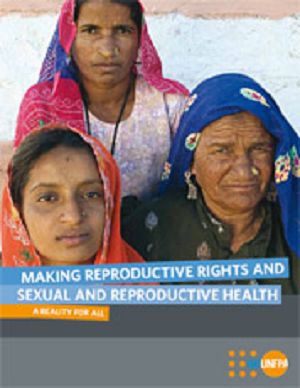
This report from the United Nations Populations Fund (UNFPA) provides overall guidance for implementing the Reproductive Health and Rights elements of the UNFPA Strategic plan 2008-2011. The framework builds on the goals of: the International Conference on Population and Development (ICPD), 1994; the Millennium Summit, 2000, with its adoption of the Millennium Development Goals (MDGs); the 2005 World Summit; and the addition, in 2007, of the goal of universal access to reproductive health to MDG 5, for improving maternal health. The framework offers a rationale for the approach in the Strategic Plan 2008-2011 to engage in policy dialogue, policy analysis, and advocacy for the inclusion of sexual and reproductive health (SRH) issues in national development strategies, plans, budgets, and government-driven processes. It explains the Strategic Plan's focus on the socially excluded and marginalised in relation to equity aspects of SRH within the health system and gender-equality concerns. It also stresses the importance of partnership, outlining the rationale behind: strengthening collaboration among United Nations organisations and other institutions such as the World Bank, as well as fostering linkages with civil society, women, youth, and faith-based organisations.
There are 5 SRH and HIV-prevention outcomes outlined in this report, and many of the strategies and activities elaborated for each are communication-related. In summary:
- The first outcome deals with the promotion of reproductive rights and the delivery of a comprehensive and integrated package of SRH services within basic health services and empowering couples and individuals to exercise their reproductive rights. "The availability of services should be complemented by comprehensive information and counselling to empower couples and individuals to exercise an informed choice in matters of SRH. These efforts will lead to social and behavior changes, increased utilization of services and ultimately to improved health outcomes. Therefore, efforts will be directed at determining the key communication and social mobilization approaches to ensure that couples and individuals have the information and the social support they need. Civil society will be a vital partner in developing and implementing these approaches. It is also essential to continue building on and expanding approaches that involve men and boys to enlist their support to their partner's choices and needs and as direct recipients of services for their own health and well-being..."
- Outcome 2 focuses on improving maternal health, reducing maternal mortality and morbidity, and preventing and managing the complications of unsafe abortion. Amongst the strategies detailed are: undertaking advocacy and policy dialogue, building strategic and multisectoral partnerships, strengthening the capacity of countries to develop and implement national plans to ensure quality maternal health care, and empowering communities to demand and support access to quality maternal care.
- Outcome 3 focuses on access to and utilisation of quality voluntary family planning services by individuals and couples. "Unmet need will be addressed and complemented by demand creation with behaviour and social change communication (BSCC) and community mobilization. Emphasis will be placed on disadvantaged groups....Capacity development will focus on those cadres of service providers who deliver outreach services. Quality of care, including counselling for method selection and switching, is an important component of capacity development..."
- Outcome 4 is: "Demand, access to and utilization of quality HIV- and [sexually transmitted infection] STI-prevention services, especially for women, young people and other vulnerable groups, including populations of humanitarian concern, increased". Selected communication-related context provided in the report includes: (i) "Behavior change continues to be a complex issue; given the social-economic and cultural context in which this behavior takes place....Despite cultural, social, political and religious barriers to comprehensive social behaviour change programmes, multisectoral approaches in various countries have met with success. Field research demonstrates the need to focus on specific populations, consult with them extensively and involve them in the design, implementation and evaluation of programme interventions." (ii) "Evidence collected worldwide confirms that quality education, including relevant content and life skills related to SRH, and better understanding of the socio-cultural determinants that oppose or facilitate SRH, is strongly predictive of better knowledge and awareness, safer behaviour and reduced risk and vulnerability to STIs and the HIV/AIDS epidemic, especially among girls and women..." (iii) "...[T]here is a need to constantly raise awareness and adapt and adjust national policies according to recent research findings in SRH, e.g., human papilloma virus (HPV) vaccines and internationally agreed strategies."
- Outcome 5 is: "Access of young people to SRH, HIV- and gender-based violence prevention services, and gender-sensitive life skills-based sexual and reproductive health education improved as part of a holistic multisectoral approach to young people's development." UNFPA will focus on 4 key areas: supportive policy environment; life skills-based education, including sexual health and relationships; health service provision; and, finally, leadership and participation. Details are provided in the report.
UNFPA website, October 31 2011. Image credit: Diego Goldberg/Pixel Press/UNFPA
- Log in to post comments