










































Measuring the Outreach Efforts of Public Health Authorities and the Public Response on Facebook During the COVID-19 Pandemic in Early 2020: Cross-Country Comparison
National University of Singapore
"With widespread social media use and the participatory web, PHAs [public health authorities] must understand that health risk communication is no longer a linear process..."
The purpose of risk communication during pandemics is to direct the public to adopt certain behaviours, such as social distancing and good hygiene habits. Transparent and consistent communication amidst the uncertainty of the pandemic is also crucial in maintaining public confidence and trust. During the coronavirus disease (COVID-19) outbreak, governments and public health authorities (PHAs) around the world used social media such as Facebook as one tool for quickly communicating pandemic response measures. This study examined COVID-19-related outreach efforts of PHAs in Singapore, the United States (US), and England, and the corresponding public response to these outreach efforts on Facebook. The hope is that understanding communication strategies across different PHAs and examining the public response on the social media landscapes could help improve practices for disseminating critical information to the public.
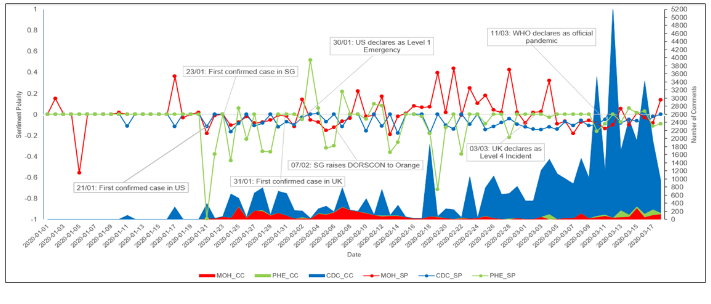
The researchers extracted posts and comments from the Facebook pages of the Ministry of Health (MOH) in Singapore, the US Centers for Disease Control and Prevention (CDC), and Public Health England (PHE) from January 1 2019 to March 18 2020. They categorised posts published before January 1 2020 as pre-COVID-19; the remaining posts were categorised as peri-COVID-19 posts. COVID-19-related posts were identified and classified into themes: situation update, preventive measures, appreciation, public reassurance, disease information, falsehood correction, face mask, research, testing and diagnosis, and miscellaneous. Metrics used for measuring outreach and engagement were frequency, mean posts per day (PPD), mean reactions per post (RPP), mean shares per post (SPP), and mean comments per post (CPP). Responses to the COVID-19 posts were measured using frequency, mean sentiment polarity, positive to negative sentiments ratio (PNSR), and positive to negative emotions ratio (PNER). Toxicity in comments (rude, disrespectful, or unreasonable language that may provoke another user to leave the discussion) were identified and analysed. Trend analysis was performed to examine how the metrics varied with key events, such as when COVID-19 was declared a pandemic (March 11 2020).
In Tables 1 and 2 in the paper, the aggregated statistics related to the Facebook posts from the MOH, the CDC, and PHE are listed, and In Figure 1, the COVID-19 posts daily count values are plotted in a line graph. In short, the MOH published more COVID-19 posts (n=271; mean PPD 5.0) compared to the CDC (n=94; mean PPD 2.2) and PHE (n=45; mean PPD 1.4). The posting frequency of the CDC and PHE on matters pertaining to COVID-19 was low in the initial peri-COVID-19 phase; this was because a substantial number of posts were still dedicated to other public health topics. This may reflect that both countries perceived the risk to be low or possibly that the outbreak was still largely confined within Asia.
Compared to the pre-COVID-19 phase (Table 2), there was a considerable increase in the public engagement metrics in the peri-COVID-19 time period. For instance, the MOH had a 7-fold increase in CPP, with a higher average number of people commenting in 2020 compared to 2019; the CDC saw a 9-fold increase in the mean RPP from 2019 to 2020 and close to a 10-fold increase in mean SPP from 2019 to 2020; and PHE saw a nearly 5-fold increase in SPP from 2019 to 2020. The fact that Facebook users who engaged with the CDC or PHE posts were more likely to share rather than to react or comment on the posts indicates that Facebook may possibly be a useful platform for the CDC or PHE to disseminate information for Facebook users to propagate to others.
The CDC and PHE received predominantly negative comments from their followers, based on the low PNSR and PNER values; anger was the most prevalent emotion. For the MOH, however, not only was there a higher percentage of positive sentiments (e.g., trust), but there was a trend in positivity about the government's response over time (from mid-February to the first week of March 2020). Toxic comments were rare (0.01%) across all PHAs, but the CDC had the highest number, perhaps in part because the US President "repeatedly referred to SARS coronavirus 2 as the 'Chinese virus,' and this may have led to anti-Asian sentiments..." PHE had the highest average of likes per toxic comment (LPTC) compared to the CDC and the MOH.
As shown in Table 3, the CDC and PHE posts were largely related to preventive measures; the themes from the MOH are more diverse, with no theme exceeding 30% of the total posts. The CDC and PHE did not issue any post to correct false information, while the MOH issued 16 such posts, which reflects the fact that MOH adopted misinformation debunking as one of its community and social measures for handling the COVID-19 situation. There was also no post from PHE and only 2 posts from the CDC to reassure their Facebook followers, while the MOH issued 32 such public reassurance posts.
Thus, on the whole, the MOH stepped up its outreach efforts on Facebook more intensively compared to the CDC and PHE. Perhaps in part this could be due to the fact that Singapore joined countries such as Taiwan and South Korea in taking precautions to handle this pandemic within their borders in January 2020, when the pandemic was largely confined to China. Precautionary measures have been reported to be found wanting, and delays in response observed, in other countries such as the US and the United Kingdom (UK).
Social media use during pandemics may be of interest to PHAs in pandemics not only as a risk communication tool but as a research instrument. Via platforms such as Facebook, the public "can voice their sentiments and comments on the actions undertaken by the government as events related to the pandemic unfold," which "demonstrates that monitoring sentiments and emotions on social media can help PHAs gauge the effectiveness of their public health education efforts on Facebook....This will highlight the trigger points, allowing health authorities to fine-tune messaging along the course of the pandemic to allay public fear and panic."
Journal of Medical Internet Research 2020 (May 19); 22(5):e19334
- Log in to post comments