










































Cross-Country Comparison of Public Awareness, Rumors, and Behavioral Responses to the COVID-19 Epidemic: Infodemiology Study
Fudan University (Hou, Du, Zhou, Jiang); University of Oxford (Martin); London School of Hygiene & Tropical Medicine (Larson, Lin); University of Washington (Larson)
"Governments should engage early in public risk communication about epidemic control, detect misinformation, confront inaccurate messages, and clarify rumors in real time..."
The COVID-19 pandemic has triggered the spread of rumours and misinformation through social media regarding unproven remedies, which has prompted disruptive behaviour (e.g., panic buying and adoption of unproven treatments). Understanding why and how the public responds to COVID-19-related information can inform government risk communication and appropriate official guidelines. The use of internet search data is a method for systematically tracking public responses to epidemics in real time that is also less likely to be affected by recall bias. Using internet surveillance data from 12 countries, this study assessed public awareness and behavioural responses during the first 100 days of the COVID-19 epidemic.
The data cover the period from December 1 2019 (prepandemic baseline) to April 11 2020 (at least one month after the governments of the 12 countries took actions to address the COVID-19 pandemic). Table 1 in the paper lists the keywords used to measure public awareness, rumours, and behavioural responses to COVID-19. Specifically:
- In 11 countries (other than China), the Google Trends index (web search) on the topic of coronavirus was used to assess awareness of COVID-19 among the general public, whereas the Google Shopping indices on 2 topics, mask and hand sanitizer, were used to assess the adoption of personal protection measures. In addition, leading politicians have touted the antimalarial drugs chloroquine and hydroxychloroquine as treatments for COVID-19 without clinical data to support their efficacy; these drugs have potentially deadly side effects. By analysing Google Trends data on both drugs, the researchers assessed the public behavioural response towards misinformation worldwide.
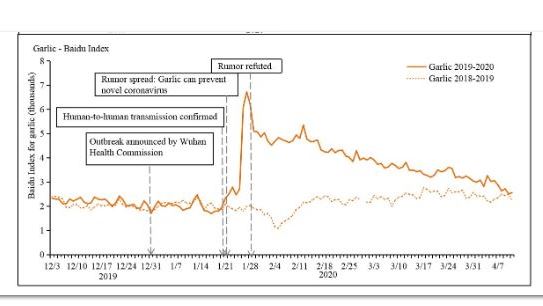
- Rumours and misinformation circulated widely in China regarding certain herbal medicines for personal health protection. From the Sina Weibo "Hot Search" ranking, the researchers identified 3 keywords related to these rumours and misinformation: radix isatidis (a traditional Chinese medicine used to treat fever), Shuanghuanglian (another traditional Chinese remedy), and garlic (rumoured to have a protective function) and then used Google's equivalent in China, the Baidu Index, on these terms was used to detect public behavioural responses. Also, the researchers used the Ali platform, Amazon's equivalent in China, to look at mask, hand sanitizer, disinfectant, and thermometer to assess public behavioural responses to COVID-19 in China.
Results are shared in terms of:
- Public awareness and searches related to COVID-19 - sample finding: Figure 1 in the paper highlights 2 missed windows of opportunity for early epidemic control in China, as well as an additional 1-month window of opportunity that the rest of the world missed for early epidemic control, even when the number of COVID-19 cases had reached almost 80,000 in China.
- Behavioural responses of adopting recommended personal protection measures - sample finding: The Chinese public responded quickly to the issuing of specific guidelines, and both intended and actual purchasing behaviour dramatically increased accordingly. Elsewhere, overall, the Google Trends data for mask and hand sanitizer were in line with the trends of the number of cases in each country, and these trends reached their own peaks only when COVID-19 spread locally.
- Public responses to rumours and misinformation on remedies - sample finding: A rumour that garlic could prevent COVID-19 started to spread on January 21 2020, and the Baidu Index of garlic increased accordingly. This index reached a peak on January 27 2020 and declined after January 28 2020, when People's Daily first refuted rumours about the protective function of garlic. Likewise, public searches for chloroquine and hydroxychloroquine peaked on March 20 2020 after United States (US) President Donald Trump's initial public remarks on the drugs at a briefing on March 19 2020; this increase was observed in all countries.
Notably, the epidemic in China and the declaration of a public health emergency of international concern (PHEIC) on January 30 2020 did not prompt a worldwide public reaction to adopt public health protective measures; instead, most countries and regions only responded to the epidemic after their own case counts mounted. The epidemic in China only caught the public attention of East and Southeast Asia, and the lessons learned in this region did not trigger appropriate epidemic responses in the rest of the world. Similarly, the epidemic in Italy only resulted in public awareness and reaction in Europe and the US. As the researchers suggest, the World Health Organization (WHO) should be empowered to take a leading role in guiding more preparedness actions than solely making statements that a disease has reached pandemic proportions. In short, the study indicates the need for strengthened international partnerships and coordination to combat the COVID-19 epidemic and future epidemics.
The data also highlight the importance of individual governments' response in early epidemic preparedness for mobilisation and surge capacity, effective control measures, and timely and clear communication to cue public action. Chinese data show that the timely governmental clarification of rumours mitigated the rush to buy unproven remedies to treat or prevent COVID-19. However, the lack of transparent, timely, and effective risk communication by health authorities in the early stages of the emergency failed to bring about appropriate levels of public awareness and behavioural responses worldwide, such as avoidance of mass gatherings and personal protection. In fact, some political leaders and media outlets repeatedly called the COVID-19 pandemic a hoax and downplayed the threat the pandemic posed to society, leading to a delay in public response.
The researchers observe that, compared with traditional surveys, internet surveillance tools can generate "real-time, longitudinal, and dynamic data for capturing public awareness, rumors, and behavioral reactions, and they can be an effective means to evaluate public response towards epidemic information and rumors..." These data can inform early release of official guidelines and timely governmental clarification of rumours, which are necessary to guide the public to make rational responses in the context of a pandemic.
Journal of Medical Internet Research (JMIR) 2020;22(8):e21143. doi: 10.2196/21143; and email from Zhiyuan Hou to The Communication Initiative on August 4 2020.
- Log in to post comments