










































Mapping and Analysis of ODA to Media and the Information Environment
"Overall, there is a mismatch between rhetoric and resource allocation."
This report reflects findings from a mapping of official development assistance (ODA) support to public interest media and the broader information environment. It includes a review of development partners' funding policies and practices through four case studies of media assistance to Ukraine/Western Balkans, Myanmar, and Tanzania, as well as to global core funding programmes. Commissioned by the Organisation for Economic Co-operation and Development (OECD) Development Assistance Committee (DAC)'s Network on Governance (GovNet), the objective of the study is to identify barriers and opportunities to improve the quality and quantity of ODA, as well as to improve GovNet members' responses to the mounting challenges facing public interest media and the information environment.
The research involved a quantitative mapping and analysis of development partners' funding reported to the DAC between 2002 and 2021, as well as a qualitative review of recent and current development partners' policies and practices to capture trends and the diversity of approaches and perspectives to funding - what is funded and how. The latter was based on 25 interviews with DAC and non-DAC members and media and information systems experts and a review of over 100 published and internal documents. The research also included the following four case studies based on evaluations of 25 programmes representing different contexts and aid modalities since 2016:
- Ukraine and some regional Western Balkans programmes, which face disinformation from Russia and other threats to their information ecosystems.
- Myanmar, which saw a period of democratisation followed by a military coup in 2021.
- Tanzania, which came out of a period of restrictions on data and media in 2021.
- Core funding to specialised organisations as an alternative aid modality.
The case studies are meant to provide an assessment of the relevance, effectiveness (at output, outcome, and impact levels), sustainability, and coherence of current support to public interest media and the information environment.
As highlighted in the executive summary, the research revealed the following:
- Development partners are aware of the pressures faced by traditional and new media, and how the information environment can influence their wider democracy and sustainable development objectives.
- Despite this, the sector only receives a very small share of total ODA. While ODA for media and the information environment has increased since 2002, reaching $US1.5 billion in 2022, this amount only represented 0.5% of total ODA in that year. When support to media and communications infrastructure is excluded, ODA for media has actually remained stagnant, at around $US500 million a year since 2008 (representing 0.19% of total ODA in 2022).
- Not enough aid directly reaches local organisations. Only up to 8% of ODA for media and the information environment (representing 0.05% of total ODA over 2016-2022) is directly channelled to media organisations in partner countries, such as journalists, media outlets, and civil society organisations. In contrast, 42% is directly delivered to recipient governments, especially for infrastructure programmes funded by the World Bank. A quarter (26%) of ODA for media and the information environment goes to organisations based in donor countries, and this figure excludes funding for international public broadcasters (such as Deutsche Welle and the BBC World Service).
- ODA can achieve important results. The case studies demonstrate that in worsening political contexts or under war conditions, international cooperation can help media sectors survive and keep citizens as well informed as possible, such as in Myanmar and Tanzania. Long-term and large investments can have a system-wide effect, such as supporting the transformation of Ukraine's media sector. Thematic programmes can be effective, such as for shining a light on corruption and holding perpetrators to account through investigative journalism networks, as in the Western Balkans. Well-designed capacity development for journalists, media outlets, and the wider media enabling environment can ensure larger audiences are reached with better-quality and more engaging information.
- However, overall, there is a discrepancy between rhetoric and resource allocation by the main development partners. Diplomatic condemnation of violations of freedom of expression by Western governments is rarely matched by significant increases in financial or human resources. Yet, support for the integrity of the information environment requires both diplomatic and development assistance. Technical expertise is also limited - even the largest funders only have a couple of media experts in headquarters, and there are few dedicated policies, strategies, or technical guidance to assist frontline staff to develop or manage relevant programmes.
To improve the quality and quantity of ODA for media and the information environment, the report recommends:
- Increasing direct assistance for local public interest media, from the low base of 8% of ODA for media and the information environment;
- Adopting a broader "information environment" lens that considers how information is produced, flows across a system, and is used or misused;
- Improving coordination between (i) digital transformation and information and communication technology (ICT) infrastructure and (ii) media and information policies and programmes;
- Improving coordination and coherence between development partners to respond to the increasingly well-coordinated and funded efforts of authoritarian governments to undermine the integrity of information; and
- Strengthening the evidence base. While there are initiatives to improve access to evidence for development partners, this mapping showed there are still evidence gaps, such as what works to counter disinformation and how best to ensure media financial viability.
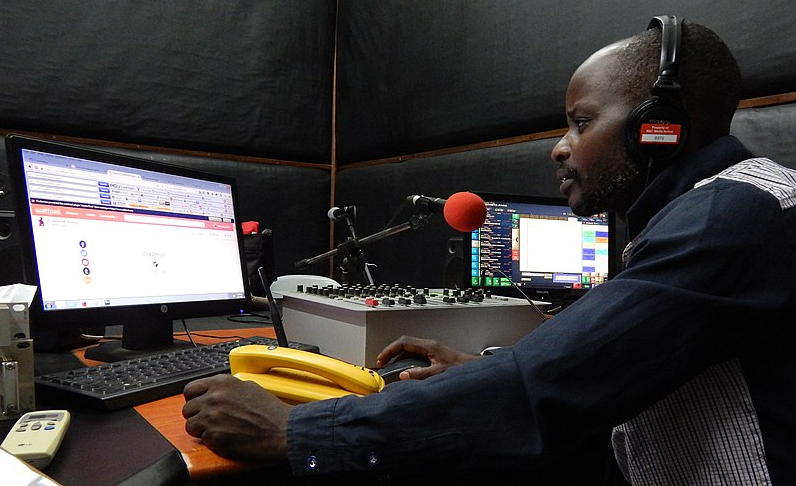
Email from Gülin Özcan to The Communication Initiative on September 30 2024. Image credit: Noahpdoty via Wikimedia (CC BY-SA 4.0)
- Log in to post comments