










































Social Norms Diagnostic Tool: Young Women's Economic Justice
"Interventions that provide training, assets or services alone are often insufficient to achieve the desired changes..."
Practitioners have increasingly recognised the importance of addressing discriminatory social norms to realise the social, political, and economic rights of women, girls, and gender non-binary people. From Oxfam, this tool offers a set of participatory exercises designed to guide programme staff to work together with young people and other community members to identify and discuss social norms that shape, constrain, or promote young women's economic justice within their contexts. The exercises are informed by the Dynamic Framework for Social Change and support participants to think about how overlapping individual, social, material, and institutional factors can influence people's actions.
With delivery envisioned in the form of a one- to three-day workshop, the six activities in the tool include:
- Getting started - introducing social norms
- Gender roles, responsibilities, and decision making - identifying gender norms around roles, responsibilities and decision making, how norms change, and who and what influence norms
- Care work and market-oriented work - identifying social norms around perceptions of different types of work as skilled and valuable, and gender roles in relation to this work
- Gender-based violence - identifying social norms around street, public transport, and workplace harassment, and intimate partner violence
- Sexual and reproductive health and rights - identifying social norms around early marriage and pregnancy, and family planning
- Strategies for change - brainstorming and prioritising change strategies according to feasibility and impact
The methodology is rooted in a feminist and youth-led participatory action research approach to diagnosing social norms. It uses participatory and transformative methods, such as Theatre of the Oppressed techniques and interactive games, to engage young people and other community members as agents of change identifying solutions to arising issues. In the activities, different groups are often engaged separately to help address power inequalities in safe spaces.
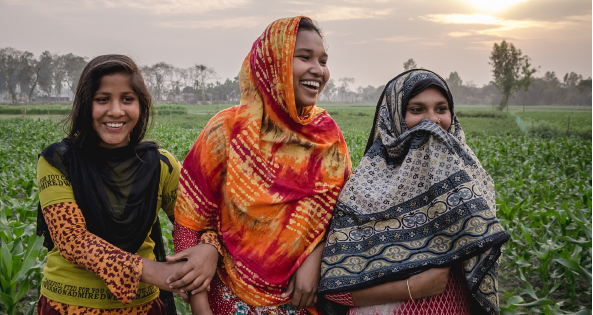
This version of the tool was originally developed for use in Oxfam's Empower Youth for Work (EYW) programme in Bangladesh, and activities were piloted and adapted by representatives from Oxfam and local and national organisations with young people and community groups. It can be adapted to projects in different countries, regions, and communities.
Publishers
35
Email from Oxfam Policy & Practice to The Communication Initiative on January 11 2022. Image credit: Tasfiq Mahmood/Oxfam in Bangladesh
- Log in to post comments