










































Smashing Spatial Patriarchy: Shifting Social Norms Driving Sexual and Gender-Based Violence on Public Transport in Sri Lanka
Oxfam
"Initiatives aimed at combatting SGBV require an understanding of the social norms unpinning it and how they interact with individual, material, institutional and social factors."
Global literature has shown how behaviours such as sexual and gender-based violence (SGBV) on public transport are strongly governed by social norms: the unwritten rules or shared beliefs around what is considered typical or appropriate behaviour. Co-created with local partners, the Sri Lanka version of Oxfam's global "Enough: Together We Can End Violence Against Women and Girls" campaign (see Related Summaries, below), "Not on My Bus" aims to reduce sexual harassment in public transport through promoting bystander intervention. In the context of the campaign's development, this report explores the belief systems that legitimise, excuse, and drive violence against women, girls, transgender, and gender-non-conforming people on public transport in Sri Lanka.
The research methodology for this project was grounded in feminist principles of: overcoming gender biases and social inequalities; recognising and interrogating the central role of gendered inequalities, norms, and unequal power relations; treating women and gender-diverse and socially excluded groups as central to the research, and engaging them as agents of change; using an intersectional and contextualised approach; and recognising how research itself can be an act of power between researcher and participants. These principles were reflected throughout the research cycle.
The primary objectives of the formative research were to: gain an in-depth understanding of the norms and other factors that interact to sustain perpetrator and bystander behaviour, and prevent women from speaking out and/or seeking support; and identify the drivers of norm change that could inform the design of the Enough campaign in Sri Lanka. Oxfam's social norms diagnostic tool is a research methodology based on best-practice research methods for diagnosing social norms and the socio-ecological framework of behaviour change, rooted in a feminist participatory action research approach. It was applied in 9 workshops with women, men, transwomen, and those who identified as queer across 5 cities that serve as mass transit points for people of multiple ethnicities and ages. In addition, 13 key in-depth interviews were carried out with duty bearers (including but not limited to bus drivers, police, government transport officials) and key stakeholders concerned with SGBV and/or public transport issues.
The research identified 12 norms around gender roles and responsibilities and sexual harassment that, to varying degrees, fuel violence against women and transgender and gender non-conforming people on public transport, and creates a culture of impunity for perpetrators. It also highlighted key influencers and factors that intersect with norms to weaken/reinforce SGBV on public transport. (For example, technology was largely seen as a force for positive change and a serious deterrent for sexual harassment against women.) In addition, the researchers identified some positive deviances or outliers, key allies, and positive influencing factors that could potentially assist norm change.
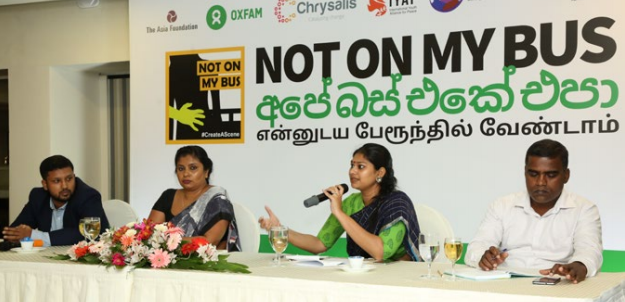
At a December 2018 sense-making and campaign-planning workshop, the norms identified in the formative research were ranked and prioritised; the central focus of the multilingual campaign (in English, Tamil, and Sinhala) is breaking the norm that bystander intervention will not help, or that it will further exacerbate the issue, as well as the norm of placing the responsibility of action solely on the survivor. The campaign was given the name "Not on My Bus" and the slogan "don't ignore sexual harassment: #CreateAScene".
The campaign was launched by Oxfam in Sri Lanka and partners in April 2019. The launch event saw the participation of key ministerial representatives from the transport sector, government representatives, activists, partners, and female commuters. Participants at the event signed a pledge titled "Be a Better Bystander" and witnessed a short theatrical performance on bystander intervention. A panel discussion was held to highlight practical solutions towards harassment experienced in public transport and prevailing issues around reporting harassment.
The campaign will communicate the importance of bystander intervention on social media (Instagram, Facebook and Twitter) and traditional (print, online, TV) media. Strategic activities will range from media campaigns to dialogues with government institutions, which will aim to challenge the negative norms and promote positive norms that encourage bystander intervention.
While the primary goal of the research was to inform the Enough campaign in Sri Lanka, the authors "hope these findings will inspire further research into the norms that sustain violence against women and girls in public places; enable other organizations to take action and influence policy; and support the efforts of feminist networks and CSOs [civil society organisations] to shift the public discourse." Because they also seek to advocate the integration of a participatory approach that includes all voices and identities, a related blog based on the above report offers 5 tips on how to ensure the research process genuinely supports social change:
- Link research with the campaign strategy.
- Adopt a gender transformative and participatory approach to research.
- Understand how social norms interact with other contextual factors to drive behaviours.
- Link participatory research validation to campaign planning and design.
- Learn from changemakers and map influencers.
Advancing Learning and Innovation on Gender Norms (ALIGN) website and "5 Top Tips for Designing Research to Change Social Norms on Gender (or anything else)", by Anam Parvez Butt and Gopika Bashi, August 7 2019 - both accessed on November 5 2019. Image credit: Oxfam
- Log in to post comments