










































The Politics of Poverty: Elites, Citizens and States
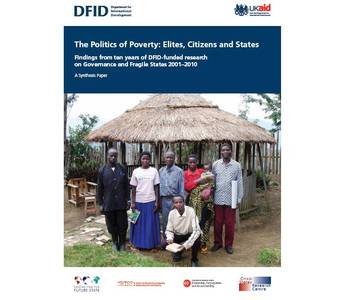
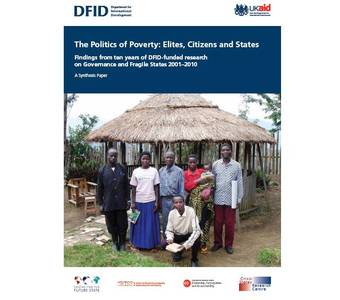
From the United Kingdom (UK) Department for International Development (DFID), this synthesis report examines how and why DFID has invested in governance research in order to understand how to promote policy reform that works in developing countries, and especially fragile states, and how programmes can have maximum impact in the political contexts in which they take place. Specifically, it explores research from 4 major DFID-funded research programmes closing in 2010. It is based on the premise that effective aid depends on whether and how governments, leaders, and citizens work together in developing countries to fight poverty and build peace and prosperity.
Governance, according to DFID, has an effect in fragile contexts in ways such as the following: the inability of government institutions to prevent conflict, provide basic security, or basic services can have life-or-death consequences; lack of opportunity can prevent generations of families from lifting themselves out of poverty; and the inability to grow economically and collect taxes can keep countries trapped in a cycle of aid-dependency. Governance also matters for donors: understanding the political and economic actors and institutions that promote or oppose change has often made the difference between success and failure of development interventions.
The Centre for the Future State and the Centre on Citizenship, Participation and Accountability (Institute of Development Studies, Sussex); the Centre for Research on Inequality, Human Security and Ethnicity (CRISE, University of Oxford); and the Crisis States Research Centre (London School of Economics) - funded by DFID over the past 10 years - have discovered findings about governance.
Communication-related findings from the report include:
- From Chapter 5, "More Equitable and Inclusive States": Citizen engagement in development is more important than previously thought. It helps to get better outcomes in terms of service provision and contributes to building more effective and accountable states. Even in the least democratic societies, and in conflict-affected countries, local associations and groups find spaces to promote development. According to DFID, the evidence suggests:
- "We must find ways to promote effective citizenship, recognising that citizenship can be exclusionary as well as an inclusive. Deepening genuine democracy is not a simple process in development, and democracy is not built simply through 'top down' political institutions.
- We should recognise how global trends impact both positively and negatively on citizenship.
- We should be more aware of the disadvantages of decentralisation: it can consolidate local inequalities and elite capture.
- We need to consider how to strengthen the informal local institutions that work for the poor: since informal ('traditional') local governance institutions are persistent, influential and very diverse, they matter for development outcomes."
- From Chapter 6, "Effective Citizens, Effective States": "Citizens may engage with the state not only through electoral processes as voters, but also through local associations and social movements outside of the state." According to DFID, the evidence suggests:
- "Whether or not citizen engagement can promote positive change depends on the political context. Broader based participation is often necessary but not sufficient.
- We must find legitimate ways to help citizens to engage in different dimensions of the policy process ["participation may be more effective when social movements, from the outside, hold open democratic spaces that create possibilities for reformers on the inside to change and implement policy. Social movements do not emerge only when the political system creates opportunities to do so. Alternative forms of political mobilisation such as protests, social participation, activism, litigation and lobbying engage with the formal institutions of representative democracy. These serve to contribute to strengthening state accountability and responsiveness, as well as complementing formal institutions of representative democracy."]
- But we need to be clear that not all civil society organisations contribute to the development of active citizens, and not all claims to represent the poor are legitimate. We also need to look beyond a narrow concept of 'pro-poor' to support middle class political engagement in development.
- We should put more effort into increasing women's participation in civil society ["...special attention should be paid to the following challenges: Building women's confidence, speaking skills and knowledge of the issues under discussion, as well as women's association and forms of mobilisation which support them in public spaces....; Creating networks and linkages between women would-be political candidates and women in political office, between women in politics and women in movements and women's organisations, and among women within political institutions...; Addressing the barriers to women's participation in public life: the way women are treated in public when they speak out; the way what they say is listened to and whether it is heard; whether women are asked to speak if they raise their hands; attitudes of family members and partners to women going out alone to meetings; and a host of other cultural and social dimensions...]"
- From Chapter 10, "Conclusion": "The experience of the DFID-supported governance research programmes points to the importance of developing and supporting multi-partner research networks...to develop Southern owned research agendas and ensure the communication and use of findings....This will also require bringing together research partners with differing skills and academic disciplines, from differing types of institutions and contexts, to promote Southern capacity and ownership over not just research but its formulation and policy application. It also requires academics and policymakers...to work more effectively together at translating knowledge into evidence for improving the impact of aid and development."
R4D Research News from DFID, June 21 2010; and DFID website, June 30 2010.
- Log in to post comments