










































Political Crisis, Mediated Deliberation and Citizen Engagement: A Case Study of Bangladesh and Nirbachoni Sanglap
Pennsylvania State University (Raman); BBC World Service Trust (Bhanot)
Accepted by the International Association for Media and Communication Research (IAMCR) Conference, held in Mexico City, Mexico, July 21-24 2009, this 32-page paper examines the role of the media in Bangladesh during emergency rule through a look at television and radio debates designed to foster awareness and conversations among citizens and to engage them politically.
It does so through a case study of the following BBC World Service Trust (BBC WST) initiatives:
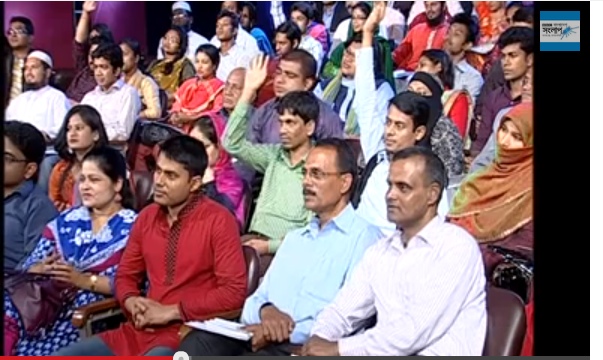
- Bangladesh Sanglap - "Sanglap" means discussion dialogue in the Bangla language. Working in partnership with Bangladeshi broadcasters, the BBC Bengali Service and BBC WST produced a weekly political debate programme to give citizens an opportunity to interact with policymakers and individuals from civil society on various issues related to governance. Broadcasting of Bangladesh Sanglap began in November 2005; a second series went on air in September 2006 covering 7 regions in addition to Dhaka. At these weekly debates, which reach approximately 7 million people, citizens could question their political leaders and decision makers.
- Nirbachoni Sanglap - 7 debates focused on City Corporation (Mayoral) Elections aired between July 15 and July 31 2008 with an audience of 13 million people across TV and radio. These debates "were among the first to allow citizens open access to policy makers after the state of emergency declared in October 2006".
As explained in this paper, tension and unrest have been a significant part of political life in Bangladesh since it came into being in 1971. After 15 years of military rule, democracy was restored in 1990, but unrest and violence continued. The crisis escalated in October 2006, leading to postponement of elections and the appointment of a military-backed caretaker government. Although elections had been promised by the end of 2008, much of the political process has been suspended. In this context, governance has become an important issue.
The main broadcasters - Radio Betar and Bangladesh Television (BTV) - are described here as state-owned and favourable to the government. TV dominates media usage, especially in the cities, and BTV is the sole terrestrial TV channel. State-run radio covers almost the entire country. BBC World Service programs in English and Bengali are broadcast on 100 MHz FM in Dhaka. The print media are privately owned, and there is a strong tradition of owner-editorship. The International Telecommunications Union (ITU) reports that there were 450,000 internet users in Bangladesh by September 2007 - 0.3% of the population. According to the authors of this paper, "The constitution guarantees press freedom, but journalists are subject to regular harassment from the police and political activists. The government exercises a degree of control through the placement of official advertising. Media rights organization, Reporters Without Borders, has accused the army of targeting journalists, who it says face arrest, maltreatment and censorship."
After providing the political and media context in which the programmes were developed, the authors lay out a theoretical/conceptual framework revolving around understandings of "mediated deliberation" and "civic journalism". The media are described here as distributing information necessary to citizens to make an informed choice at election time, facilitating the formation of public opinion by providing an independent forum of debate, and enabling people to shape the conduct of government by articulating their views.
Further details about each of the debate programmes are offered next. One notable strategy involved publicising the debate times through advertisements in daily newspapers, radio channels, and on TV channels. Members of the public who wanted to participate were requested to call BBC WST to receive an invitation card. To receive an invitation, the individual had to be a Bangladesh citizen aged 15 years or more for Bangladesh Sanglap and a registered voter to receive an invitation to Nirbachoni Sanglap. Individuals who received invitations were requested to submit questions they would like to ask panelists. These questions were then screened and consolidated by the debate moderators and then posed to panelists during the programme. Panelists did not know the questions beforehand. At the debate sessions, participants could spontaneously pose follow-up questions.
To assess the impact of Bangladesh Sanglap among audience members, the BBC WST's Research and Learning Team conducted face-to-face interviews with a sample of respondents chosen using a multi stage random sampling technique. Data were gathered using a structured questionnaire with precoded multiple responses, with a few open-ended questions for capturing verbatim responses. The data reported here were gathered from 1,500 interviews conducted among randomly chosen respondents: Exposed to Sanglap (N=751), Not exposed to Sanglap (N=749). Data to assess the impact of Nirbachoni Sanglap were gathered from a sample of 7,500 adults drawn randomly from the list of 250 Primary Sampling Units (PSUs) provided by Bangladesh Bureau of Statistics (BBS).
An Excerpt from the Analysis section of the paper follows:
"...Bangladesh Sanglap [or, BSanglap] influenced people's perception about major problems facing Bangladesh. A significantly higher proportion of those exposed to Bangladesh Sanglap mentioned Political Instability, Crime and Corruption, issues discussed in the Sanglaps as important issues when compared to those not exposed to the Sanglaps. In addition, data shows that people exposed to BSanglap debates had statistically significant lower levels of trust in politicians (15%) than those not exposed to BSanglap (22%). People who were politically engaged had higher exposure to BSanglap (18%) compared to people in the satisfied and indifferent (14%) and resigned (13%) groups. In keeping with this trend, levels of political engagement were higher among those exposed to Nirbachoni Sanglap. Finally, respondents felt that Nirbachoni Sanglap helped them make decisions based on the issues...
Metro and urban dwellers show higher levels of political engagement than rural dwellers. Similarly more males show higher levels of engagement than females....It can be seen that nearly half the adult population in the 4 cities where the Mayoral elections were held, was exposed to Nirbachoni Sanglap....It is likely that the rural audiences may not have been interested in Mayoral Debates which were specific to the city corporations, and not relevant to rural areas or the country as a whole...
It is important to note that for a country faced with political crisis, the Sanglaps provide an important outlet for mediated deliberation....[T]hrough these programs, media producers have been able to create a platform where policy makers, politicians, civil service employees and other citizens can share information and explore the underlying public concerns behind the issues. There is a high level of trust in BBC's ability to provide relevant information when other local media outlets may not be able to do so. This independence has been leveraged by the Sanglaps to subject the different view points expressed by panelists to careful scrutiny and invite diverse guests with different ways of addressing issues to answer questions. The format of the programs allows it to reach beyond conventional debates to make political information accessible to people and provides them arguments from multiple perspectives that are respectfully presented, during a time of political uncertainty.
When asked about Nirbachoni Sanglap, the majority of the respondents rated the program very high on the relevance and importance of the debates to them and all the voters in their respective cities. Over 90% rated the program high (very high & somewhat high) on the relevance and importance of the issues discussed. A similar percentage rated the program high for setting high standards and pioneering election debates in Bangladesh. The majority (92%) of the respondents agreed that Nirbachoni Sanglaps will impact the mayoral elections by making the candidates accountable, 96 % said such debates should be conducted for Parliamentary elections and 94% said such debates should be held for other city corporation elections.
Levels of political engagement were higher among those exposed to Nirbachoni Sanglap. Among people exposed to NSanglap, 11 % were highly engaged, 79% were somewhat engaged and 9% were not engaged. For those not exposed, the levels of political engagement were: highly engaged, 76% somewhat engaged, 21% not engaged.
Bangladesh Sanglap has set a precedent and proved the popularity of political debates. As a sign of this, the numbers of political debate/discussion programs on TV have gone up since the start of Bangladesh Sanglap...
Thus Bangladesh Sanglap and Nirbachoni Sanglap act as important platforms for mediated deliberation for Bangladesh. While there is more data required to argue that it has caused greater political engagement, there is no doubt that it has enhanced opportunities for political engagement. These mediated deliberations have proved strategic in encouraging participation in political dialogue and discussions about change in the country."
Email from Emily LeRoux-Rutledge to The Communication Initiative on October 1 2009.
- Log in to post comments