










































Maya Salud (Mayan Health)
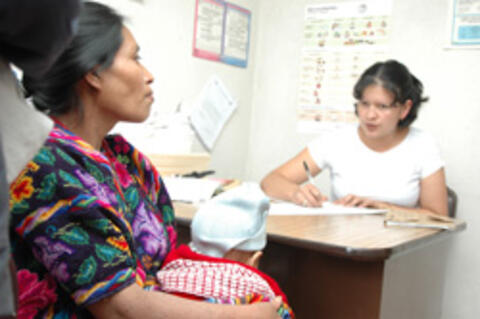
To achieve its aims, Maya Salud engaged a range of constituents as equals in a process that built local capacities to improve and monitor the quality of SRH services: community members, Ministry of Health (MOH) representatives, Cooperativa Todos Nebajenses or Cooperative of the People of Nebaj (COTONEB), and community health workers (CHW) - MOH volunteers who receive a stipend to provide certain health services in rural communities.
Maya Salud used a methodology that Save the Children calls Partnership Defined Quality (PDQ), which was developed in 2000 and has since been implemented in more than 18 countries. (click here for a related toolkit in PDF format.) PDQ engages community members in improving and monitoring the quality of their health services, and is shaped by the awareness that solutions to health service problems might lie outside the formal health system.
Representatives of 88 communities and of the health system jointly examined and improved SRH services according to this 4-phase PDQ process:
- Building Support: Save the Children staff held a series of meetings with residents who could represent their communities' concerns to the health system and with local, district, and national service providers, including the MOH and COTONEB. In all, Maya Salud achieved acceptance of the PDQ process in 88 communities (or 92% of target) over the life of the project.
- Exploring Quality: 5 Maya Salud field staff guided community groups and service provider groups - separately - to explore their perceptions of what constitutes a quality health service, particularly in matters of SRH. Each group developed its own definition of quality by considering its members' needs, resources, rights and responsibilities, and cultural heritage. Each group also explored the benefits of a partnership between community and health workers.
- Bridging the Gap: In each community, the residents' group and the health workers' group brought their definitions and characteristics of quality health care to a joint forum. They presented their own and heard each other's ideas and perspectives. In each case, Maya Salud staff guided the 2 groups to form a team and develop a shared vision of quality. Together, each team then identified and prioritised problems and constraints that made it difficult to achieve quality health services within the community. Each of the 88 participating communities established its own Quality Improvement Team (QIT) composed of a subset of community members and health workers.
- Working in Partnership: Through dialogue and analysis, the QITs explored the root causes of inadequate quality of services and identified appropriate, feasible solutions for reaching the desired level of quality. The resulting Quality Improvement Plans delineated actions to fill gaps in knowledge, skills, or attitudes at 2 levels: community/client (service demand) and community/provider (service supply). The QITs also established goals and identified indicators to monitor progress and determine when a goal had been achieved.
Here are a few examples of activities that the QITs undertook in their Quality Implementation Plans.
Building demand:
- Peer networks called Amigas/Amigos (friends) were established in participating communities. Amigas and Amigos learned the basics of FP, including modern methods, peer counselling, and referral (and sometimes accompaniment) to health facilities.
- Maya Salud developed and distributed a Contraception Sample Kit to help the Amigas/Amigos, MOH service providers, and CHWs show which methods are available, what they look like, and how they work. The kit was designed to demystify contraception for new users who could touch, see, and ask questions about methods in an informal environment.
- Maya Salud trained 1,000 QIT members to mobilise their peers and community members to promote social change. Likewise, 1,000 QIT members learned the basics of family planning (FP) and modern contraceptive methods so that they, too, could promote them and counsel others in their use.
Building supply:
- The MOH and COTONEB trained more than 200 health workers in FP and SRH counseling.
- 80 CHWs learned the basics of SRH and modern contraception, counselling, and information dissemination. In the most remote communities, the CHWs dispensed condoms, pills, and quarterly injections to new users who did not have the time, resources, or confidence to travel dozens of miles to seek contraception from the nearest health facility.
- One community built a new post, and 3 more rehabilitated their posts to provide comfortable, confidential FP services. In one case this involved building a wall to create more privacy; in others, interiors were painted and basic furniture built. Some clinics changed their operating hours to better suit the needs of clients who worked long days in the fields.
- QITs and Maya Salud partnered with APROFAM (the Guatemalan branch of International Planned Parenthood Federation) to bring 5 mobile clinics to the most remote of villages. The clinics offered voluntary tubal ligations and vasectomies, Jadelle® implants, and gynaecological exams including pap smears. "Such services had never before been offered in these far-flung hamlets."
- Maya Salud staff gauged client satisfaction with SRH services via exit interviews, monitored contraceptive stocks, and observed service delivery to clients as appropriate. Staff shared the results with the QITs as a way to ensure consistent application.
Sexual and Reproductive Health.
The Ixil Triangle, deep in the highlands of western Guatemala, is an isolated area home to the Ixil Maya, who make a living from their farms and looms. Ixil's remoteness and near-invisibility on the national stage made it a target during Guatemala's civil war (1960-1996). A rebel group established its headquarters there; hundreds of civilians lost their lives. Not surprisingly, the people of the Ixil Triangle have learned to be wary of outsiders. At the same time, the disconnect between them and social services has exacted a toll, as indicated by data such as the following (cited by Save the Children):
- 82% of residents live on less than US$2 per day (versus 52% nationwide).
- More than 60% of Ixil's girls do not attend school and a mere 20% complete their primary education.
- Maternal mortality is estimated at 277 deaths per 100,000 live births (the national average is 153).
- Infant mortality rates reach 66 deaths per 1,000 live births (versus 47 nationally).
- In Ixil, girls marry young - some as young as 12 - and experience an average of 10 pregnancies before the end of their reproductive years.
- Studies from 2002 and 2003 revealed that just 20% of women in Ixil had healthy birth spacing, and only 28% were using any form of effective contraception - even though 56% did not want to become pregnant in the next year.
- Just 13% received information on SRH during visits to their closest health post, which in some instances was as far as 38 miles from home.
According to organisers, "Often, health workers in rural Guatemala are trained to dispense contraceptives upon request, but they have not learned to counsel and inform, or to consider cultural taboos, the sensitivity of the issue, and the gender divide between the (typically) male service provider and the (typically) female contraception seeker."
Endline research (2009) found that, by the end of the 4-year project, the number of couples using safe and effective FP methods had more than doubled, and the contraceptive prevalence rate had surpassed 33%.
Save the Children, MOH, COTONEB, APROFAM. Funded through a subgrant from the US Agency for International Development (USAID)'s Flexible Fund.
Improving Family Planning by Creating Community-Service Provider Partnerships in Guatemala [PDF], Save the Children - forwarded to the CORE Group Child Survival (CS) Community listserv, December 2 2009. Photo credit: ACME Producciones/Hugo Gonzalez
- Log in to post comments