










































COVID-19-Related Infodemic and Its Impact on Public Health: A Global Social Media Analysis
International Centre for Diarrhoeal Disease Research, Bangladesh - icddr,b (M.S. Islam, Sarkar, Khan, Yeasmin, M.A. Islam, Chowdhury); University of New South Wales (Islam, Kabir, Chughtai, Seale); Khulna University of Engineering and Technology (Kamal); Mahidol University (Hasan); International University of Health and Welfare (Anwar)
"Governments and other agencies must understand the patterns of COVID-19-related rumors, stigma, and conspiracy theories circulating the globe so that they can develop appropriate risk communication messages."
Rumour, stigma, and conspiracy theories around public health emergencies are neither new nor innocuous. During the Ebola outbreak in the Democratic Republic of Congo in 2019, misinformation was linked to violence, mistrust, social disturbances, and targeted attacks on healthcare providers. Globally, there have been reports of rumours, stigma, and conspiracy theories connected to the ongoing COVID-19 pandemic - constituting what has been deemed a potentially dangerous "infodemic". Monitoring social media data is a method for tracking rumours in real time and a possible way to dispel misinformation and reduce stigma. A team of scientists from various countries followed and examined COVID-19-related rumours, stigma, and conspiracy theories circulating on online platforms and their impacts on public health.
The researchers extracted information posted online between December 31 2019 and April 5 2020. They reviewed fact-checking agency websites, Facebook, Twitter, and websites for television networks and newspapers. The team also subscribed to websites of various national and international television networks and newspapers, national and international fact-checking agencies, the World Health Organization (WHO), and the United States Centers for Disease Control and Prevention (CDC). Most of the retrieved items were English-based media sources; items in other languages were translated using Google translator.
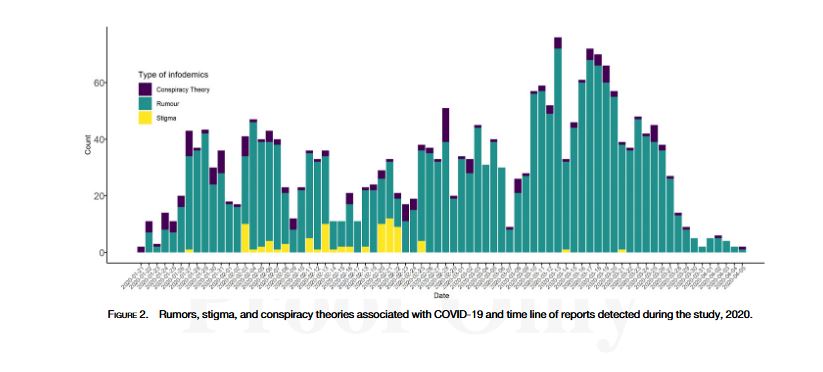
The team identified 2,311 reports of rumours, stigma, and conspiracy theories in 25 languages from 87 countries. Claims were related to illness, transmission, and mortality (24%), control measures (21%), treatment and cure (19%), cause of disease including the origin (15%), violence (1%), and miscellaneous (20%). Of the 2,276 reports for which text ratings were available, 1,856 claims were false (82%). Most of the rumours, stigma, and conspiracy theories were identified from India, the US, China, Spain, Indonesia, and Brazil.
Among all categories tracked, rumour was the most prevalent (89%). The volume of rumours increased from February and continued until the end of the study period, peaking in the middle of March 2020. There were reports, for example, about eating garlic or cow dung, keeping the throat moist, avoiding spicy food, drinking bleach, and spraying chlorine to prevent coronavirus infection.
Furthermore, during the pandemic, "there have been repeated accounts of verbal and physical abuse against people of Asian descent, and those involved in healthcare activities," the researchers noted. "Stigmatized people are vulnerable to social avoidance or rejection, poor health-seeking behavior, and physical violence."
Since the onset of the COVID-19 outbreak, several conspiracy theories circulated in China, Iran, Russia, United Kingdom, and the US, and some of those were spread globally. One early theory postulated that a vaccine against this virus had already been invented, and this pandemic is an attempt to further vaccine sales.
One study cited in the discussion section of the paper reveals that roughly 800 people died from drinking highly concentrated alcohol in the hope of disinfecting their bodies, while 5,900 citizens were hospitalised after consuming methanol, with 60 people going blind as a result. In India, 12 people, including 5 children, became sick after drinking liquor made from toxic seed Datura (ummetta plant in local parlance) as a cure for coronavirus disease that had been promoted in a video shared on social media.
As the researchers observe, the spread of rumours, stigma, and conspiracy theories not only affects individuals but can also have consequences at the societal level, including the healthcare system. In several countries, the rumour of complete lockdown sparked panic buying, which led to shortages of face masks and hand sanitizer that may have contributed to transmission of COVID-19. In addition, it has been shown that conspiracy theories can motivate people not to get vaccinated; this can impact the common good by threatening herd immunity.
In conclusion: "Misinformation fueled by rumors, stigma, and conspiracy theories can have potentially serious implications on the individual and community if prioritized over evidence-based guidelines. Health agencies must track misinformation associated with the COVID-19 in real time, and engage local communities and government stakeholders to debunk misinformation." The team also suggests that governments and international health agencies "continue publishing correct and context-appropriate information supported by scientific evidence about COVID-19 on their websites" and "engage social media companies to spread correct information."
American Journal of Tropical Medicine and Hygiene, 00(0), 2020, pp. 1-9. doi:10.4269/ajtmh.20-0812 - sourced from "Spread of coronavirus fake news causes hundreds of deaths", DW Akademie, August 14 2020.
- Log in to post comments