










































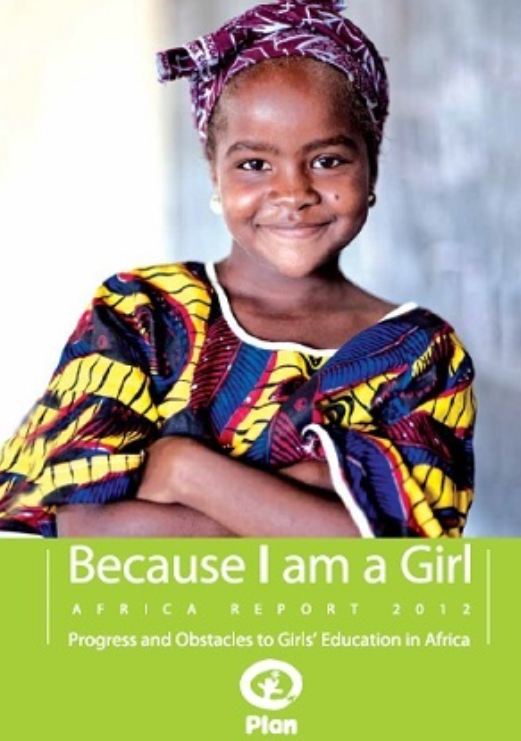
Because I am a Girl: Africa Report 2012
Plan International
This 56-page inaugural edition of the pan-Africa "Because I am a Girl" 2012 report is a culmination of research conducted in 11 African countries to assess the "Progress and Obstacles to Girls’ Education in Africa." Launched in October 2012, Because I am a Girl (BIAAG) is Plan's campaign to fight gender inequality, promote girls' rights, and lift millions of girls out of poverty. According to the report, educating girls is the key to breaking the cycle of poverty and improving the lives of girls, boys, and everyone in their communities.
During the research, Plan worked with children both in and out of school, parents, educators, leaders, and policy makers at village and at national levels, to explore what lies behind the statistics on girls’ education - from the presence and impact of policy frameworks, to the daily choices and challenges for girls, parents, communities and teachers which influence girls’ educational opportunities and capacities. This report draws on research undertaken by Plan from November 2011 to May 2012 in 11 countries in sub Saharan Africa: Ethiopia, Ghana, Guinea Bissau, Kenya, Liberia, Malawi, Mali, Senegal, Togo, Uganda, and Zimbabwe.
According to the report, the factors influencing whether a girl is able to go to school and stay there are complex and dynamic. Plan’s research shows that constraints of poverty, location, gender stereotypes, social norms, customs, and harmful practices all form a shifting and interconnected web through which girls, their families, and their communities have to navigate on a daily basis. In particular, students, teachers, and parents have highlighted the way in which poverty lies at the heart of many of the challenges that hinder girls’ access to, and experience of, education. The pressures of poverty mean that parents must constantly make decisions about how to utilise extremely limited resources and how best to provide a secure future for their family.
To ensure girls receive the empowering and transforming experience that education can offer, there is a need to not only ensure girls are enrolled in school, but also look at girls’ experiences in schools. Across sub-Saharan Africa, 43% of teachers are female at primary level and only 29% at secondary level, going as low as 7% in Togo and 4% in Liberia. There is widespread evidence of the positive influence that female teachers can have on girls’ enrolment, retention, and learning outcomes. Well trained, supported, and motivated female teachers can act as effective professional role models for girls, offering an alternative to the traditional roles of women in the community.
Ensuring there are sufficient teachers in schools is a significant step. Equally important is ensuring that the education teachers deliver is of good quality and is gender equitable. Classroom practices need to meet girls’ individual learning needs and engage them in a safe and positive learning environment. The Forum for African Women Educationalists' (FAWE) Gender Responsive Pedagogy model provides in-service training to teachers to enable them to be more gender aware. It equips teachers with the practical skills and knowledge to understand and address the specific learning needs of individual students and to encourage the equal participation of boys and girls in the classroom.
According to the report, meeting the numerous and inter-related challenges in girls' education will require a coordinated and holistic response that spans both the education system and the constraining factors in communities and wider society. Stakeholders at every level need to be engaged in this response: from individuals and civil society organisations working at the grassroots to national and international policy makers.
Among the recommendations the report suggests that there is a need to undertake a gender review of government Education Sector Plans. This could include the following:
- Encouraging Girl-friendly educational environments: There is a need to ensure safe and supportive learning environments for girls by assessing schools against girl friendly criteria; requiring schools to adopt policies that involve students in decision making and strengthen girls’ capacity to participate in school governance; and developing/strengthening and enforcing legislation on school-related gender-based violence, including mandatory school and teacher codes of conduct and reporting and accountability mechanisms. There is also a need to provide sufficient numbers of trained, motivated, and resourced teachers, with a particular focus on female teachers as well as examine and revise the curriculum and teaching materials to ensure they are free from gender stereotypes and bias, and are relevant to the needs of girls. The report also recommends strengthening comprehensive sexual and reproductive health education and expanding flexible and non-formal education options for excluded children and young mothers.
- Addressing socio-cultural barriers to girls’ education: The report recommends strengthening public service information campaigns and community advocacy on girls’ education and challenging harmful gendered norms in partnership with girls and women, men and boys, communities, parents and local authorities. This should build on research into sensitive issues and harmful practices such as child marriage and transactional sex, and their impacts on girls’ (and boys’) education. The report also recommends strengthening the enforcement of policies to enable pregnant girls and young mothers to stay in school, and taking appropriate measures to prevent child marriage.
- Building Government capacity to support girls’ education: The report recommends ensuring effective education policy dissemination and implementation through realistic plans at all levels that take account of budget constraints. Policies must be backed up by adequately resourced monitoring and evaluation systems at each level and stronger policy enforcement mechanisms. This will include monitoring and improving learning outcomes through the development of national gender-sensitive learning outcomes, and the tracking of learning at national and sub-national levels using methods which provide gender disaggregated data.
In order ensure that adequate resources are made available, the report suggests a review of current budget allocations to fill funding gaps identified by the gender review of Education Sector Plans. As well, the report recommends support for the development of an effective post-MDG framework that maintains a strong priority on education as a goal. Governments will need to engage in policy reforms and to increase financing to make sure that education policies will provide all girls with a quality education. Finally, governments are encouraged to engage and work with civil society to create the social changes needed to ensure the right to education for all boys and girls – by 2015 and beyond.
Click here to download the full report in PDF format in English.
Plan International website on December 19 2013.
- Log in to post comments