










































National Consultation on Strengthening Community Radio in India: Working Papers and Recommendations
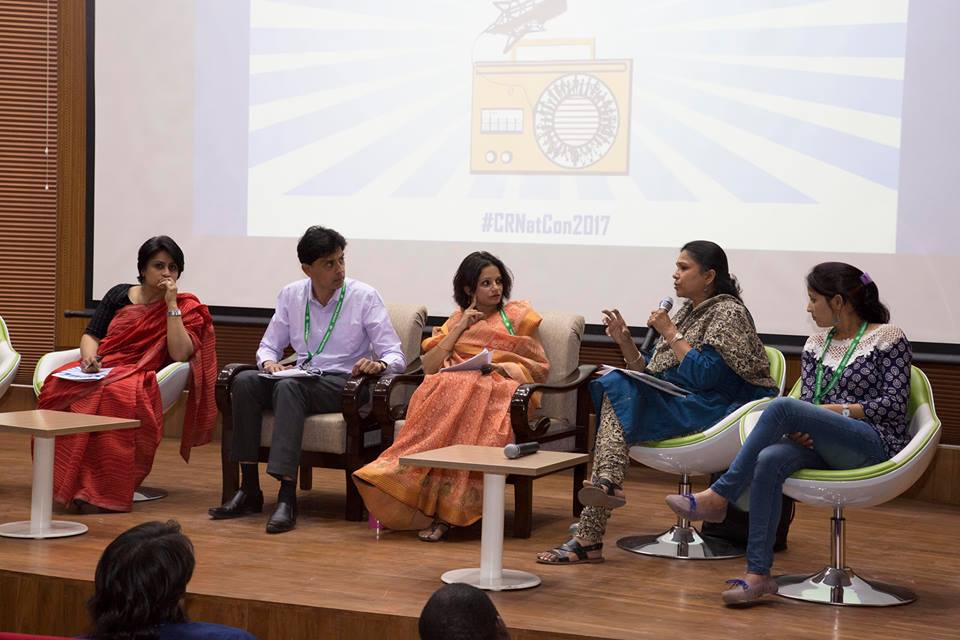
On April 11 and 12 2017, the United Nations Educational, Scientific and Cultural Organization (UNESCO) Chair on Community Media and UNESCO organised the National Consultation on Strengthening Community Radio in India in order to revisit the recommendations made at the National Consultation in 2010 and review the status of the community radio (CR) sector in India since the policy guidelines issued in 2006, which opened the airwaves for community broadcasting. The agenda for the consultation, which drew over 100 CR representatives and domain experts, was to determine how CR can contribute to future generations, to the Sustainable Development Goals (SDGs), and to national goals such as Swacch Bharat and Skill India.
The two-day consultation was structured into 6 sessions, each around a working paper presented by CR experts on a specific theme, and also resulted in a document of recommendations for the government and CR stations.
Inclusivity, Equity & Diversity, by Ashish Sen, Pinky Chandran, Kanchan K. Malik, Arti Jaiman, Radha Shukla - Assessing the CR policy guidelines of 2006, which emphasise that at least 50% of the content production and programming should be carried out with participation of community members, the paper tries to come up with ideas to improve the ownership of members of marginalised populations in the operations of the CRs. Expounding participation as a layered concept, the paper states a need to identify, acknowledge, and air unheard voices - ranging from sex workers and, rag pickers, and tribals to people with disabilities and other minority communities.
- Click here for the 10-page paper in PDF format.
- Click here for a summary of the paper and highlights of the panel discussion that inspired it.
Capacity Building for CR: Whose Capacities? What Capacities?, by Rukmini Vemraju, Anushi Agrawal, Jayalakshmi Chittoor, Pooja Murada, and Brijendra Panwar - Training in content production and radio practices will assist the CR members in experimenting with content design that goes beyond language and dialect innovation. Capacity building for producers will expand their creativity in production work, resulting in more open, participative, and gender-sensitive programmes that have equal representation of both male and female population. There is a gap in the skills required of community reporters. Training by users of the latest technology and software will help in refining the technical skills of CR reporters around mixing, sound recording, and sound designing, and eventually motivating them to experiment with new technologies when working on a programme.
- Click here for the 12-page paper in PDF format.
- Click here for a summary of the paper and highlights of the panel discussion that inspired it.
CR Sustainability, by N. Ramakrishnan, Venu Arora, and Ankuran Dutta - Rejecting the generally perceived meaning of the word 'sustainability' to mean financial sustainability, CR experts have called for a broader understanding of the term sustainability that also includes social, technological, and institutional aspects. For example, several mechanisms can be put in place to ensure social sustainability of a station. For sustained volunteerism, capacity building of a large number of community members of all ages, genders, and socio-economic strata can create a large pool of volunteers for the station who can contribute less time per capita without sacrificing on other aspects of their lives.
- Click here for the 19-page paper in PDF format.
- Click here for a summary of the paper and highlights of the panel discussion that inspired it.
Documentation, Research & Evaluation, by Venu Arora, Kanchan K. Malik, Vinod Pavarala, Bidu Bhushan Dash, and Nirmal Bhatnagar - This working paper contends that CR stations need research, assessment, and evaluation methodologies that are distinct and different from those adopted by mainstream media - e.g., that are highly participatory. Suggested here is the strengthening of existing practices of sharing and learning within the CR sector, in concurrence with an emphasis on horizontal learning by deploying processes that facilitate exchange visits among different organisations in the CR sector. This can be done through self-assessment and peer-review tools like the Community Radio Continuous Improvement Toolkit (CRCIT) and the Self-Assessment Toolkit, both of which are available at Related Summaries, below.
- Click here for the 10-page paper in PDF format.
- Click here for a summary of the paper and highlights of the panel discussion that inspired it.
Technology and Community Radio, by Ram Bhat, Vasuki Belavadi, Hemant Babu, and N. Ramakrishnan - One point made here is that the Ministry of Information and Broadcasting (MIB) presently regards Frequency Modulation (FM) technology for community broadcasting due to its better sound quality despite having lower geographic outreach. However, some linguistic communities are spread over different regions. The paper proposes to bring in MW (Medium Wave) technology, which has the capacity of over 100 watts to overcome geographical separation of communities. Combining CR with telephony will increase listeners' participation, but CR stations should strike a balance between community members' participation and commodification of their participation.
- Click here for the 11-page paper in PDF format.
- Click here for a summary of the paper and highlights of the panel discussion that inspired it.
Revisiting CR Policy, by Archana Kapoor, Vinod Pavarala, Sajan Venniyoor, Preeti Raghunath, and Ashok Singh Sunhal - The growth of CR in India has been slow-moving; the Ministry of Information and Broadcasting (MIB) mentioned setting up 4,000-5,000 CR stations, but the sector from has only grown from 20 to 202 CR stations since 2006. Civil society organisations attribute this limited number of CR station growth to complex bureaucratic procedures. The paper reiterates the need for a single window clearance of CR license applications by involving the concerned ministries in the process.
- Click here for the 10-page paper in PDF format.
- Click here for a summary of the paper and highlights of the panel discussion that inspired it.
Recommendations - After detailed deliberations, the participants endorsed a list of recommendations that was complied by the UNESCO Chair on Community Media. Various community radio organisations helped translate the document into Hindi, Marathi, Malayalam, and Tamil for wider circulation and feedback. The recommendations are arranged thematically according to the 6 topics above, with the recommendations to the government and the CR stations presented separately. To cite only one example: CR stations must include AMARC gender guidelines and other documents related to gender-sensitive programming in all capacity sharing efforts to sensitise the radio station staff, volunteers, and management about the need for democratic communication and diversity.
- Click here for the 7-page recommendations in English in PDF format.
- Click here for a summary of the recommendations and access to all language versions of it.
In the closing remarks, Al-Amin Yusuph, UNESCO Adviser (Communication and Information), reiterated the need, expressed in the recommendations, to create a consortium for the CR sector in South Asia, and said that UNESCO would be committed to facilitating the functioning of such a group consisting of various networks, groups, and organisations involved in CR. Those present at the consultation signed a resolution to move towards formation of such a consortium for the benefit of the CR sector.
Everything in English; recommendations also in Hindi, Marathi, Malayalam, and Tamil
CR News, Volume 8, Issue 1 (Oct-Dec 2017); and UNESCO Chair on Community Media website, January 19 2018. Image caption: UNESCO Chair on Community Media team
- Log in to post comments