










































Communication for Education and Development - Toolkit
Image
SummaryText
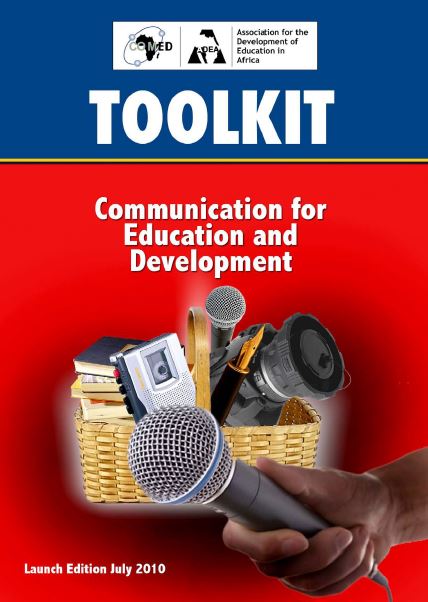
This 454 page toolkit, published by Association for the Development of Education in Africa (ADEA), is divided into nine sections, each containing a number of training modules focusing on specific themes in communication, education, and development. Each module contains a general objective, specific objectives, expected outcomes, and activities. Each specific objective is divided into relevant activities. A section on supporting materials, further reading pertaining to the module, and references is also included at the end of each module. According to the publishers, the toolkit is primarily designed to be a do-it-yourself training programme that will build the capacity of media practitioners and those working towards the development of education in Africa. It can be used by individuals or groups either online or in face-to-face sessions. It can also be used with a facilitator.
The kit is designed for media decision-makers, practitioners (editors and journalists reporting on education), and communication officers working in ministries of education in Africa and the education sector. It was produced to contribute to enhancing dialogue with ministers of education, senior officials at policy level, and funding partners to work together to include communication components in education policies and programmes, thus ensuring greater visibility and enhanced public support. The toolkit is also intended for members of civil society organisations (CSOs), communities, and other stakeholders in education who will be engaged in policy debates and dialogue on educational issues at national, sub-regional, and regional levels, as well as researchers and students of communication, media studies, education and development.
The toolkit contains the following sections:
The kit is designed for media decision-makers, practitioners (editors and journalists reporting on education), and communication officers working in ministries of education in Africa and the education sector. It was produced to contribute to enhancing dialogue with ministers of education, senior officials at policy level, and funding partners to work together to include communication components in education policies and programmes, thus ensuring greater visibility and enhanced public support. The toolkit is also intended for members of civil society organisations (CSOs), communities, and other stakeholders in education who will be engaged in policy debates and dialogue on educational issues at national, sub-regional, and regional levels, as well as researchers and students of communication, media studies, education and development.
The toolkit contains the following sections:
- Section I - Foundations and Theoretical Framework: looks at the foundations and theories of communication focusing on communication theory, an overview of education in Africa, and the role of communication in education and development.
- Section II - Contemporary Forms of Education: examines contemporary forms of education with modules on current models of education. This section has modules on early childhood care and development, primary education, secondary education, education of adolescents, and tertiary education.
- Section III - Life-Long Learning Section: gives an in-depth look at non-formal education and examines in detail how non-conventional forms of education can contribute towards achieving international goals such as the Millennium Development Goals and the Education for All objective. It contains modules on adult education and principles of adult learning, parental education, and alternative and inclusive education.
- Section IV - Current Issues in Education Section: examines the current issues that are having an effect on contemporary education. It contains modules on education and gender, HIV and AIDS issues in education, education and human rights, education in conflict and post-conflict situations, special need in education, quality issues in education, and health education.
- Section V - Emerging Issues in Education: focuses on two emerging issues in education. These are popular culture and education and the use of national languages in education.
- Section VI - Reporting Educational Issues: looks at reporting on educational issues and covers media and education, media monitoring, quality assurance, and training and skills development for media practitioners.
- Section VII - Advocacy and Social Mobilisation: tackles advocacy and social mobilisation for education and development, and probes into the role of the media in all of this.
- Section VIII - Resources in Education: addresses resources in education, including institutions in education, human resource development, and resource management in education.
- Section IX - Resourcing for Education: examines resourcing for education and focuses on education financing, partnerships in education and the role of research in the quest for resourcing in education.
Publication Date
Languages
English
Number of Pages
454
Source
ADEA website on January 3 2011.
- Log in to post comments