










































Overcoming Violence: Exploring Masculinities, Violence, and Peacebuilding - Pilot Training of Trainers Cycle 2009-2010
Women Peacemakers Program (WPP), International Fellowship of Reconciliation (IFOR)
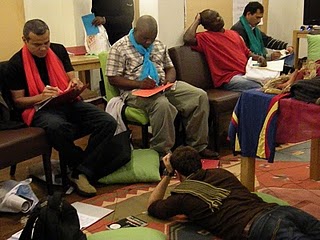
This is the report of the first block of the 2009-2010 pilot Training of Trainers (ToT) cycle, entitled "Overcoming Violence: Exploring Masculinities, Violence, and Peacebuilding". Organised by the Women Peacemakers Program (WPP) of the International Fellowship of Reconciliation (IFOR), that first training block, which took place in early December 2009, brought together a group of 19 male peace activists from 17 different countries.
After an introduction to IFOR's Women Peacemakers Program and an outline of IFOR/WPP training of trainers (ToT) sessions held with women only since 2002, the report explores the preparation and development of the 2009-2010 pilot ToT cycle for male peace activists. Next, detailed explanation is provided for each day of the first block of the ToT cycle (2009). In brief, using interpersonal communication, printed material, and films, the first training session focused on: the theory and practice of active nonviolence (skills such as effective social mobilisation, conflict analysis models, and case studies of successful counter movements such as the Gandhian movement in India and the civil rights movement in the United States); facilitation and group dynamics; participatory teaching methods; conceptualising gender and diversity; leadership; women's rights; international instruments such as United Nations (UN) Security Council Resolutions 1325, 1820, 1888, and 1889; an introduction to and analysis of masculinities; and lobbying and advocacy. Participants created a statement entitled "Together for Transformation: A Call to Men and Boys" [PDF]. Upon returning home, each of the male participants was linked to a female support person ("ally") from his own region and/or country who supports him in the development and implementation of his follow-up plan.
The first block of this pilot ToT cycle was evaluated using: a "daily impressions" feedback system, a pre- and post-training survey, mid-term and final evaluation forms, and testimonies on video and in writing by participants, documenting the impact of the ToT cycle.
The evaluation revealed that the participants highly valued:
- the connection to and sharing within a multi-cultural, male-only group;
- the opportunity to learn about theories on active nonviolence and gender-sensitive active nonviolence, as well as on positive masculinities and their link to socialisation processes; and
- sharing of training tools and facilitation methodologies.
Before and after percentages of participants who indicated feeling (ranging from "somewhat" to "a lot"), pre- to post-survey training:
- knowledgeable about peacebuilding: 68% vs. 100%
- knowledgeable about gender relations and gender equality: 74% vs. 89%
- knowledgeable about gender-sensitive active nonviolence (GSANV): 26% vs. 89%
- knowledgeable about positive masculinity: 37% vs. 95%
- comfortable about talking to others about peacebuilding: 89% vs. 95%
- comfortable about talking to others about gender relations and gender equality: 74% vs. 100%
- comfortable about talking to others about GSANV: 63% vs. 95%
- comfortable about talking to others about positive masculinity: 58% vs. 95%
- prepared to engage in collaboration with women: 95% vs. 100%
- prepared to conduct a presentation or workshop about GSANV: 74% vs. 100%
- prepared to organise a community activity related to GSANV: 68% vs. 95%
Based on the first experiences with this pilot project, the WPP has formulated 15 recommendations for women's organisations that are planning to engage men in their work for women's empowerment and gender justice:
- "Consult with the women you work with" while analysing if and why it is important to collaborate with men and men's organisations.
- "Define as concretely as possible your goals and expectations for partnering with men and men's organizations, and use those to monitor your approach - and to see whether it needs adjusting - along the way."
- Collaborate with men who can serve as role models for other men.
- "Ask the men's organizations / networks you plan to work with about their concrete goals and expectations in terms of working with women's organizations."
- Spend sufficient time on clarifying the goals and expectations of each one of the stakeholders involved.
- "Define in concrete terms your strategy on how you would like to engage men in your work."
- "Be aware of both unintended and intended uses and abuses of (implied) power in the process of engaging men and men's organizations in your work and in the relationship with the men you work with....The sharing of power includes sharing of access to and control over information, knowledge, resources and (informal and formal) decision-making levels."
- "Don't be afraid as a women's organization to voice your position unambiguously to men or men's organizations if you do not experience them as partners cooperating in a true and respectful manner, or if they are not really sharing power equally."
- Reflect on attitudes: "If, as a women's organization, you hold the belief that men are not able or willing to change, and if you reflect and encourage that belief in your verbal and nonverbal communication with men (and with other women's organizations), it will be impossible to establish a climate of working together as true partners with men and men's organizations."
- Establish a climate for constructive communication and learning.
- "Be sensitive in your use of language...is it inclusive and does it also address men?....Try to avoid language that is mainly blaming and instills guilt."
- "Make sure that you do not affirm the notion that some men might know how to work better than women, or might be more equipped or knowledgeable to make decisions, simply because they are men."
- Maintain a continuous process of ongoing reflection and of sharing experiences and perspectives.
- Include young men as well.
- Ensure engagement on political levels.
Engagingmen.net and WPP blog - both accessed on December 14 2010.

- Log in to post comments