










































Cyprus 2015
The methods and tools of Cyprus 2015 include research and dialogue: research for action, which is designed to produce actionable policy proposals, and participatory dialogue, which includes all schools of thought within each community, and which takes place within and across the two communities. Cyprus 2015 aims to explore the opinions, views and thoughts of the public, in both Greek Cypriot and Turkish Cypriot communities, and develop them into policy proposals.
The objectives of the initiative include: a better informed public debate that relies on more objective and de-politicised information; more fluid channels of communication between the leadership and the general public; a better informed policy-making process; and improved awareness, understanding, and trust between the two communities.
The Cyprus 2015 initiative centres around a multifaceted approach - focusing on a single goal (connection) and through an integrated initiative - implemented by two teams (Greek-Cypriot and Turkish-Cypriot) brought together under the coordination of a joint team of co-directors. The project team is focusing on the following themes: sustainable development in a unified Cyprus; daily life in post-settlement Cyprus; media, active citizenship, and participation; and the role of a unified Cyprus in the wider European and Mediterranean area of cooperation.
The initiative is using a mix of communication tools and strategies, including: public opinion polls, focus groups, interviews with leading personalities, commissioned academic research, stakeholder panels - Participatory Action Research (PAR), video documentaries, and policy proposals.
Within the context of the Cyprus 2015 initiative, an island-wide survey titled "Investigating the Future" was conducted from October - November 2009 with a sample of 1,000 Greek Cypriots and 1,000 Turkish Cypriots, who were interviewed at their homes in their native tongues. The survey examines several facets of Greek Cypriot and Turkish Cypriot public opinion, including underlying values and attitudes, perceptions, and expectations of the peace process, as well as in-depth citizen evaluations of policy options over the critical negotiation dossiers (security/guarantees, property/territory, and governance/power sharing). The findings of the survey are meant to contribute towards the development of a road map for the constructive engagement and participation of the wider public in the peace process, in a way that organisers hope will enhance the sense of societal ownership - and, by extension, the long-term viability - of any future political settlement.
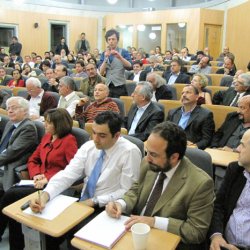
The results of the poll were presented to the mass media of both communities during a media conference in December 2009. Furthermore, in March and April 2010, the Greek-Cypriot unit of Cyprus 2015 presented the poll results at a series of public events organised by the Association for Social Reform (OPEK). At the event in Limassol, around 160 people attended, including the Mayor of Limassol, the Bishop of Limassol Athanassios, Members of Parliament (MPs), Municipal Councillors, journalists, citizens of Limassol, and students. Representatives from major political parties gave statements. One MP said that the findings of the survey help to give a clearer picture of the present situation amongst Greek Cypriots and Turkish Cypriots and, in addition, that it is the responsibility of the political leadership to analyse and utilise this survey to try to find common ground. The statements of the 4 politicians were followed by a discussion with the audience, further contributing to Cyprus 2015's goal of increasing public debate and dialogue.
The Cyprus 2015 initiative aspires to continue its activities in the future as Cyprus' island-wide think tank, supporting not only the process leading up to a dettlement, but also - hopefully - the process of post-dettlement stabilisation and reconciliation. Thus, Cyprus 2015 aims to contribute towards the development of a road map for a sustainable Cyprus until the year 2015, and beyond.
For further details, please visit the Cyprus 2015 website.
Conflict.
Cyprus 2015's organisers say that, despite the current lack of violence, Cyprus has remained divided for decades, and the Cyprus conflict is one of the longest-standing unresolved issues of the international community. The peace process takes place in an environment of ongoing lack of trust between Greek-Cypriots and Turkish-Cypriots and ongoing alienation from the peace process of public opinion within both communities.
The organisers elaborate that, for any comprehensive settlement to be sustainable, it should become accepted by the majority of Greek-Cypriots and Turkish-Cypriots - not only for the purpose of approval but also for the purpose of long-term implementation. The effort to reach a comprehensive settlement at a political level should, they say, be complemented by an effort to bridge the lack of confidence that exists at a social level, vis-à-vis the settlement. On the one hand, the peace process should take into account the fears and hopes of the public; on the other hand, public opinion should comprehend the political and technical solutions that might be reached.
Cyprus 2015 is implemented by the Joint Programme Unit (JPU) for UN/Interpeace Initiatives and is supported by United Nations Development Programme Action for Cooperation and Trust (UNDP-ACT) programme in Cyprus and the European Commission Representation in Cyprus.
International Development Research Centre (IDRC)'s Lasting Impacts: "Countries in Transition", June 2010 - forwarded from Bill Carman to The Communication Initiative on June 10 2010; the Interpeace website and Cyprus 2015 website, both accessed on September 13 2010; and email from Spyros Christou to The Communication Initiative on September 14 2010.
- Log in to post comments