










































The Ecotourism Equation: Measuring the Impacts
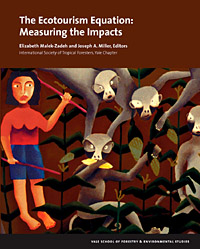
The following summary briefly outlines each of the contributions to the 302-page Bulletin Number 99 from the Yale School of Forestry and Environmental Studies. The publication emerged from the conference "The Ecotourism Equation: Measuring the Impacts" (April 12-14 1996, Yale University, New Haven, Connecticut, United States). The purpose of the gathering was to understand what ecotourism means by listening to those who define and shape its direction each day through their work. Many perspectives were represented at the conference: tour operators, professors, government officials, lodge owners, researchers, non-profit organisations, and local people.
As Elizabeth Malek-Zadeh explains in an introduction to the volume, the conference discussions were intended to address 3 main questions:
- What are the impacts of ecotourism and how are they measured? Speakers were asked to address economic, socio-cultural, and/or ecological impacts.
Summary: Vivian Newman pointed out that the definition of ecotourism is value-laden. Gene Cope emphasised the positive impacts of marketing power gained by countries hosting ecotourism and developing new jobs. New data on the specific impacts on wildlife was presented by Lori Hidinger. Jeff Langholz and Bill Talbot documented impacts on protected area management. The importance of channeling research to appropriate decision-makers was stressed by Marsha Sitnik. Jerry A-Kum suggested that ecotourism can minimise the impacts of tourism itself. James MacGregor also considered the capacity of ecotourism to raise personal awareness. And Geoffrey Wall defined the need for descriptive and predictive measurement and indicators. Overall, there was agreement that more data will need to be collected, and that a common definition of ecotourism will be necessary to achieving comparative analysis. - What are the parameters of ecotourism success? Information was drawn from field studies, experience, and research.
Summary: Most speakers stressed the often-overlooked need for profitability to accompany resource conservation. Françoise Simon emphasised the need for regulatory frameworks through international and governmental institutions. Carol Holtzman Cespedes spoke of getting feedback from tourists, tour operators, and local communities in order to ensure markets for specific sites. In the working group led by Megan Epler Wood, it was suggested that tourist education be a parameter for ecotourism success. The determination of parameters and of ratings must be a continual process, as Beatrice Blake emphasised. Most were in agreement that ecotourism must not become the principal aspect of local area management, but must be part of a diverse combination of economic and ecological initiatives. - How can ecotourism projects be successfully designed and implemented? Policy and management perspectives were offered.
Summary: Specific ideas came from speakers who have been experimenting with new techniques for effective management. According to Silvio Magalhaes Barros, Secretary of Tourism, Parana, Brazil, there must be financial and legal incentives for responsible ecotourism. James MacGregor cited job creation as important for generating political interest. David Barkin suggested that ecotourism should play a role in subsidising food production and supporting traditional community economics. Keith Sproule spoke of the importance of establishing criteria for how much tour money goes to a community and allowing communities to collectively decide how to spend their profits. Sharr Prohaska discussed the use of cultural brokers or intermediaries in assisting ecotourism development. Miriam Torres spoke of the importance of ensuring that baseline research and ongoing monitoring be incorporated in management plans. According to Stanley Selengut, the internationalisation of appropriate technology is making it more affordable to be ecologically responsible. And Douglas Trent stressed that it is the consumers who are the important link to creating a demand for an ecologically responsible market.
Noting that data on impacts of ecotourism are not abundant, conference participants did offer reflections based on their own experience. For instance, Torres, Sproule, Talbot, and Odendaal provided examples of what they deemed successful efforts to work with park management and other governmental and non-governmental organisations (NGOs). Working within the current definitional and logistical difficulties, Hidinger, Langholz, Odendaal, and Holtzman Cespedes comment on efforts they have made to increase the data and information analysis available. The papers of Holtzman Cespedes, Selengut, Blake, Becher, and Segleau Earle each provide examples of entrepreneurs who profited by providing a quality product and from acting out of respect for the natural environment.
Papers include:
Keynote address: Developing a National Sustainable Tourism Strategy: Going Beyond Ecotourism to Protect the Planet's Resources [PDF], by James MacGregor
Section I: What Are the Impacts of Ecotourism and How Are They Measured?
Opening address: The Bottom Line: Getting Biodiversity Conservation Back into Ecotourism [PDF], by Katrina Brandon and Richard Margoluis
Development through Ecotourism in the Interior of Suriname [PDF], by Jerry Ricardo A-Kum
Nature Travel and Rainforests [PDF], by Gene Cope
Ecotourism Impact on Independently Owned Nature Reserves in Latin America and Sub-Saharan Africa [PDF], by Jeff Langholz
Tourism and the Environment: Out on a Limb and Sawing [PDF], by Vivian Newman and Samuel Sage
Ecotourism's Identity Crisis: How Green is My Vacation? [PDF], by Robert Rattner
Sustainable Ecotourism: The Galapagos Balance [PDF], by Marsha Sitnik
Emerging Participatory Monitoring and Evaluation Programs in Two Ecotourism Projects in Petén, Guatemala [PDF], by Bill Talbot and Kevin Gould
Ecotourism: Change, Impacts, and Opportunities [PDF], by Geoffrey Wall
Section II: What Are the Parameters of Ecotourism Success?
Opening address: Toward a Principled Evaluation of Ecotourism Ventures [PDF], by George N. Wallace
Evaluating Ecotourism Lodgings in The New Key to Costa Rica [PDF], by Beatrice Blake, Anne Becher, and Jane Segleau Earle
The Use of Client Evaluations in the Ecotourism Process: An Example from Costa Rica [PDF], by Carol Holtzman Cespedes
Five Parameters of Ecotourism [PDF], by Huub Gaymans
Rainforest Expeditions: Combining Tourism, Education, and Research in Southeastern Amazonian Peru [PDF], by Eduardo Nycander and Kurt Holle
Trial Runs as a Tool for Responsible Ecotourism Development [PDF], by Francois J. Odendaal
Regulating Ecotourism: Legal Frameworks and Market Guidelines [PDF], by Françoise Simon
The Ecotourism Operation Was a Success, But the Patient Died: A Case Study from Western Samoa [PDF], by Lumaava Sooaemalelagi, Steve Brown, Francois Martel, and Reevan Dolgoy
The Green Evaluation Program: Preliminary Results from a Pilot Ecotourism Monitoring Program for Nature Tour Operators [PDF], by Megan Epler Wood, William Norman, Eric Frauman, and Lorin Toepper
Section III: How Can Ecotourism Projects Be Successfully Designed and Implemented? Policy and Management Perspectives
Opening address: Community-Based Ecotourism Development: Identifying Partners in the Process [PDF], by Keith W. Sproule
To Ecotour or not to Ecotour: Unpacking the Impacts and Business Realities of Tourism Development in Sana and Tariquia Reserves of Tarija, Bolivia [PDF], by Kirtland M. Barker
Ecotourism: A Tool for Sustainable Development in an Era of International Integration? [PDF], by David Barkin
Maho Bay, Harmony, Estate Concordia, and the Concordia Eco-Tents, St. John, U.S. Virgin Islands [PDF], by Stanley Selengut
Making Ecotourism an Ally in Biodiversity Protection [PDF], by Douglas B. Trent
Yale School of Forestry and Environmental Studies, May 19 2010.

- Log in to post comments