










































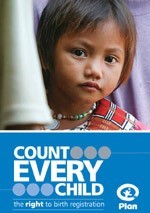
Count Every Child: The Right to Birth Registration
Plan
This 100-page report documents the process and outcomes of Plan's work with children, parents, communities, partners, and governments throughout the 5-year Universal Birth Registration (UBR) campaign. In doing so, it examines the issues and the impact of non-registration for children today and in the future, and highlights the challenges faced in achieving birth registration for every child.
As detailed here, Plan has been promoting birth registration since 1998, when the non-governmental organisation (NGO) was invited by the NGO Committee on the United Nations Children's Fund (UNICEF) to support the Unregistered Children Project in Asia. Plan's work on birth registration subsequently extended to Africa and the Americas and became the focus of a global campaign in 2005. Although the campaign ended in 2009, campaigning and advocacy on a national level is still ongoing. The core message is that "Registering a birth is a critical first step in ensuring the rights of a child."
Plan's campaign has aimed to: act as a catalyst for birth registration and work towards ensuring that more children and adults were registered; promote birth registration at grassroots level to increase awareness and therefore demand for certificates; directly support governments to increase numbers of registrations and certificates issued; create innovative programmes for registration that were effective and sustainable yet reached even the most remote populations; and explain the importance of registration as a child rights issue to duty-bearers. As Plan explains, although a child's right to an identity is set out in the Convention on the Rights of the Child (1991), millions of children every year are not registered at birth. Without proof of citizenship through registration, children struggle to realise other rights under the Convention. (Information on the implications of non-registration - for children, youth, the state, and others - may be found on page 18 of the report).
Acknowledging that the reasons why children are not registered can be complex (further information may be found beginning on page 30 of the report), Plan undertook various strategies to overcome the barriers to registration that occur at all levels of society. For instance:
- Using new technology: In Kenya, mobile phone networks set up for banking were used to text birth notifications to authorities. In Ecuador, 10 groups from the civil registration office were supplied with satellite kits, mobile phones, and internet access to record and store data in remote areas. Between 2006 and 2008, these teams registered 304,000 people.
- Using media such as radio, internet, film, and cultural events to convey messages: In Malawi, the message was spread at football matches; in Burkina Faso, films were shown at a large film festival; and 10 West African countries broadcast special radio programmes made by children.
- Harnessing local knowledge and systems: In Tanzania old and new practice came together as traditional village registers were optically scanned to update the population figures.
- Involving children and encouraging them to participate: In Indonesia, children were educated and supported to become advocates for birth registration. These children are now spokespeople in schools and on radio shows.
- Generating increased political will by persuading and supporting duty-bearers to change laws: In Bangladesh, after persistent lobbying, the government passed the Birth Registration Act 2004 which allowed registration to be free when it came into force in 2006.
- Training members of the community to increase capacity and infrastructure at local level: In Zambia, the community now approaches midwives and birth attendants to register newborns, and also learn about child rights. In a single project in Paraguay, 492 birth attendants were trained to ensure prompt registration.
- Increasing understanding about the value of identity documents among diverse populations: In Cameroon, hundreds of marginalised Baka people became registered citizens for the first time, and in Dhaka, Bangladesh, more than 20,000 street children signed up for their birth certificates.
- Challenging defunct technology, outdated administrative systems, and social norms from colonial times: In Indonesia, Plan was actively involved in a legal review that put an end to colonial laws that discriminated against children born of minority groups. In one area of Brazil, where one-third of families are headed by women, mothers could not ask for child support unless the child's father was named on the birth certificate. Plan worked with partners between 2007 and 2009, setting up centres where men could confirm their paternity, reportedly quickly and for free. As a result, state law for the recognition of paternity was modified and fees for paternity registration lifted.
- Creating mobile registration projects to reach out to the population: In Mozambique, Plan's mobile units cut the distance travelled in order to register from up to 75km to just 1km in many instances.
- Persuading governments to decentralise registration: In Sierra Leone, health workers have been mandated to issue birth certificates in order to overcome this.
- Promoting registration despite the fear of persecution (a remnant from brutal regimes such as those of the Khmer Rouge in Cambodia).
- Changing the law: One area in Indonesia saw registration rates rise from 3% to 72% in 2 years. In Cambodia, around 7 million people (56% of the population) picked up their birth certificates in just 10 months.
Specific examples of Plan's innovations and good practice - at community, national, and international levels - are summarised in Appendix 2.
Reportedly, partnerships that involved many stakeholders were important for gaining widespread support for Plan's innovations. Plan called on governments, United Nations (UN) agencies, NGOs, local groups, and corporate partners to engage in the issue and help in the push towards UBR.
In short, over 40 million people in 32 countries have now been registered through the direct efforts of Plan and partners - the majority of them children. Thirty percent of countries targeted have changed their legal systems as a result of Plan's advocacy work, resulting in free birth certificates and registration for more than 153 million children, born between 2005 and 2009 (see Appendix 1). In 2005, before Plan began the global campaign, only 19% of children under the age of 6 had their births registered in Tanzania; of these, only 7% went on to actually obtain a birth certificate. Plan's campaign with the Registration, Insolvency and Trusteeship Agency (RITA) has led to the achievement of over one million new registrations since 2005. For specifics, see Table 3 (page 88) of the report, which details the impact on birth registration law that Plan and partners have had.
Looking to the future, Plan urges the following actions:
- The global community of UN agencies, multi-laterals, bilaterals, and international NGOs should increase their efforts to achieve UBR by incorporating birth registration into their own policies and practices and ensuring registration is included in partnerships and agreements with others.
- National governments with low registration rates should increase their efforts at registering children, for example, by changing the law or enabling access to registrars, or by raising awareness and waiving fees. Birth registration must become a national priority and be integrated into national development plans of action or poverty reduction strategy papers, while registration data must be integrated into national statistics systems. Systems put in place must be equitable, non-discriminatory, and consistent with local realities, so that rates of registration increase quickly and are sustainable, and that the data are consistently used in service planning.
- Local organisations must work with communities to engage them on their rights to a birth certificate, the purpose of registration, and the impact of non-registration. They should empower people to demand their rights from duty bearers and ensure that children and communities are consulted about appropriate methods and systems at local level. Children also have the right to participate in registration activities and they must be included in strategies and plans.
- Increased attention on international adoption over the last few years highlights the importance of birth certificates as a measure to protect children and a way to combat trafficking for illegal adoption. Given the clandestine nature of these activities, much of the evidence available on the connections between birth registration, trafficking, and migration is anecdotal in nature. Therefore, research to establish clearly the connection between birth registration and legal identity could significantly improve programming and interventions in the area of child trafficking and wider child protection challenges.
- It is imperative not to overlook the importance of registration for parents, whose proof of identity may be a requirement for registering their children. Plan's work with the UN Inter-Agency Task Team around children affected by HIV and the issue of early marriage has also highlighted the importance of death and marriage registration and certification.
But "the most significant changes and successes have included the paradigm shift towards improved legislation, and the greater levels of participation, partnership and commitment from states, local councils and organisations towards birth registration."
Plan website, accessed December 28 2009; and email from Nadya Kassam to The Communication Initiative on December 29 2009.
Comments

Enhanced Registration
The proposed actions you have cited above are perfect for enhancing registration coverage and increasing demand for birth certificates. It is however paramount to solicit and obtain political goodwill accompanied by public policy pronouncements. This has yielded success in Kenya where an upsurge in demand for birth certificates has been seen as a result of The Ministry of Education's demand for the documents for examination enrollment for both identification in order to curb cheating during examinations.
daniel MUGA
KENYA
- Log in to post comments