










































Realigning India's Disaster Management Legislation and Policy to Realities of COVID-19
Author: Ranjani K Murthy, May 18 2020
1.0 Legal and policy context of Disaster Management in India
The 2005 Disaster Management Act defines disaster as a catastrophe, mishap, calamity, or grave occurrence from natural or man-made causes, which is beyond the coping capacity of the affected community (Ministry of Law and Justice, 2005). As observed by UN Research Institute of Social Development, COVID-19 can be seen as medical disaster (UNRISD, 2020).
The institutional framework is expected to usher in a paradigm shift in disaster management from a relief-centric approach to a proactive approach that lays greater emphasis on preparedness, prevention and mitigation. Disaster management plans are to be developed at all levels, including the village level. The 2005 Disaster Management Act also mentions non-discrimination in compensation and relief on the basis of sex, caste, age, religion or descent (Ministry of Law and Justice, 2005).
The 2009 Disaster Management Policy was formulated to facilitate the translation of the Disaster Management Act into action (National Disaster Management Authority, 2009). The vision of the 2009 Disaster Management Policy is to build a safe and disaster-resilient India by developing a holistic, proactive, multi-disaster-oriented and technology-driven strategy. The policy seeks to address the disaster management continuum, comprising six elements - prevention, mitigation and preparedness (these three fall in the pre-disaster phase), response, relief and rehabilitation, and reconstruction and recovery (these three comprise the post-disaster phase).
In the response stage, the Disaster Management Policy emphasises human rescue, animal rescue, first aid and medical assistance. In the relief and rehabilitation phase, the policy refers to temporary relief camps, temporary livelihood options and provision of intermediate shelters. In the reconstruction and recovery phase, the policy suggests a community-driven approach and restoration of livelihood to what it was. In particular, the 2009 policy emphasises relief, rehabilitation, and recovery measures reaching women-headed households, artisans, farmers and people belonging to marginalised and vulnerable sections (National Disaster Management Authority, 2009). This policy is followed by a more detailed Disaster Management Plan, 2019.
2.0 Is the legal/policy framework adequate to deal with a medical disaster like COVID-19?
On the positive side, the 2005 legislation mentions non-discrimination against vulnerable groups. The 2009 policy references women-headed households, artisans, farmers, and people belonging to marginalised and vulnerable sections. However, it does not specify migrants and informal sector workers on the one end and service providers like sanitary workers, nurses, and doctors, on the other. COVID-19-positive people are yet another discriminated group, being denied housing, work, etc.
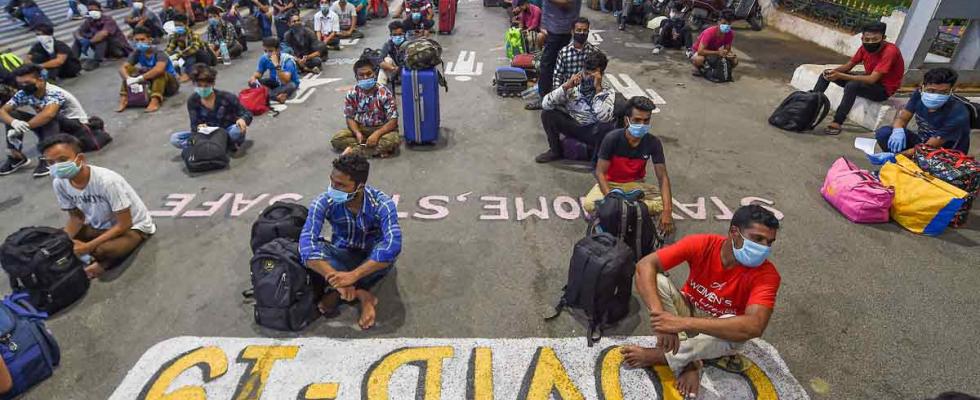
The 2009 Disaster Management Policy (and subsequent plan) clearly outlines measures to be taken in the event of natural disasters like floods, earthquakes, tsunamis, etc. There has not been adequate thought given to the occurrence of a medical disaster, as it was unprecedented, post-independence. While a lockdown was announced, there was no preparedness to provide immediate relief (food, clothing, water, sanitation, sanitary clothing/pads) to migrants who were stuck in destination cities but without employment. Many of the migrants were not registered under the Interstate Migrant Workmen Act 1979, and the employers were let off the hook. In terms of rehabilitation, after over a month, the migrants were told they could go back, but some states wanted them to stay, as they were opening the economy. Some "origin" states were scared that they would pose a threat to state of origin and did not want them to return. That is, migrants were left with little agency of their own, and, finally, the Supreme Court of India ruled that migrants have a right to go home, and the state government should facilitate the process. Though government issued a statement that migrants would have to bear the cost of returning, in practice, this varied.
As per the International Labour Organization (ILO), 81% of all employed people in India are in the informal sector as of 2018, and the figure is higher for women. Apart from migrant workers, this includes agriculture workers, construction workers, domestic workers, security guards, Uber drivers, workers in small hotels, workers in small salons, self-employed people, petty traders, etc. When the lockdown was announced, the livelihood of all these people got affected. Many employers of informal sector workers did not pay domestic workers for days not worked. This violated the Unorganised Workers Social Security Act, 2008. Some shifted to per-day payment, with domestic workers walking 5-6 kilometres to work to work in urban areas (crossing risky areas). In rural areas, too, there were ramifications, with construction and the 100-day Mahatma Gandhi National Employment Guarantee Scheme (MGNREGS) requiring people to work together, and social distancing being difficult (though during rehabilitation/recovery it is a good measure). The relief paid was little when compared to what they earn.
As part of the COVID-19 response, the government advised citizens to adopt social distancing, which people did anyway by not mixing across gender (outside relation), caste, religion, and some occupations, etc. The government really meant physical distancing, which was not possible for people living in small houses, which will be at least 60% of India. Physical distancing in lockdowns requires pre-existing housing that comprises at least two rooms. Whether social distancing is possible for married couples is in question, yet contraception is not part of the relief package; nor is sanitary material. Issues of rise in violence against women and abuse of children are emerging, which is also true during natural disasters. Whether incest is on the rise is not clear. Government needs to strengthen its services for survivors of domestic violence and incest (against girls and boys). This is at present not in the National Disaster Management Policy.
The government in several states has opened state-run or/and private alcohol shops to raise revenues. In some instances, men have stopped alcohol consumption, and whether this would promote resumption and a drain on family resources needs monitoring.
3.0 What will COVID-19-sensitive preparedness, relief, rehabilitation, and recovery look like?
The table below summarises what the Indian government could do to make its disaster preparedness, relief, rehabilitation, and recovery measures more sensitive to COVID-19 and other pandemics.
References Ministry of Law and Justice, 2005, Disaster Management Act, 2005, National Disaster Management Authority, Government of India https://ndma.gov.in/en/disaster.html, last accessed 17th May 2020.
National Disaster Management Authority, 2009, Disaster Management Policy, 2009, National Disaster Management Authority, Government of India https://ndma.gov.in/en/national-policy.html, last accessed 17th May, 2020.
Image credit: Onmanorama
As with all of the blogs posted on our website, the content above does not imply the endorsement of The CI or its Partners and is from the perspective of the writer alone. We do not check facts and strive to retain the writer's voice, as is detailed in our Editorial Policy.
- Log in to post comments