










































Caregiver and Service Provider Vaccine Confidence Following the Changchun Changsheng Vaccine Incident in China: A Cross-sectional Mixed Methods Study
Fudan University (Tu, Han, Du, Yu, Hou); London School of Hygiene & Tropical Medicine, or LSHTM (Sun, Chantler, Jit, Han, Larson); Chinese Center for Disease Control and Prevention (Zhang, Rodewald)
"Maintaining public trust in vaccination is increasingly important when it comes to resilience in the face of new and emerging disease outbreaks, such as COVID-19, to optimize the acceptance of a new COVID vaccine when it becomes available."
China's July 2018 Changchun Changsheng Vaccine Incident (CCVI) involved, in part, substandard diphtheria-tetanus-acellular-pertussis (DTaP) being administered to 215,184 Chinese children. This incident - and subsequent media reporting - increased public anxiety about the safety of vaccines and the regulation of vaccine production in China. This study investigated vaccine confidence of Chinese caregivers (those with responsibility for children under 6 years) and vaccination service providers (VSPs) 6 months after the CCVI.
The researchers conducted a mixed-methods cross-sectional study in January 2019 with 2,124 caregivers of children and 555 VSPs in Anhui and Shaanxi provinces and Shenzhen megacity in Guangdong province. Four statements from the Vaccine Confidence Index™ were used to measure vaccine confidence: "vaccines are important for children to have", "overall I think vaccines are safe", "overall I think vaccines are effective", and "vaccines are compatible with my religious beliefs". Each respondent was asked to rate the extent to which he or she agreed with these statements on a Likert scale. In addition, the researchers carried out semi-structured interviews with 48 caregivers, 43 VSPs, and 9 immunisation programme managers. Finally, they conducted media surveillance from June 2018 to January 2019 to monitor public responses to the CCVI.
Six months after the CCVI, over 95.0% of caregiver and VSP respondents thought vaccination was both important and compatible with their religious beliefs. Caregivers were less likely to agree that vaccines were safe and effective in comparison with VSPs; 82.7% versus 92.8% for safety, and 88.2% versus 94.6% for effectiveness.
Both caregivers and VSPs reported an immediate decline in vaccine confidence post-CCVI. Caregivers said they felt worried, angry, or scared when they first heard about the CCVI; similarly, VSPs recalled being angry, powerless, upset, and stressed. Caregivers reported they received reassurance from VSPs that the vaccines provided at their clinics were not involved in the CCVI. However, they also pointed to lack of communication with VSPs about vaccine safety and effectiveness linked to the CCVI. Caregivers understood the pressure and challenges that the VSPs faced after the CCVI but expected them to remain accountable and professional.
With regard to the Chinese Center for Disease Control and Prevention (CDC)'s response, 4 caregivers stated that CDC did a good job of providing official information and conducting internal investigations. These activities partially met other caregivers' expectations of CDC's role, which they thought included: (a) recommending appropriate vaccines, (b) collaborating with vaccination service providers to strengthen the delivery system, and (c) providing professional information.
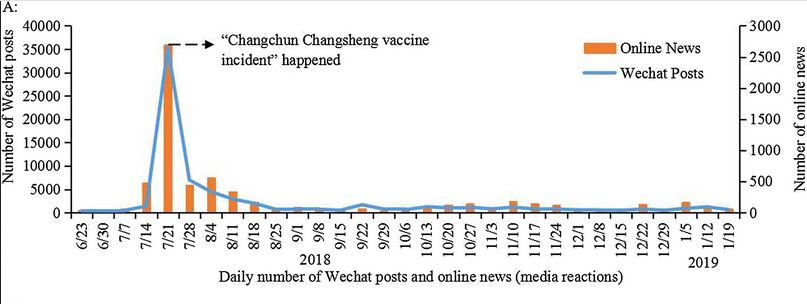
The study revealed that media and public interest in vaccination increased sharply around the CCVI. Two weeks before the CCVI, there were on average only 62 online news articles and 483 WeChat posts on vaccines daily. This increased to 2,698 and 35,310 per day the first week after the CCVI was reported publicly. Public responses changed even more rapidly than online news. However, one month later, both media reports and public reactions declined to the level before the CCVI and remained stable until January 2019.
In short, the study found that caregivers and VSPs conveyed restored and continuing trust in vaccination 6 months after the CCVI. In most cases, this trust was regained following government and public health responses (e.g., prompt publication of information by public health institutions); however, some people remained hesitant about vaccinating their children. Specifically, the researchers observed a clear move from strong to moderate agreement with vaccine confidence statements: The proportion of the public who strongly agreed that vaccines were safe and effective decreased from 47.0%-34.2% and 49.0%-38.1%, respectively, between July 2018 (Global Monitor) and January 2019 (this survey). Qualitative findings confirm these trends and provide some evidence that concerns ignited by the CCVI were leading to changes in vaccination behaviours.
In terms of implications for practice, in the aftermath of the CCVI, the study revealed a gap between the expectations of anxious caregivers and the capacity of VSPs to address their questions. Qualitative analysis indicated that consulting health professionals was the most frequent action taken by worried caregivers after the CCVI. However, some of VSPs in the study reported feeling overwhelmed by increased questioning and demands for information. This finding indicates that VSPs need more technical and emotional support, such as through both global and locally tailored communication resources - especially in times of crisis.
In conclusion, though vaccine confidence recovered to pre-incident levels 6 months after the CCVI, there is a need for increased support for VSPs, better communication about government initiatives to strengthen vaccine monitoring and regulation, and efforts to promote the acceptance of vaccination. These considerations may be particularly relevant given the need for new vaccines to control the coronavirus epidemic.
- Log in to post comments