










































Africa Good Governance Programme on the Radio Waves
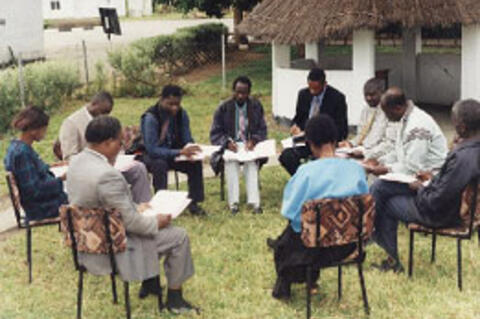
The objective of the project was to support local government capacity building and community empowerment through transmission of key information related to anti-corruption, civic participation, and fiscal decentralisation. The programme stems from the lessons learned from the Local Government on the Radio Waves pilot project held in Malawi in 2003.
The programme included 4 different components:
- Governing Municipalities without Corruption - this programme was designed with all of Africa in mind, but particular attention was paid to municipal national associations from Ghana, Kenya, Malawi, Tanzania, and Uganda. Key stakeholders from central government and non-governmental institutions were involved directly in its design and content. All local governments and members of civil society were invited to participate in this learning programme to combat corruption. The programme was produced in both English and Swahili to increase outreach to stakeholder groups.
- Civic Participation – this programme introduced listeners to concepts, definitions, and tools regarding civic participation and governance. The course featured four modules: Principles of Community-Driven Development, Strategic Planning for Communities, Civic Participation and Local Governance, and Participatory Monitoring & Evaluation. Listeners learned why participating in their community's development was important, and how to effectively engage in their own local governance. They also learned tools such as setting goals and forming action plans, and gained knowledge on how to hold local governments and organisations accountable through monitoring and evaluation methods.
- Municipal Finance/Participatory Budgeting – this programme presented a step-by-step methodology on how municipal government can work collaboratively with the community in order to define, execute, monitor, and evaluate a budget which reflects the priorities and needs of the population. The course focused on both revenue generation in budget formulation and on defining public expenditures within the context of limited means. In addition, the course emphasised how to ensure that the budget mobilises and motivates the contribution of both the community and the private sector. Given that each country has their own internal budgetary processes, the course was not intended to replace or change existing systems, but, rather, to complement and improve the overall municipal budgeting experience.
- Africa Municipal News Magazines – the objective of this programme was to ensure that the news of municipal governance was known throughout Africa. In addition, the monthly news magazine presented lessons learned from past practice and emphasised how to avoid errors and mistakes. The magazine intended to give voice to municipal government in Africa ensuring that local governments were linked through knowledge and news. The magazine took as its principal source the Africa Local Government Action Forum (ALGAF) but was also open to contributions by listeners and interested institutions. Each municipal association was invited to participate, thereby hopefully ensuring relevance and impact. A summary of the programme was then prepared in written form and posted on partner home pages and sent as a news release to national and local journalists in order to foster local dissemination.
Three of the programmes - Governing Municipalities without Corruption, Civic Participation, and Municipal Finance/Participatory Budgeting - were structured as formal capacity-building initiatives. The fourth component, Africa Municipal News Magazine, used a magazine format and served as an umbrella programme to disseminate information, share experiences, and provide news to municipal stakeholders in the region. The three capacity-building initiatives use an interactive methodology that promotes active participation in the learning programme.
Democracy and Governance.
The goal of the learning programmes was the elaboration of action plans by the participants (mayors, local public officials, members of local communities, and representatives of civil society) that could be incorporated into ongoing reform work and had the potential to be replicated in other municipalities and countries.
The first component of the programme - Governing Municipalities without Corruption - started on July 14 2005. The other components started in early 2006, and ran until June 2006. The programme was broadcast in English, and there were plans to include local languages (French and Portuguese).
WBI, First Voice, Municipal Development Partnership for Eastern and Southern Africa (MDP-ESA), and the national associations of local governments.
World Bank website on February 17 2007 and July 23 2009.
- Log in to post comments