










































Young People's Participation in Peacebuilding - A Practice Note
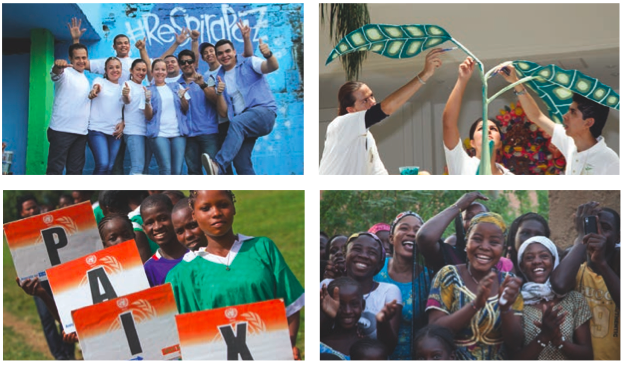
"...a growing body of evidence suggests that young women and men can and do play active roles as agents of positive and constructive change. The recently adopted Security Council Resolution 2250 on Youth, Peace and Security marks the formal recognition of the positive role young women and men for the maintenance of international peace and security."
Recognising the important role that youth play in peacebuilding, this Practice Note, developed by the Inter-Agency Network on Youth Development Working Group on Youth and Peacebuilding, seeks to inform policymakers and donors of key strategic and programming considerations for supporting young people’s participation to peacebuilding. Specifically, this note has been developed to: 1) offer evidence-based, promising practices in youth peacebuilding in the field; 2) advance the understanding of donors and policymakers of complex and often interconnected policy and programme considerations for more holistic support to youth peacebuilding interventions, and 3) enhance the effectiveness of policies and funding strategies of bilateral and multilateral donors and agencies supporting youth peacebuilding interventions.
The Practice Note summarises the situation of youth in conflict-affected environments, argues the importance of investing in youth and peacebuilding, and addresses existing assumptions. For instance, as stated in the brief, “In conflict- and violence-affected contexts, young people are commonly perceived as either perpetrators or victims of violence with young men usually assumed to be the primary perpetrators and young women the primary victims, especially of sexual and gender-based violence. Yet the lived realities of young people in these contexts are much more complex than these stereotypes suggest. Some young people may be both direct victims and perpetrators of violence; others may be neither, but instead have to use their skills and resources to survive and support themselves and their families.”
The largest section of the brief is dedicated to highlighting a variety of promising practices related to policy development and national peace building plans, as well as promising practices related to youth-focused programming. These include examples of programmes that involve: youth leadership, youth organisations and associations, youth centres and clubs, education, governance, community building, the economy, sports, media, religion, extractive industries, and countering violent extremism. Related to each of these focus areas, the note offers an overview of best practice in this field, as well as a list of recommendations related to that particular area of youth programming. It also offers concrete examples from across the globe, highlighting the theory of change and programme results of each programme, and providing links to further information. The Practice Note primarily explores promising practices in the field that have undergone some level of evaluation or review, although the brief acknowledges that some examples are not supported by evidence of impact.
The note concludes with the following overarching recommendations for donors, policymakers, and planners:
- "In developing strategies and policies, avoid the conceptual trap that youth are either victims or perpetrators, or only a risk factor - draw upon the increasing evidence that demonstrates that youth are largely peaceful agents and assets.
- Fund and require independent evaluative work of youth and peacebuilding projects and programmes that measures impact on conflict dynamics, and compare this with the situation of youth who were outside of the intervention.
- Use and require use of - in donor strategies, procurement tenders, and in programming - theories of change that are evidence-based, holistic and multi-sectoral as much as possible. Sectoral initiatives should factor in cross-sectoral youth considerations for integrated, holistic approaches.
- Support youth strategies and programmes that promote youth-led initiatives that go beyond capital elites, and foster intergenerational dialogue and collaboration.
- In results frameworks, include youth in outcomes and results as appropriate, and disaggregate indicators by sex, age, location, identity, etc., as appropriate.
- Learn from successful violence prevention efforts in Latin America and the Caribbean to inform youth peacebuilding initiatives in other countries.
- In developing peacebuilding strategies and policies for and with youth, ensure consistent attention to gender equality and young women’s participation. Girls and young women are youth, just the same as boys and young men are. Ensure implementation of and complementarity with the United Nations Secretary-General’s Seven-Point Action Plan on Gender-Responsive Building.
- Fund rigorous, longitudinal, research and evaluative data that demonstrate how interventions contribute to (or fail to) developing skills, attitudes, and behaviour of youth - including marginalized youth - for peacebuilding."
- Log in to post comments