










































World Press Freedom Index
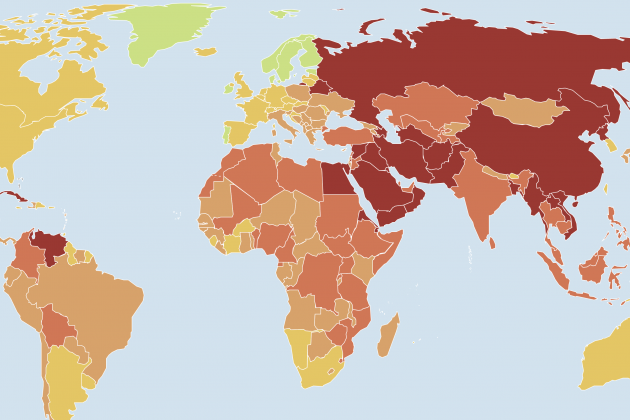
"At the international level, democracies are being weakened by the asymmetry between open societies and despotic regimes that control their media and online platforms while waging propaganda wars against democracies." - World Press Freedom Index 2022
The World Press Freedom Index is an annual ranking of countries that has been compiled and published by Reporters Without Borders (RSF) since 2002. It is based on an assessment of countries' press freedom records in the previous year and is designed to compare the level of press freedom enjoyed by journalists and media in 180 countries and territories.
The country comparison is based on a definition of press freedom formulated by RSF and its panel experts when they developed a new methodology to be used from 2022 onward: "Press freedom is defined as the ability of journalists as individuals and collectives to select, produce, and disseminate news in the public interest independent of political, economic, legal, and social interference and in the absence of threats to their physical and mental safety."
The Index's rankings are based on a score ranging from 0 to 100 that is assigned to each country or territory, with 100 being the best possible score (the highest possible level of press freedom) and 0 the worst. This score is calculated on the basis of two components:
- a quantitative tally of abuses against journalists in connection with their work, and against media outlets; and
- a qualitative analysis of the situation in each country or territory based on the responses of press freedom specialists (including journalists, researchers, academics, and human rights defenders) to an RSF questionnaire available in 23 languages. For 2022, the questionnaire was updated to take better account of new challenges, including those linked to media digitalisation.
Each country or territory's score is evaluated using five contextual indicators that reflect the press freedom situation in all its complexity:
- Political context - evaluates the degree of support and respect for media autonomy, vis-à-vis political pressure from the state or from other political actors.
- Legal framework - evaluates the legislative and regulatory environment for journalists, including the level of censorship, the level of impunity for violence against journalists, and the ability to protect sources.
- Economic context - evaluates economic constraints linked to governmental policies, to non-state actors (advertisers and commercial partners), and to media owners.
- Sociocultural context - evaluates social constraints based on such issues as gender, class, ethnicity and religion, and cultural barriers to questioning certain bastions of power or influence or covering certain issues, because it would run counter to the prevailing culture.
- Safety - evaluates the ability to identify, gather, and disseminate news and information in accordance with journalistic methods and ethics, without unnecessary risk of bodily harm, psychological or emotional distress, or professional harm resulting from, for example, loss of one's job, confiscation of professional equipment, or ransacking of media installations.
A subsidiary score ranging from 0 to 100 is calculated for each indicator. All the subsidiary scores contribute equally to the global score. And within each indicator, all the questions and sub-questions have equal weight.
Results are made available on the RSF website and can be viewed by country or region, and according to the five contextual factors. A press freedom map offers a visual overview of the scores of all the countries in the index.
The 2022 edition of the World Press Freedom Index, which is the 20th World Freedom Index, highlights the disastrous effects of news and information chaos resulting from a globalised and unregulated online information space that encourages fake news and propaganda. It reveals a two-fold increase in polarisation that is amplified by this information chaos - that is, media polarisation fuelling divisions within countries, as well as polarisation between countries at the international level.
Although data are gathered from January to December of the previous year, the 2022 edition includes updates for January to March 2022, which were carried out for countries where the situation had changed dramatically - as is the case in Russia, Ukraine, and Mali.
Publishers
English, Arabic, French, Persian, Portuguese, Spanish
Methodology Used for Compiling the World Press Freedom Index and RSF's 2022 World Press Freedom Index: A New Era of Polarisation, both accessed on the RSF website on June 23 2022.
- Log in to post comments