










































Using Intervention Mapping to Develop and Adapt Two Educational Interventions for Parents to Increase HPV Vaccination Among Hispanic Adolescents
The University of Texas Health Science Center at Houston (Rodriguez, Roncancio, Savas, Lopez, Vernon, Fernandez); University of Texas Southwestern Medical Center (Rodriguez)
In the United States (US), cervical cancer disproportionality affects Hispanic women. This study used a systematic framework called Intervention Mapping (IM) to develop and adapt a theory- and evidence-based educational intervention designed to increase human papillomavirus (HPV) vaccination by communicating with parents of Hispanic adolescents aged 11-17 years. These interventions were designed as part of a larger comparative effectiveness study to develop and evaluate a print vs. tailored intervention delivered by lay health workers in clinic settings.
IM guides programme planners through 6 steps, from needs assessment to programme evaluation. In short, the steps included:
- Developing a logic model and identifying modifiable factors associated with vaccination among Hispanic adolescents by conducting literature reviews, focus groups, and in-depth interviews with Hispanic parents. The complete logic model of the problem included the behaviour of interest (lack of HPV vaccination), the related health consequences (HPV-related cancers and genital warts), and determinants, or parental factors, associated with the decision not to vaccinate.
- Identifying Por Nuestras Hijas (For Our Daughters) outcomes and objectives - organising elements into a logic model of change illustrating the expected change mechanisms leading to the desired behaviour.
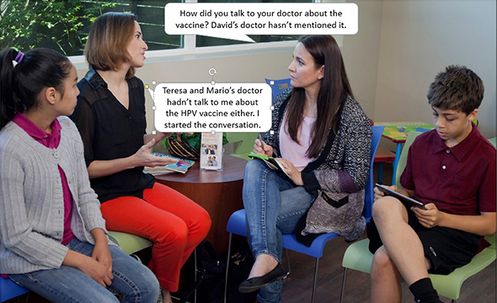
- Articulating the Por Nuestras Hijas theme, programme components, theoretical methods, and practical applications. The intervention follows the story of a mother gathering information about the HPV vaccine and making the decision to vaccinate her daughter to protect her against cancer. The programme included 2 components: a print fotonovela and a tailored interactive multimedia intervention (TIMI) delivered on a tablet. Fotonovelas are soap-opera-style stories popular in Spanish-speaking societies that often employ theory- and evidence-based methods such as social modeling and vicarious learning. They have been shown to be effective in helping individuals personalise health issues, identify with and internalise the information being presented, and engage in positive health behaviours. Tailoring and targeting, modeling, skill building, and education and counseling were identified as key theoretical methods to address determinants influencing Hispanic parents' decision-making regarding the HPV vaccine. These determinants included: parental knowledge, attitudes, self-efficacy, skills, perceived benefits/barriers, perceived susceptibility, perceived norms, and outcome expectations. For example, by identifying participant-specific barriers to initiation and completion through tailoring, the programme provided tools and information necessary to build skills and overcome those barriers. In addition, lay health workers clarified information that was unclear to participants and provided additional sources of information as needed.
- Producing Por Nuestras Hijas. Scripts were in both English and Spanish, and simple, direct sentences free of jargon were used to accommodate a low-literacy population. Actors for the TIMI and fotonovela were bilingual Hispanic actors with experience in health-related productions. Filming took place in locations that were culturally appropriate for the intended audience (e.g., community-based clinics serving predominantly low-income populations). Similar to a comic book or illustrated novel, each page of the fotonovela contained short text bubbles along with a relevant image from a relevant video scene. The fotonovela also contained: (i) a list of resources available to help cover the cost of the vaccine; (ii) information about HPV and the HPV vaccine; (iii) a calendar to help parents keep track of dosing schedules; and (iv) a place for mothers to write down questions about the vaccine to ask their healthcare provider.
- Implementing Por Nuestras Hijas, with an eye toward building lay health worker capacity to deliver the programme in community clinics. Theoretical methods - information, modeling, feedback, reinforcement, and active learning - were operationalised through presentations, activities, and practice sessions during a 2-day training session.
- Evaluating Por Nuestras Hijas by first recruiting 1,398 parents of adolescent females in participating clinics to take part in a randomised controlled trial (RCT) to assess the effectiveness of the fotonovela and TIMI. Results are forthcoming.
The researchers followed these steps again to adapt the programme once HPV vaccine recommendations included males - repackaging it as Por Nuestros Hijos (For Our Children). In brief, this required mostly surface adaptations, such as changing characters to include males, altering scripts to include HPV-related cancers related to males, and updating the HPV guidelines to include males. According to the researchers, IM can guide programme planners in making adaptations that are more significant by systematically guiding decision-making throughout the process. Throughout both the original development and adaptation processes, the researchers relied on theory, empirical evidence, and new data to make decisions. Tasks in each step built upon one another as researchers integrated findings from the literature, previous research, qualitative findings, and theory. The systematic process allowed the researchers to develop messages and materials designed to get at factors beyond HPV knowledge or awareness to create behaviour change.
For instance, based on the IM logic model of change, modeling was a critical method for increasing self-efficacy, creating positive outcome expectations, and ultimately increasing vaccination behaviours. "Systematically identifying and addressing multiple factors associated with HPV vaccination, such as attitudes, beliefs, or self-efficacy, allows intervention planners to move beyond simply providing information or cues to action to create behavior change."
According to the researchers, the steps that guided programme development and adaptation are applicable to a broad group of researchers, programme planners, and public health professionals. If future studies find that Por Nuestras Hijas (For Our Daughters) and Por Nuestros Hijos (For Our Children) interventions are effective in increasing vaccination, the researchers indicate that they could be adapted for other populations using the process outlined in this paper. They conclude that "IM provides a user-friendly, iterative stepped approach to facilitate development and adaptation guiding researchers and public health practitioners every step of the way."
Frontiers in Public Health, 15 June 2018 | https://doi.org/10.3389/fpubh.2018.00164
- Log in to post comments