










































UNICEF's Child-Friendly Schools: Ethiopia Case Study
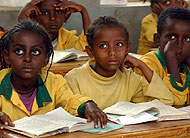
From the United Nations Children's Fund (UNICEF), this case study examines UNICEF Ethiopia's establishment, since 2007, of child-friendly schools (CFS) in Ethiopia, covering all 9 regional states and the 2 city administrations in the country. As detailed here, the CFS model is structured around a child-seeking, child-centred, gender-sensitive, inclusive school that emphasises teaching effectiveness and community involvement. To this end, the introduction of the CFS model is designed to encourage schools and education systems to move progressively towards quality standards to ensure the development of the whole child.
As detailed here, the current target in the Government of Ethiopia-UNICEF country programme is to have 1,000 primary schools certified as child-friendly by 2011. "Creating the minimum conditions for schools to operate as safe, healthy and attractive learning environments became the first priority and entry point to progressively deal with quality issues in a child-friendly environment." Specifically, the CFS intervention included: renovation or construction of classrooms, paedagogic centres, libraries, early childhood development (ECD) centres, water points, and teachers' residences; provision of furniture, science kits, mini-media equipment, computers, printers, duplicating machines, supplementary reading materials, indoor and outdoor games, and tutorial classes for girls; support for capacity building and incentives to encourage best performance; and supply of uniforms and school supplies, as appropriate.
The evaluation findings detailed here indicate that, although much remains to be done, stakeholders at all levels of planning and implementation indicated their satisfaction with accomplishments in the child-friendly schools, especially in relation to physical learning environments, which in turn contributed to increased enrolment and community participation. As articulated by parent-teacher associations (PTAs), school principals, and students, the difference in general appearance and attractiveness of the physical environment before and after introduction of CFS was significant.
Specifically:
- 85% of student respondents indicated their satisfaction with overall improvements in relation to quality of classrooms and libraries, adequacy of desks, and provision of learning materials. About 75% of students were also happy with access to water and sanitation facilities. In certain cases, however, children reported that access to water services was restricted and sanitary facilities were less than hygienic.
- Enrolment since the introduction of the CFS initiative has been growing steadily, in favour of girls, in 67% of the child-friendly schools visited. Actions taken to improve physical infrastructure were considered to be responsive for the increased enrolment.
- The various enrolment mechanisms used by child-friendly schools to identify, enrol, and retain out-of-school children were found to be instrumental in boosting timely enrolment.
- 73% of the visited child-friendly schools indicated their satisfaction with the extent and nature of community participation. Some were exceptionally successful in their approach to community participation and have demonstrated their capacity to solicit funding from local sources, which is very important to the continuity and sustainability of the CFS programme. Some teachers, however, still have a view that community participation is characterised by a "tell mode" that does not go beyond asking communities to contribute cash, materials, or labour - making community participation less meaningful in the decision-making process on core issues affecting the future of their schools.
- In spite of the efforts made, child-friendly schools did not show progress in reducing dropout and repetition rates over the programme years. Compared to 2006, the baseline year, the drop-out rate was higher by 2 percentage points. The repetition rate was also slightly higher, by 0.3 percentage points. It was observed that more boys than girls deserted schooling in the child-friendly schools. Reasons for dropping out mentioned by students include: sickness, family problems, and the need for child labour; lack of parental support; poverty; and hunger. Factors attributed to causing low performance and/or repetition were recurrent absenteeism, lack of textbooks, and difficulty of the subject matter. Forty percent of students indicated dissatisfaction with the teaching-learning process in the classroom, implying that there is a long way to go to reach a CFS level of student-centred, active learning and teaching practice.
- All of the visited child-friendly schools were aware of gender issues and claimed to be more gender responsive than they were before participating in the initiative. However, they still seem to lack a clear gender strategy for action that goes beyond quantitative targets of enrolment. This is true even at the policy level.
- Planning, implementation, management and monitoring of the CFS initiative were generally found to be weak at all levels.
Ways forward described in the case study include:
- More capacity-building programmes for principals, teachers, and PTAs on micro-planning techniques to enhance existing enrolment mechanisms. "Involving children in the training process would have a paramount benefit."
- Development of a sound national and regional policy on minimum standards and indicators that provide a framework for CFS operation.
- Create synergy with partners to mobilise additional resources from the community. Training teachers and parents in non-violent, child-based strategies for dealing with disciplinary issues is also required; school clubs could have a significant role in promoting this aspect of school life.
- Establish gender-specific, results-oriented qualitative plans with an earmarked budget to more strategically advance gender issues in all child-friendly schools. Outreach plans may also help mobilise communities and social systems to ensure gender equality outside the school compound.
The case study concludes with suggestions for taking CFS to scale in Ethiopia. For instance, "there is an urgent need to develop national minimum standards, flexibly tailored to local contexts, followed by needs-based capacity building."
UNICEF website and UNICEF Ethiopia website - both accessed on February 11 2011. Image credit: © UNICEF/Ethiopia/UN/Debebe
- Log in to post comments