










































Supporting Innovation and the Use of Technologies in Accountability Initiatives: Lessons from Making All Voices Count
Making All Voices Count
Making All Voices Count was an international initiative that harnessed the power of innovation and new technologies to support effective, accountable governance. The research, evidence, and learning (REL) component led the process of building an evidence base on the roles that technologies play in securing responsive, accountable governance, and supporting practitioners to learn from this evidence. In that light, this programme learning report from the REL team highlights five of the lessons learned in the course of the initiative (2013-17) about how - and how not - to run large, complex programmes that intend to support innovation in governance.
The report opens by describing the context and design of Making All Voices Count and describing how it evolved as it was implemented. In total, Making All Voices Count funded 178 projects: 72 innovation projects, 61 research projects, 38 scaling projects, and 7 existing tech hubs. Focusing on 6 countries in Africa and Asia, the programme was implemented by a consortium comprising Hivos (the lead agency), the Institute of Development Studies (IDS), and Ushahidi. It was supported by the Department for International Development (DFID), United States Agency for International Development (USAID), Swedish International Development Cooperation Agency, Open Society Foundations (OSF), and Omidyar Network (ON). (Editor's note: clicking on "Making All Voices Count" next to "Network Contact", above, will take you to a list of those research publications Making All Voices Count produced that are summarised on The CI website.)
The projects described in Box 1 on page 6 illustrate some of what Making All Voices Count achieved. For example, in Pakistan's Punjab region, the Bahawalpur Service Delivery Unit took an innovative approach to digitalising the health records managed by women health workers delivering antenatal care (ANC), using geographic information systems (GIS) mapping to develop an online monitoring dashboard. The project improved and extended service delivery (antenatal registration and care) to 31% more women, increased delivery by skilled birth attendants by 26%, and increased deliveries at government health facilities by 11%. Despite successes like this, there were challenges, and "a brief look at how the programme unfolded reflects the importance of that old principle of development: context matters. Within its relatively short lifetime, the programme's political context underwent significant shifts and changes." For instance, "a number of trends and incidents contributed to a deflation of the hype and expectations concerning the emancipatory promise of technology..."
In that reflective light, the report goes on to discuss 5 lessons learned:
- Take time at the start to get the basics right. "In a complex programme with diverse stakeholders, time is needed to develop shared understandings of expectations and requirements between all donors and consortium members in relation to these basics. Equally, the consortium needs to develop a shared understanding of and mutual responsibility for the programme's theory of change and theory of action - especially how different constituent components should complement one another."
- Trusting relationships at all levels are vital in successfully running a large, complex programme. "The strategic and embedded approach Making All Voices Count adopted in June 2014 (described on page 6), relied on programme staff building trusting relationships with a very wide and diverse range of grantees and other stakeholders in the accountability and tech ecosystems of their countries."
- As they are inherently risky and uncertain, and require adaptive approaches to succeed, innovation programmes are not for all funders, or for all implementers. "Very few Making All Voices Count-supported projects did exactly what they initially set out to do; most adapted to the changing dynamics of each context, and in response to lessons that emerged as the projects unfolded....Binary notions of success and failure are problematic in themselves for numerous reasons, but in the innovation field, donors, practitioners and researchers need to recalibrate their expectations and consider innovation projects as failures only if they do not build on existing evidence and knowledge, or make available to future innovators knowledge generated by the project."
- What gets measured and monitored needs to be what matters for effectiveness and impact, complex as this may be. "In Making All Voices Count, as in many large aid programmes, there were disjunctures between the kinds of monitoring and indicators that were useful at a project level and the kinds of performance data that were needed for aggregating upwards from project level to programme level, and from programme level to the donors. Such disjunctures of scale can create perverse incentives and distortions, and make learning-focused discussions difficult within and between the different layers of the funding chain." Box 2 on page 10 describes Making All Voices Count's use of the qualitative assessment scorecard (QAS) methodology to create a space for staff to reflect critically on programme performance. As part of this process, Global Integrity facilitated and supported six grantees in undertaking "learning journeys" through four face-to-face, reflective learning workshops, and through ongoing virtual support throughout the full life cycle of each project. The workshops offered spaces for grantees to learn and reflect on how their projects and contexts were changing, and to benefit from peer learning and support.
- Some types of knowledge and relationships needs to be viewed as valued outcomes to be pursued, rather than assumed to exist from the start. "Making All Voices Count brought together varied actors from a range of backgrounds and countries, with diverse perspectives and epistemologies....Each individual is uniquely attuned to the various elements that are crucial to an innovation's success..." Some of the approaches Making All Voices Count developed to address this challenge, as outlined in the report, include:
- Facilitating grantees and staff to go beyond single-loop learning ("are we doing it right?") to double-loop learning ("are we doing the right things? Why do they or don't they work?").
- Offering practitioner research and learning grants to provide practitioners with the space and research mentoring to identify their own knowledge gaps and / or to uncover and examine their own assumptions for the purposes of learning and making their interventions more effective and impactful.
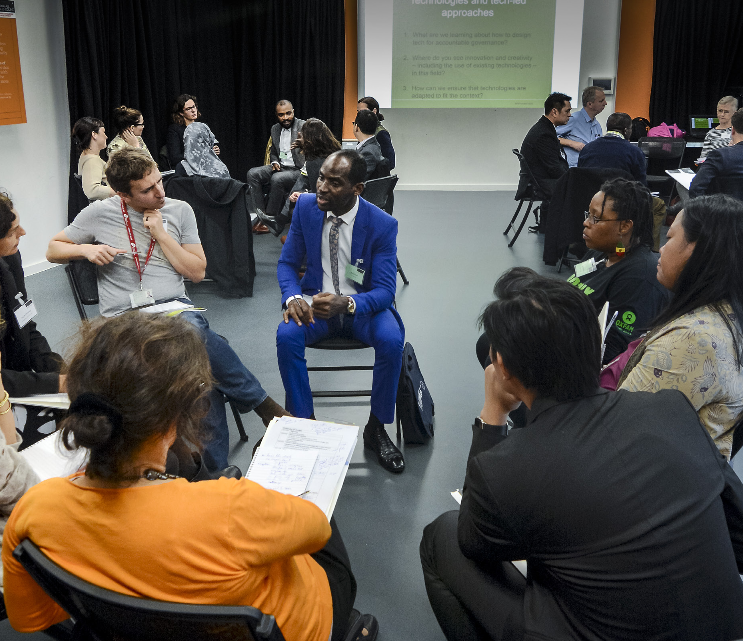
- Holding 3 programme-wide learning and inspiration events to bring grantees and other stakeholders together to learn from one another, using elements of governance concepts and theory as discussion frameworks.
- Fostering country-level communities of practice such as the one seeded by Making All Voices Count in South Africa to create a safe space for grantees to share their experiences and navigate both individual and shared challenges.
In conclusion: "The legacy of Making All Voices Count is not only the innovative ideas supported, but also, in large measure, the knowledge generated, the new relationships and partnerships developed, the communities of practice formed, and the new ways of working which will shape future governance innovations."
Making All Voices Count website, January 18 2018. Image credit: Making All Voices Count
- Log in to post comments