










































The Strengthening the Social Acceptance of Family Planning in the Philippines Project (TSAP-FP)

- The BCC component aimed to reposition and popularise the concept of FP as a way of life and encourage open public discussion of FP.
- The ASM component aimed to develop the capacity of groups and individual advocates/champions who could confidently speak about and endorse FP to others.
- The HP component aimed to strengthen the capacity of health providers in government and industry-based health facilities to promote and provide accurate information on FP using evidence-based medicine (EBM).
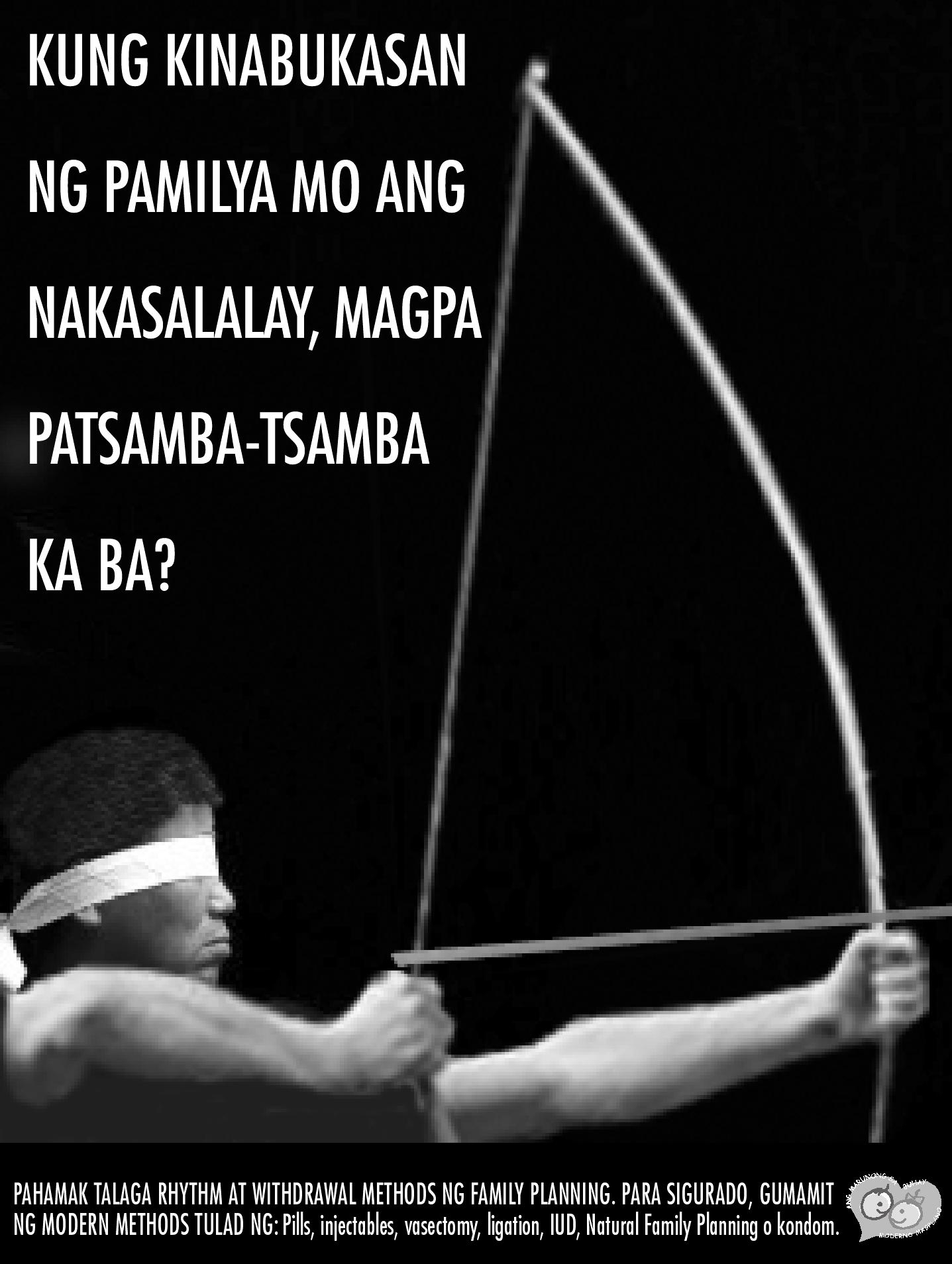
- In the BCC component, advertising was the major strategy to create widespread awareness and acceptance of the repositioned FP message - e.g., make the topic of FP "sexy" and exciting once again - and to promote modern methods of FP. One televised ad features a pregnant woman explaining how each of her many children came into the world (the "withdrawal method"); the key slogan is "Sa Modern Methods Sigurado Ka, Walang Patsamba-tsamba" ("You are sure with modern methods, there are no risks"). TSAP-FP pre-tested the ads with various focus groups, revising them accordingly in some cases, and also presented them to a senator, legislators, and various organisations in order to generate approval of and support for the ad campaign from other groups supporting FP.
Visitors to C-Hub may watch video clips of the television ads, listen to the radio spots and campaign song, and download print ads, brochures, and scripts. (The image above is from one of the print ads; the Archer ad shows a blindfolded archer aiming at an unseen target with the message communicating the analogy between the picture shown and use of traditional (as opposed to modern) FP methods).
A series of activities was organised to create a "buzz" around the advertising campaign. The campaign song entitled Sigurado (Sure!) was produced and aired starting April 19 2004 over 15 popular FM stations in Metro Manila, Metro Cebu, and Metro Davao. Also, TSAP-FP positioned FP champions as a resource for members of the media and enlisted broadcast media champions to, for instance, begin discussing FP in daily public affairs radio and television programming. The project also held FP orientations for members of the print and broadcast media. TSAP-FP established the Family Planning Hotline, which could be accessed via voice, text (short messaging service, or SMS), and email.
- In the ASM component, the key strategies used were: (i) identify influential individuals and groups, (ii) build advocacy capabilities, (iii) support advocacy campaigns and community mobilisation activities, and (iv) foster linkages and partnerships. To cite only one example of this strategy in action, realising that community theatre is a creative way to communicate responsible teen sexuality among adolescents and youth in the community, TSAP-FP trained 28 youth from the local organisation KATINIG in leadership and repertory theatre through the Philippine Educational Theater Association (PETA) in October 2003. Through similar activities, TSAP-FP worked to weave together and scale up the FP advocacy efforts of the informal sector, the urban economically poor, the labour sector, and male organisations (e.g., a national network of tricycle drivers and operators and men in the military).
Seeing the need to gather all partners in one occasion to reaffirm their commitments to FP advocacy and collectively gear up for FP campaigns in their respective constituencies, TSAP-FP organised a national TSAP Partners Forum in June 2004; it drew 81 individuals representing 58 organisations and networks from various sectors. TSAP-FP trained 45 FP champions in skills and techniques in public speaking and dealing with media and also held a networking conference.
A key activity on this ASM component involved advocacy with religious leaders; working in the Autonomous Region in Muslim Mindanao (ARMM), TSAP-FP held dialogues and fora on FP. TSAP's work in the ARMM resulted in a religious decree - the fatwa - that, it is hoped, will create opportunities for generating greater acceptance of FP, and modern methods in particular, among the Muslim communities of the Philippines.
- In the HP component, activities included: provision of updated FP information, revision of the Family Planning Clinical Standards Manual, influencing the Professional Regulation Commission to ensure the inclusion of FP in the undergraduate curriculum and the professional board examinations, and the conducting of evidence-based counselling skills training. To support the transition to EBM, TSAP-FP developed Critically Appraised Topic (CAT) kits focusing on topics such as oral contraceptives, injectables, intrauterine devices, barrier methods, fertility awareness methods, and surgical methods (e.g., vasectomy).
Family Planning.
- Log in to post comments