










































Sri Lanka Press Institute (SLPI)

In the context of the recent ethnic conflict, the SLPI's approach is to serve Sri Lanka as a whole: in the diploma and other training courses, when receiving complaints, and when advocating for professional journalism. Although not an explicit objective, the SLPI believes that its approach helps bridge divisions across the nation. The SLPI strives to maintain good governance, human rights, gender equity, and poverty alleviation. SLPI operates from the strong belief that a diverse, professional, and vibrant media can be critical in times of conflict.
SLPI has 4 operational arms:
- Sri Lanka College of Journalism (SLCJ) - conducts 3 core programmes: the one-year diploma course for new entrants in journalism, the mid-career programme for working journalists, and the training programme for regional correspondents. This involves curriculum development, training of staff, and investment in technology.
- Press Complaints Commission of Sri Lanka (PCCSL) - works to resolve disputes between the print media and the public and advocates for more responsible, ethical journalism. In its efforts to improve confidence and awareness of stakeholders about the PCCSL as well as the Code of Ethics it adopts (The Code of Professional Practice of The Editors' Guild of Sri Lanka [PDF]), the PCCSL conducts networking with key civil society organisations in an effort to expand its membership. Given the fact that there is strong support for a self-regulatory body in Sri Lanka, the PCCSL also plans to explore possibilities of opening up for third-party complaints, as well as initiating complaints on its own.
- Advocacy and Free Media Division - conducts programmes on an annual basis. While networking with like-minded local and international organisations, it also campaigns on media law reforms in Sri Lanka.
- Media Resource Centre (MRC) - offers facilities and training to support the financial sustainability of SLPI. MRC offers space for workshops, seminars, meetings, press conferences, and exhibitions. It also functions as a place of gathering for journalists. Rental services at the MRC include: audio-visual equipment, TV and audio production facilities, computer labs, film screening halls, and an auditorium with multimedia facilities. MRC also offers its own workshops on: how to write a press release; how to write an article; how to conduct an interview and be interviewed; how to take a good photo; how to produce a radio show; and how to write scripts.
Examples of past initiatives include: SLPI took the lead in a joint media effort and managed to block an announced censorship through the re-introduction of the Press Council in June 2007. SLPI also played a role in bringing newsprint to Jaffna in 2007 when the Jaffna papers were about to close down due to lack of newsprint. In the wake of another attempt by the government to formulate a "media policy," SLPI was the key networking point for all the media activist groups to formulate a united response.
Media Development, Rights.
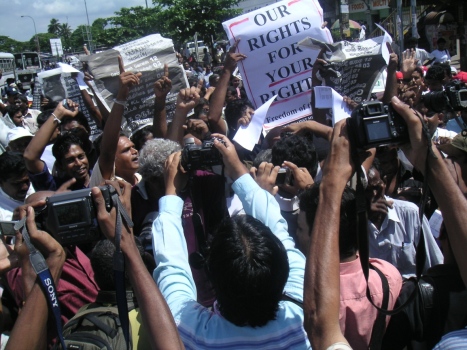
According to one of SLPI's funders (Sweden-based Fojo Media Institute), journalism in Sri Lanka is under siege. Reporters are murdered, media activists are forced into exile, and newsrooms are burnt. Currently, Sri Lanka is ranked as number 165 on Reporters without Borders press freedom index - making it the lowest ranked democracy in the world. Although the political situation in Sri Lanka has deteriorated and the media has limited space to produce quality journalism, Fojo claims that Sri Lankan press, radio, and TV failed to remain independent during the conflict. Editors were appointed on political merits, and reporters who tried to publish balanced and impartial journalism risked their lives. Instead of balanced, impartial, and accurate reporting, the media supported one side or the other in the conflict. In many ways, these patterns have continued after the end of the armed conflict in May 2009. SLPI is working to change this.
Funders include the Fojo Media Institute, Danida, and Sida - the Swedish International Development Cooperation Agency.
Fojo Media Institute website and SLPI website, both accessed March 25 2010.

- Log in to post comments