










































The Role and Influence of Grandmothers on Child Nutrition: Culturally Designated Advisors and Caregivers
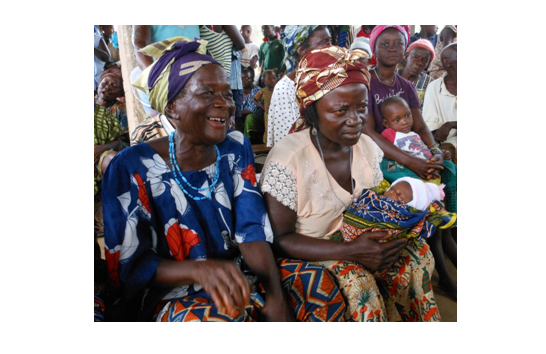
Grandmother Project (GMP) - Change through Culture
"[T]he involvement and influence of senior women, or grandmothers, in child and maternal nutrition is much more significant than conventionally assumed by international public health and nutrition policy-makers and programme planners."
In non-Western societies, most women and young children are embedded in extended and multigenerational family systems, and older, more experienced women play an active role transmitting socio-cultural norms. Thus, there is a recognised need to adopt an ecological and systems perspective on community nutrition and health issues and, in this vein, to consider not only mothers but also other caregivers involved in child nutrition and health within the family and community environments. This paper reviews research findings from Africa, Asia, and Latin America on the role and influence of grandmothers related to nutritional practices and care of women during pregnancy and of infants and young children related to breastfeeding, complementary feeding, and feeding of sick children.
As a backdrop, author Judi Aubel explores three facets of non-Western societies: family systems, cultural systems, and hierarchy and the role of elders. Many maternal and child nutrition programmes, Aubel argues, neglect these concepts, failing to account, for example, for a comprehensive notion of cultural systems, which consists of two interrelated components: (i) social structures and organisations related to family, kinship, roles, relationships, hierarchies, and communication nets; and (ii) normative systems of values and beliefs that affect practices or behaviour.
Aubel reviewed studies from both published and grey literature from 60 different cultural contexts in 35 countries in Africa, Asia, and Latin America to identify common patterns related to grandmothers' involvement in and influence on nutrition-related practices within families and the wider community context. This review reveals three common patterns:
- Grandmothers play a central role as advisers to younger women and as caregivers of both women and children on nutrition and health issues. For example, in Malawi, given their status as "guardians of tradition", both maternal and paternal grandmothers actively coach new mothers on culturally appropriate practices regarding newborn care.
- Grandmother social networks exercise collective influence on maternal and child nutrition-related practices, specifically regarding pregnancy, feeding, and care of infants, young children, and sick children. For example, in both rural and urban contexts in various country settings, women's attitudes and actions are found to be influenced particularly by female members of their own social networks; the age and experience of network members determines, to a great extent, their degree of influence.
- Men play a relatively limited role in day-to-day child nutrition within family systems. The literature reveals two determining characteristics of non-Western societies related to men's roles: (i) specificity in household roles and (ii) a hierarchy of authority within households. One Malawian researcher asserts that, although men defend their official title of "household head" and maintain they are major decision-makers, in reality, with regard to pregnancy and newborn care, men's involvement is relatively limited.
Per Aubel: "The research reviewed supports the need to re-conceptualize the parameters considered in nutritional policies and programmes by expanding the focus beyond the mother-child dyad to include grandmothers given their role as culturally designated advisers and caregivers." To that end, she presents recommendations to promote adoption of culturally adapted and grandmother-inclusive approaches within nutrition and health programmes:
- Carry out formative research in specific cultural settings to understand roles, norms, communication networks, and decision-making patterns in household and community settings. Such research should draw upon research tools based on a systemic, rather than reductionist, framework that can bring to light key features of family organisation and dynamics. Rapid and participatory assessment methods can be used that are neither extremely time-consuming nor costly.
- Help health sector professionals and community-level health workers re-examine their perceptions of both culture and of grandmothers so that they view them as resources rather than obstacles. In addition, both of these categories of health workers need to be skilled in non-directive communication/education methods based on principles of adult education and an assets-based approach to community capacity-building.
- Revise the curriculum of basic health training schools to give greater attention to local realities related to family and cultural systems and to research methods for understanding and incorporating elements of both into health sector programmes.
- Conduct additional research in non-Western cultures to either validate or reject the conclusions of this review related to the three characteristics of family organisation and influence associated with child nutrition and health.
Aubel concludes "that nutrition policies and programmes should give greater attention to the culturally designated roles and hierarchy related to nutrition and health strategies within the family and community and particularly, to the role of grandmothers. More specifically,...grandmothers should be actively involved in public health programmes that promote optimal nutrition and health practices for children and women."
Maternal & Child Nutrition. 2012 Jan; 8(1): 19-35. doi: 10.1111/j.1740-8709.2011.00333.x - sent via email from Judi Aubel to The Communication Initiative on May 12 2021. Image credit: GMP
- Log in to post comments