










































Protecting Human Rights (PHR)
The Protecting Human Rights (PHR) project is a 5-year (March 2011-2017) domestic violence prevention and protection programme in Bangladesh, implemented by Plan International across the country, focusing on 102 unions and 8 upazilas of 6 districts: Barguna, Bogra, Chittagong, Dinajpur, Jessore, and Sylhet. The project, funded by the United States Agency for International Development (USAID), aims to reduce domestic violence (DV) and related human rights (HR) abuses in Bangladesh. To implement the programme, PHR works in partnership with the Bangladesh National Woman Lawyers' Association (BNWLA) and 11 local non-governmental organisations (NGOs) at the district, upazila, and union levels. Objectives include:
- Improve mutual understanding and effectiveness between key actors involved in reducing violence and strengthening other interwoven HR;
- Increase access to and willingness of survivors to seek justice through formal and informal sectors;
- Expand immediate and longer term support to survivors of DV; and
- Increase awareness on DV and related HR issues at national and local levels.
According to a PHR baseline survey, the overall prevalence of physical and/or sexual violence is 53%; the PHR programme has a goal to reduce the prevalence rate by 20% at the end of the programme.
The PHR programme stresses the importance of forming partnerships, alliances, and collaborative efforts that foster preventive, protective, and legal HR measures and developing linkages between and among local and national government representatives, NGOs, civil society, and community leaders. The coalition, working together as agents of change with local communities, spearheads efforts to: eradicate DV and related HR abuses such as dowry, child marriage, sexual harassment, trafficking-in-persons, stalking, rape, and child abduction; protect and support survivors; and prosecute perpetrators. Engaging men and boys is a priority of PHR.
In order to achieve its goal of reducing DV and other HR abuses in targeted areas, PHR is designed around USAID's 4 relevant Intermediate Results (IRs): IR 1: Key DV and HR Legislation and Policies Enforced; IR 2: Increased Use of Formal and Informal Justice Systems by HR Survivors; IR 3: Increased Support Services to HR Abuse Survivors; and IR 4: Public Awareness on HR Issues Improved. Each of these IRs is linked to these major programme areas:
- Advocacy of legislative reform and enforcement to reduce DV - PHR collaborates with government - the Ministry of Women and Children Affairs (MOWCA) and other ministries and agencies - to achieve a strong and effective Child Marriage Restraint Act, Domestic Violence (Protection and Prevention) [DVPP] Act, a new Sexual Harassment Prevention Law, and related policies and action plans. PHR holds multi-stakeholder Human Rights Forums at local and national levels to conduct advocacy, share evidence, inform government services, spark policy dialogues, and strengthen the services available to survivors. On November 30 2016, PHR organised a dissemination seminar on the findings of their study (with BNWLA) entitled Five Years after Bangladesh's Domestic Violence (Prevention and Protection) Act 2010: Is It Helping Survivors? In the seminar, the study findings were shared (click here for the full report [PDF]), and some 66 participants spoke of the challenges they (survivors, judges, lawyers, Women Affairs Officers, religious leaders, survivors, and other major stakeholders of the DVPP Act) faced while filing a DV case or processing it. The study has received media coverage.
- Capacity building of key stakeholders involved with the protection and promotion of HR - Based on the belief that sustained protection of victims of DV and other HR abuses requires strengthening the capacity and the ability to change stakeholder attitudes, PHR trains 5 key groups: civil servants, NGOs and HR defenders, journalists and media, and community leaders and Social Protection Groups (SPGs), police, and medical staff. The trainings are tailored to the needs of each group and informed by the baseline study to ensure that trainings are relevant and participatory and that they promote critical self-reflection and lead to transformation of views on gender roles and responsibilities. There is a focus on DV andHR laws. At the regional level, the project has provided training and support to over 14,500 people from civil society, religious groups, and government agencies.
- Increasing access to justice for survivors of HR abuses - PHR has been expanding access to justice for abused women and other vulnerable groups through informal and formal mechanisms, including alternative dispute resolutions (ADR). PHR has trained legal counselors on the latest legal rulings, outlined the legal framework to protect victims of DV and other violations, delineated options available for victims including shalish, and discussed methods to provide women and child-friendly services to DV victims. Local NGOs have been identified in each upazila to act as a resource for the legal counselors. PHR modules have been incorporated into the curriculum of the Judicial Administration Training Institute (JATI). Over 8,683 survivors of DV have received legal services.
- Providing survivor services for victims of DV and HR abuses - including, but not limited to, psychosocial support, emergency and long-term shelter services, medical treatment, legal aid, and skills and livelihood training. PHR's SPGs work in 102 communities to assist survivors of DV as well as to raise awareness and reduce child marriage. Social workers are on the frontline in each community to provide psychosocial counseling and paralegal counseling to survivors as well as make referrals to other service providers. Through these activities, more than 49,000 instances of psychosocial counseling services have been provided.
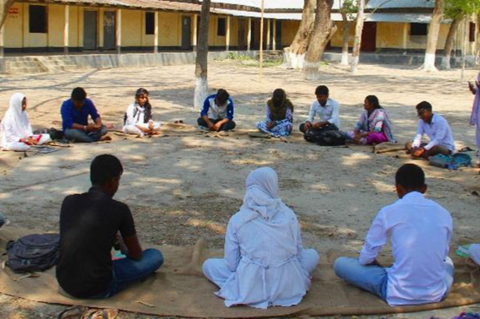
- Building mass awareness and implementing educational campaigns on DV and other HR abuses - For example, PHR has sought to raise awareness and inspire social change through courtyard meetings, ludu games, community radio, theatre for development, an HR champions programme, and community events and materials. PHR also maintains a website and social media presence including a Facebook page in order to disseminate information about the programme and relevant issues. With a focus on behaviour change, PHR has worked in 134 schools and 9 madrassas schools to build awareness of gender equality at a critical time when gender identities and respect for gender differences among boys and girls are being formed. This has included: awareness sessions and training with students, teachers, and school administrators; training of peer educators; and the creation of sexual harassment prevention committees. The schools programme started with formative research that was carried out in 10 schools in 2 project areas. In 2012, a pilot programme was carried out in the same 10 schools; the pilot has since expanded and reached 23,360 students to date in 2016. The programme found receptivity on the part of school administrators, teachers, students, and parents to gender-based violence (GBV) prevention programming. In addition to training opportunities, PHR has peer educators who conduct awareness-raising sessions, which include ludu games, quiz competitions, and cultural events. The School Management Committees (SMCs) and teachers have also taken the time to discuss causes of child marriage, dowry, and DV, as well as how sexual harassment is perpetrated inside and outside of school premises. Sexual harassment boxes have been established in many of the PHR schools as a way for young people to anonymously report incidents. PHR has been effective in getting the Ministry of Education to integrate its materials into revised school textbooks with content about DV prevention. Furthermore, starting in 2017, the national helpline number that individuals can call to receive counseling, make reports, and get referrals on GBV issues will be published on the back page of school textbooks from classes 4 to 8. This initiative is another opportunity to raise awareness so students will know where to go if they need support and assistance.
Gender, Rights, Youth.
According to PHR, throughout Bangladesh, poverty is endemic, with 31% of the population living on less than US$1.50 a day. There are approximately 28 million adolescents between the ages of 10 and 19 years old, of which 13.7 million are girls and 14.3 million are boys. The net enrollment ratio in secondary schools is 45% for boys and 50% for girls. Furthermore, 47% of boys and 56% of girls drop out of secondary school. Although there is a government stipend that is supposed to serve as an incentive for girls to stay in school - the equivalent to 3 days of food for a family - the number of girls completing secondary school is 6% less than boys. In Bangladesh, 66% of girls marry before the age of 18, the third highest rate in the world. Parents often encourage girls to stay at home due to safety concerns, as sexual harassment is widely experienced on the way to school, with the number of reported cases increasing.
Plan International in partnership with the Bangladesh National Women Lawyers' Association and 11 local NGOs, with support from USAID.
Plan USA website and PHR website, both accessed on January 12 2017.
- Log in to post comments