










































Production of Vaccination Videos in India: Learnings from a Science-art Partnership
Affiliation
Bloomberg School of Public Health, Johns Hopkins University (Burleson, Bhaktaram, Jamison, Barnett, Rimal); Department of Biomedical Laboratory Sciences (Ganjoo); Swasthya Plus Network (S. Rath); OdishaLIVE (N. Rath); Loyola University of Maryland (Alperstein, Pascual‑Ferra, Kluegel); D‑Cor (Development Corner) Consulting (Mohanty, Parida); Wellflix Inc (Orton)
Date
Summary
"While most vaccination messages broadcast by the Indian government are structured as public service announcements, we utilized an approach to creating videos that would be different from the din of government-produced announcements."
This paper is the result of a cross-cultural collaboration between a United States (US)-based research team with scientific expertise in behaviour change and health communication, on the one hand, and India-based filmmakers with narrative expertise in scriptwriting, on the other hand, who together created videos promoting the second dose of COVID-19 vaccines in India.
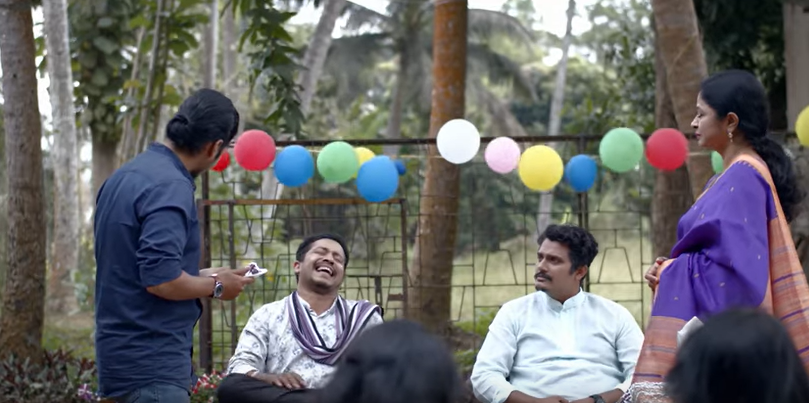
The experiment investigated whether videos could change people's attitudes, beliefs, and intentions to receive COVID-19 vaccines. The team manipulated three variables: type of appeal (collectivistic or individualistic), message tone (humourous or serious), and the gender of the vaccine promoter (male or female). The resulting experiment, which adopted a 2 × 2 × 2 between-subjects design, produced 8 videos (one example is below) with similar scripts, camera angles, and post-production features, except for the experimental manipulations. Led a professional production team in Bhubaneshwar, India, alongside the US-based researchers, the filmmaking process entailed:
The paper discusses some of the challenges associated with the process, highlighting the notoriously subjective element of humour. Through a rigorous process of pre-testing and experimental design, the team was able to demonstrate that viewers distinguished between the funny and serious videos, without having to push the humour into farce. "This success was only possible through partnership."
Lessons learned include:
This paper is the result of a cross-cultural collaboration between a United States (US)-based research team with scientific expertise in behaviour change and health communication, on the one hand, and India-based filmmakers with narrative expertise in scriptwriting, on the other hand, who together created videos promoting the second dose of COVID-19 vaccines in India.
The experiment investigated whether videos could change people's attitudes, beliefs, and intentions to receive COVID-19 vaccines. The team manipulated three variables: type of appeal (collectivistic or individualistic), message tone (humourous or serious), and the gender of the vaccine promoter (male or female). The resulting experiment, which adopted a 2 × 2 × 2 between-subjects design, produced 8 videos (one example is below) with similar scripts, camera angles, and post-production features, except for the experimental manipulations. Led a professional production team in Bhubaneshwar, India, alongside the US-based researchers, the filmmaking process entailed:
- Conceptualising filmmaking and script writing through a scientific lens: The team adopted a narrative approach to create videos distinct from government-produced announcements. Borrowing ideas from entertainment education, they adopted a narrative approach for the videos meant to appeal to an 18- to 35-year-old population. The filmmakers depicted a common social event (a child's birthday celebration), where vaccination issues arose incidentally and not as the primary thrust of the communication. Embedded within the depiction of the birthday event were the various independent variable manipulations: Discussions about the risks of COVID-19 and the benefits of vaccination were framed in either individual or collectivistic language, the overall tone was either funny or serious, and either a male or a female protagonist advocated for vaccinations.
- Pilot-testing and finalising the script: The team convened a community advisory board (CAB) comprising two young parental couples, a doctor, a school principal, and an accredited social health activist (ASHA). The CAB reviewed 4 audio-recorded scripts: 2 humourous and 2 neutral, each featuring 1 individualistic and 1 collectivistic viewpoint. One significant feedback from the CAB centred around the need to strike a meaningful balance between the seriousness of the pandemic, which has resulted in significant numbers of deaths, and the study's need to inject humour as a message feature. The team incorporated the CAB's feedback into the scripts before filming.
- Video production and editing: The team sought to keep formal features constant across the videos. The filmmaking team, well-versed in the research needs and aims, subsequently reviewed the videos to ensure uniformity across non-manipulated content.
- Disseminating the videos through the Swasthya Plus Network Odia website, Facebook page (513,000 subscribers), YouTube channel (248,000 subscribers), and WhatsApp groups in February 2022.
The paper discusses some of the challenges associated with the process, highlighting the notoriously subjective element of humour. Through a rigorous process of pre-testing and experimental design, the team was able to demonstrate that viewers distinguished between the funny and serious videos, without having to push the humour into farce. "This success was only possible through partnership."
Lessons learned include:
- Researchers should discuss the objectives of the study, scientific theories informing the work, and justifications for study variables with the filmmakers in the partnership.
- Committing to a unified vision is essential for facilitating open and honest bidirectional communication and building trust between researchers and local partners. Written documentation of the evolving rationale and feedback surrounding the experiment are helpful to clarify, communicate, and coordinate.
- Clearly denoting research boundaries ensures that the scientific needs of the project will be met while simultaneously inviting space for the filmmakers' creativity, fostering a sense of ownership, and enhancing the final product.
Source
BMC Public Health 23, 736 (2023). https://doi.org/10.1186/s12889-023-15607-w. Image credit: YouTube snip from 1 of the 8 project videos
- Log in to post comments