










































Preventive Behaviours during the Pandemic: The Role of Collective Rituals, Emotional Synchrony, Social Norms and Moral Obligation
Universidad Complutense de Madrid
"In modern societies, there are normative and practical limits to repressive interventions, since these may clash with democratic rights...It is therefore crucial to identify the psychosocial mechanisms that may promote behavioural change and encourage compliance with socially-responsible behaviours in the contexts of collective threat, including the current and also future pandemics..."
One of the major challenges faced by any social group when exposed to a collective threat, such as a health emergency, is the development of a coordinated, cooperative response. It is neither sufficient nor feasible for the authorities to regulate citizens' preventative behaviour through sanctions and policing alone. Rather, what is required is a commitment by the population to abide by the new rules in order to ensure long-term behavioural change. Conducted during the COVID-19 pandemic in Spain, this two-part study investigated the impact of (i) participation in the ritual of collective applause for health workers and (ii) perceived social norms in fostering behavioural adherence to public health measures. It also examined the mediating role of perceived emotional synchrony and a sense of moral obligation.
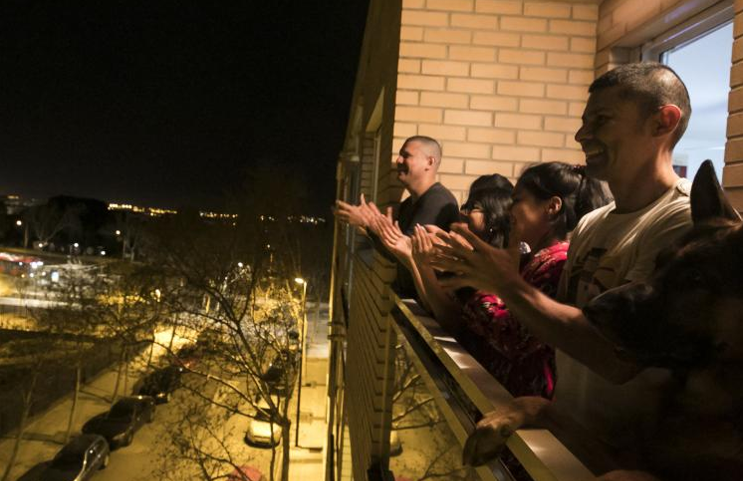
The first of two processes that may promote the adoption of preventive behaviours explored in this study is the phenomenon of participation in shared rituals. Starting in February 2020, collective applause became a community ritual in several countries around the world as a means of thanking health workers and those providing basic services, as well as a demonstration of cohesion and collective resistance. In Spain, the ritual was systematically performed for over 70 days until the end of lockdown in June 2020. There was large-scale adherence: Every evening, claps could be heard coming from virtually every household in Spain. Both the media and several opinion leaders explicitly linked the collective applause ritual to a firm commitment to follow the lockdown rules.
This study asks, in part, whether such collective rituals really have the power to influence behaviour and, if so, what psychosocial processes explain their impact. The researchers examine a few possible mediating variables:
- Emotional synchrony: Collective rituals often involve participants coordinating their actions by singing, dancing, or chanting together. There is evidence that during these synchronised experiences, participants' attention and emotions are aligned. In this sense, a ritual can become "a powerful personal experiences of those who actively take part in it (instead of just being aware of its performance by others) because of its shared nature and the amplifying effect of collective emotions."
- A sense of moral obligation: Preventive behaviours, such as those required in the pandemic (e.g., lockdowns), may imply a certain amount of effort or sacrifice and, at the same time, hamper the satisfaction of individual interests; a feeling of moral obligation may provide the necessary motivation to maintain strong the adherence to the needed behavioural adjustment.
Social influence is the second source of behaviour on which the research focuses. Previous research has shown that social norms and their perception are powerful predictors of a wide range of social behaviours. In the context of COVID-19, collective norms are manifested by the prevalence of social distancing or mask wearing in a social environment, with perceived social norms consisting in the belief that most others are engaging in these preventive actions (descriptive norms) and that most important people approve of an individual's preventive actions (injunctive norms). In this case, health behaviours do not merely embody the individual's choices; instead, they acquire collective significance and may be highly moralised. In this way, social factors become influential in shaping citizens' compliance with prevention guidelines.
The first study (general population, N = 528) was conducted in June 2020, just after the end of the lockdown. The results of the structural equations modelling (SEM) for Study 1 indicated that active participation in the collective applause ritual predicted greater perceived emotional synchrony and that synchrony predicted perceived social norms and feelings of moral obligation. Also, a significant path was observed from social norms to reported preventive behaviours and to moral obligation. Finally, a sense of moral obligation was confirmed to be a significant predictor of adherence to prevention guidelines.
The second study (university students, N = 292) was carried out in January 2021, after the clapping ritual was no longer performed and when no substantial progress had been achieved in eliminating the threat (which implied the maintenance of the restrictions and the continued need for preventive behaviours). The results of the SEM in Study 2 generally supported the hypothetical model developed in this research and indicated that the impact of participating in collective applause ritual was alive eight months after. Thus, the researchers found that emotional synchrony felt when the ritual was performed acted as significant predictor of individuals' current sense of moral obligation to keep practicing preventive behaviours and that active participation in collective applause continued to exert significant indirect effect on both moral obligation and current self-reported behaviour eight months later. At the same time, this study revealed that taking part in the ritual and the intensity of emotional synchrony were not significantly related to social norms. Although Study 2 was conducted with a different sample, this result seems to realistically reflect the dynamic nature of social perception (the impact of rituals is temporary for some phenomena, such as social norms).
The paper's discussion section addresses some variations in the results and also focuses on the implications of the findings for both theory and psychosocial intervention. For instance, this study "provides empirical evidence that the collective applause ritual, viewed as a community effort to combat adversity, triggered directly and indirectly affective and cognitive responses which served to foster self-reported preventive behaviours...Although past experience has shown that collective rituals are not always benign for others (Nazi rituals are perhaps the most salient example of this), the idea that initiating or promoting collective rituals may help encourage desired behaviours in times of social emergency is nevertheless a useful one."
The researchers note, however, that the collective applause ritual analysed in this study "arose in a fairly natural and powerful way....The question is, would a more 'artificial' introduction of a ritual designed by socio-political stakeholders have the same effect...? Or would the impact of the ritual be supressed if participation or the ritual itself were not valued by the community?....Another consideration concerns the effectiveness of a ritual when it becomes or is perceived to be a mere virtue-signalling, especially if the ritual is related to an issue which is highly moralized, as is the case of COVID-related responses....Further research is needed to answer these questions."
With regard to the role of social norms and sense of moral obligation as factors that promote compliance with desired behaviours, the results suggest that including information about social norms in persuasion campaigns may be more effective than, for example, using authoritarian messages or those based on fear or disgust. Social norms interventions communicating about collective change in behaviour among important others ("reference groups") have been shown to play a central role for shifting norms that strengthen behavioural adherence. Finally, framing the behavioural adherence to certain norms as an issue of moral obligation may increase people's motivation to continue engaging in these actions, despite the costs involved.
In conclusion: "The present study sought to advance existing knowledge of collective and social influence processes as potential triggers of individual prosocial reactions. Future research and intervention may design actions focused on enhancing corresponding social norms and also on organizing collective rituals related to a shared purpose (e.g. protecting the Earth)."
British Journal of Social Psychology 00, 1–19. https://doi.org/10.1111/bjso.12539; and email from Anna Zlobina to The Communication Initiative on April 8 2022. Image credit: Guillermo Mestre
- Log in to post comments