










































Participatory Budgeting Programme
Launched in April 2010, the Participatory Budgeting programme in South Kivu province, Democratic Republic of the Congo (DRC), is designed to facilitate citizens' knowledge and decision-making related to the budgets of their cities and communities. Through face-to-face meetings, supported by the use of cell phone SMSs (text messages) to disseminate information, the project is working to enable people to play a lead role in determining where public funds should be spent, as well as monitoring this spending. The programme in DRC is part of ongoing work of the World Bank globally to encourage participatory budgeting.
Participatory Budgeting (PB) can be broadly defined as the participation of citizens in the decision-making process of budget allocation and in the monitoring of public spending. In such a process, citizens are invited to periodic public assemblies that are held to deliberate on the allocation of public resources. In South Kivu, the first step in the process was a capacity-building workshop on PB, carried out with more than 50 key stakeholders from the provincial and local governments, civil society, local information technology companies, and academia.
In August 2010, the provincial government informed local governments of its decision to start transferring funds to the local level as mandated by law but widely not practiced. The condition was that they would start to consult their population and would develop a strategy for the implementation of PB, a process that local governments started following. In April 2011, the government institutionalised the process of PB through a Decree. For the year 2012, local governments must guide their budgetary implementation according to the principles of PB, meaning that they are to submit a part of their investment budget so that citizens can decide where those funds should go.
Advantages of the process for local governments include the reduction of tax evasion as citizens become more aware of the uses of the public funds they are contributing to through taxes. Another aspect of this strategy, according to the World Bank, is that politicians at the provincial level of government are concerned about increased legitimacy as they are non-elected officials, and, according to organisers, PB is a meaningful way to bring them closer to the population and to increase the legitimacy of their actions.
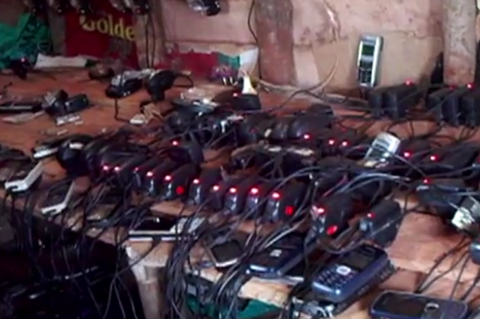
In DRC, PB implementation is being facilitated by the use of mobile phones, which are used to inform people about upcoming meetings, as well as about the outcome and decisions taken. Prior to the assemblies where citizens convene to decide on the budget allocation, hundreds of thousands of messages (SMS) are sent to citizens, inviting them to attend the meetings. This is designed to ensure high levels of popular mobilisation and foster the inclusiveness of the PB process. Mobile phones also allow the population to monitor how the projects voted on are doing and to answer surveys regarding their access to services like water. Also, citizens started mapping public services and budget allocation in order to track the implementation of the public works decided on through PB and locate existing services.
Governance, Democracy
Preliminary results of an external evaluation suggest that for the first time in the region, local governments are realising investments at the local level, benefiting the economically poorest sections of society. Moreover, the activities carried out have led to a dramatic reduction of tax evasion at the local level, with citizens more willing to pay taxes as they link government spending to improvement in the delivery of services. There has also been concrete projected delivery of public services, such as the repair of 54 classrooms and a bridge in Luhindja, the creation of a health centre and the repair of the sewage system in Bagira, the construction of toilets in local markets, as well as the creation of a water fountain in Ibanda.
ICT4Gov website , The Non-Profit Press website, ICT4Gov website , and TMobile Active website on December 2 2011.
- Log in to post comments