










































mHealth Pilot Study: Text Messaging Intervention to Promote HPV Vaccination
University of Minnesota (Lee, Koopmeiners, McHugh); New York University (Raveis); Rutgers University (Ahluwalia)
"mHealth interventions are able to overcome barriers to participation in traditional face-to-face interventions, such as inconvenience, time/place of delivery, and cost."
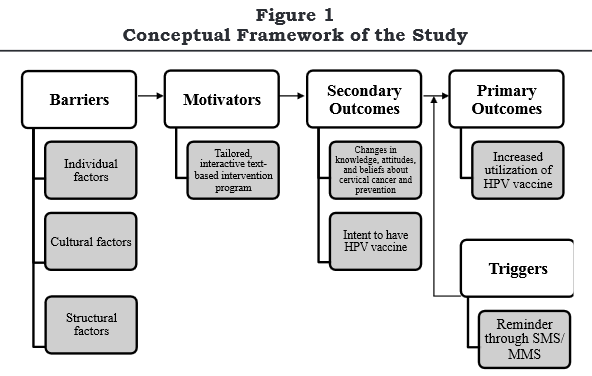
Data from the California Health Information Survey indicate that Asian-American immigrants to the United States (US) are the least knowledgeable across racial/ethnic groups about human papillomavirus (HPV) as the main cause of cervical cancer. Research on HPV vaccination promotion specifically designed to reach Asian-American women is almost nonexistent, but results from past limited efforts suggest that employing more culturally specific and personally tailored strategies could more persuasively encourage Asian-American women to use the HPV vaccine. Recognising the urgent need to increase HPV vaccination in this population, the current study tested a mobile health (or mHealth) intervention with young Korean-American women guided by the Fogg Behavior Model (FBM).
Specifically, the researchers created a 7-day text message HPV intervention using a pre-test/post-test, quasi-experimental research design for 30 Korean-American women aged 21 to 29 living in Minnesota. To do this, they used a community-based participatory research (CBPR) method that involved a series of focus groups with young Korean-American women and key informant interviews with Korean-American community leaders and health professionals. The content of the mScreening intervention (in English) was individually tailored for each participant and included: (i) basic health information about the cervix and cervical cancer, including statistical facts, such as cervical cancer incidence and mortality among Korean-American women compared to other racial/ethnic groups in the US; (ii) introduction of the HPV vaccine as a preventive means against cervical cancer; (iii) information about healthcare accessibility and availability of local clinics; (iv) cost of HPV vaccination and information about how to use health insurance; (v) stories that described Korean-American women overcoming cultural barriers to vaccination; and (vi) testimonials of cervical cancer survivors who had gone through HPV vaccination. Participants selected their preferred time for intervention delivery (20-30 minutes per day), and messages were delivered according to those individual preferences. The mScreening intervention also contained a high level of interaction, using quizzes and questions. The 14 questions and quizzes delivered during the 1-week intervention asked about participants' knowledge of cervical cancer mortality and screening rates. Messages were tailored by providing culturally-relevant testimonies from peers about cervical cancer diagnosis and experiences with HPV vaccination, as well as offering clinic information near each participant.
At one-week post-intervention, the researchers administered a post-test survey of the same items they had collected at baseline. Significant differences were observed for knowledge about HPV and HPV vaccination (p < .001), personal barriers to cervical cancer prevention and screening (p < .001), culturally-based attitudes toward cervical cancer prevention and screening (p = .005), and self-efficacy toward cervical cancer prevention and screening (p = .002). No significant difference was observed for modesty (p = .347). They observed a statistically significant increase in participants' intent to receive the HPV vaccine (mean difference=0.47, 95% CI: 0.21, 0.72; p < .001). At the 1-week post-test visit, 83.4% of participants reported being either "satisfied" or "very satisfied" with the intervention program. In addition, 100% of the participants indicated that their knowledge about HPV and HPV vaccination increased, and 93.3% of participants indicated that they wanted to receive the HPV vaccine. The percent of participants indicating intention to receive the HPV vaccine within one year increased (from 63.3% to 96.7%; p = .009). In addition, 16.7% of study participants reported receiving the first of the 3-shot series for the HPV vaccine one week after completing the intervention programme. An additional 13.3% of participants reported receiving the first dose of the HPV vaccine by the 3-month follow-up visit, indicating that 30.0% of participants received the HPV vaccine (95% confidence interval (CI): 9.9%, 42.3%) following the intervention.
"These findings suggest that mobile phone text messaging interventions can be effective tools for creating behavior change around cervical cancer prevention for previously hard-to-reach, underserved populations, such as young Korean-American women." The researchers argue that more research should be done to assess the potential for culturally and personally tailored interventions utilising this technology, which is ubiqitous in the US and other countries, to promote preventive health care among minority, at-risk populations. "[T]he methods and intervention delivery used in this study could easily be adapted to other ethnic groups, expanded to meet the needs of such underserved minority groups as Latina-, Hmong-, Vietnamese-, and African-American women. These groups encounter similar barriers to cervical cancer prevention and limited HPV vaccine uptake."
- Log in to post comments