










































Messages that Increase COVID-19 Vaccine Acceptance: Evidence from Online Experiments in Six Latin American Countries
Department of Political Science, Columbia University
"In comparison with the Global North, relatively little is yet known about whether and how Latin Americans can be encouraged to take vaccines against COVID-19."
In Latin America, the mortality and socioeconomic impacts of COVID-19 have been substantial. As of this writing, mass vaccination campaigns had begun only recently and were expected to continue into 2022. To evaluate which types of messages can overcome COVID-19 vaccine hesitancy, the researchers conducted an online experiment in six Latin American countries before vaccines had become generally available to citizens. The hope is that, beyond illuminating the informational and social bases for vaccine hesitancy, the study's assessment of how vaccine attitudes can be shaped by public messaging could inform efforts to increase vaccine willingness across Latin America and elsewhere in the Global South.
At the time of the survey, which was conducted between January 11 and January 29 2021, uncertainty about vaccines and public health misinformation were prevalent - and remain so. Emerging COVID-19 research predominantly in the Global North has suggested that vaccine willingness is responsive to both expert information and misinformation. In addition, theories of collective action emphasise that information about the (expected) behaviour of others could influence individual willingness to vaccinate, as could incentives relating to social approval, altruism, and economic recovery.
For the single-wave between-subjects study, the researchers recruited around 2,000 adults from large online panels maintained by Netquest in each of Argentina, Brazil, Chile, Colombia, México, and Perú. The researchers first elicited respondents' willingness to accept a vaccine once available to them and how soon they would take it. Only 59% of the sample agreed or strongly agreed they would take a vaccine once it were available to them, while the average respondent would wait 4.3 months before getting vaccinated. The hesitancy varied across the six countries.
To focus attention on hesitant individuals, the researchers screened out respondents who agreed or strongly agreed they would take a vaccine once available to them and would take it within two months of becoming eligible. The survey proceeded with around 1,200 vaccine-hesitant individuals in each country. The primary concerns of these respondents concerned: the vaccines' potential side effects (59%), the speed with which the vaccines were developed (42%), mistrust in government (33%), and skepticism of the vaccines' effectiveness (21%).
Next, the researchers experimentally assessed messages designed to counteract informational deficiencies and collective action problems that may drive hesitancy:
- The vaccine information treatments provided basic facts about COVID-19 vaccines, conveying: that approval of COVID-19 vaccines was based on rigorous medical trials; that these trials show the vaccines are safe and effective at preventing mild and severe forms of COVID-19; and that the side effects are generally minor (and the vaccines cannot give you COVID-19). The researchers supplemented the basic information treatment in two ways designed to capture features of citizen behaviour emphasised by social scientific theories: the roles of information credibility (i.e., informing respondents that United States President Joseph Biden had already been vaccinated) and collective action dynamics (e.g., varying whether respondents were informed that 60%, 70%, or 80% of the population would need to be vaccinated to achieve herd immunity, and reporting the share of the population willing to be vaccinated in the respondent's country).
- Motivational treatment conditions included: a social approval message (that by vaccinating, individuals can show others they care about their community, and may then gain respect and approval), an altruistic message (that vaccinating can evoke the satisfaction individuals receive from helping others), and an economic message (that vaccinating helps stop the spread of COVID-19, which is required to help people return to work).
The results show that:
- Basic vaccine information increases vaccine willingness: The receipt of any information about vaccines significantly increased vaccine acceptance among the hesitant in Latin America, with 7.7% of the hesitant persuaded by the messaging to become willing to take a vaccine by the end of the survey. This information also reduced the average time that a respondent would wait to vaccinate by 0.41 months and increased the probability that respondents would encourage others to get vaccinated. These effects appear to be driven by reducing concern that the vaccines will be ineffective, were developed too fast, would give people COVID-19, and would produce serious side effects. The treatment was roughly twice as effective among women, which suggests that mass campaigns emphasising basic vaccine information may be more effectively directed at women. Neither informing respondents about the levels of vaccination required to reach herd immunity or current vaccination intentions nor informing respondents that President Biden was vaccinated systematically produced additional effects on vaccine willingness on average.
- Vaccine willingness is not shaped by free riding, social learning, or social conformity: Being informed that current level of willingness is above (below) prior expectations did not decrease (increase) an individual's vaccine acceptance, as free riding would predict. Similarly, being informed that willingness is above (below) expectations did not increase (decrease) an individual's vaccine acceptance, as social learning or a desire to conform with the behaviour of others in the population would predict.
- Expecting a vaccination campaign to achieve herd immunity increases vaccine willingness: Being informed that the currently expected national willingness rate exceeds the expert herd immunity requirement increased vaccine willingness by 0.079 probability points - meaning that expecting to be part of a successful vaccination effort increased vaccine acceptance by more than receiving basic vaccine information. This finding could reflect intrinsic motivations to be part of a "winning team" or, as the next set of findings suggests, social incentives to be seen to be part of such a successful collective effort.
- Social approval increases vaccine willingness: Comparing the social approval, altruistic, and economic recovery motivational messages, emphasising the respect individuals may receive in their community by getting vaccinated translates into persuading 7.9% of hesitant respondents - a level comparable to exposure to basic vaccine information. The 0.25 month reduction in how long respondents would wait to get vaccinated is a little lower than for basic vaccine information, but non-trivial in magnitude when extrapolated to a national level. Priming the social incentives to get vaccinated also caused individuals to become more likely to encourage others to get vaccinated.
In terms of communication strategies, some implications of the findings include:
- Saturating public discourse or microtargeting more hesitant demographic groups with information about safety and efficacy may then increase uptake in the population both by directly persuading individuals but also through social amplification mechanisms - given the apparent desire for social approval and the penchant to encourage others to vaccinate.
- It also remains possible that observing domestic figures - such as politicians or local healthcare providers, who had not yet generally been vaccinated when the study was fielded - could more effectively signal the credibility of basic vaccine information than foreign leaders like President Biden.
- Policymakers could increase vaccine uptake by making vaccine uptake observable such as through "I got vaccinated" stickers or wristbands, the use of vaccine passports, or ways of sharing vaccination status on social media. In addition, policymakers should make aggregate uptake rates visible - whether in the news, through official briefings, or more direct messaging (in person or through ads) - as vaccination levels approach herd immunity. Upbeat communication might be enhanced by emphasising winning together as a "team", perhaps by including groups that inspire camaraderie like sports teams in campaign programming.
The researchers conclude: "By showing that hesitancy reflects informational and coordination problems, our results suggest that intended behaviors are malleable and effective public messaging could significantly increase both vaccine uptake and the speed of uptake among the hesitant. Our online experiment shows that providing basic information about vaccines, encouraging individuals to believe that they could be part of a successful collective effort, and harnessing the reputational benefits of vaccination that people expect to receive can all reduce vaccine hesitancy....Although careful design is needed..., campaigns to redress informational deficiencies and harness social dynamics could persuade hesitant individuals to vaccinate and thereby help countries more quickly vaccinate significant shares of their populations."
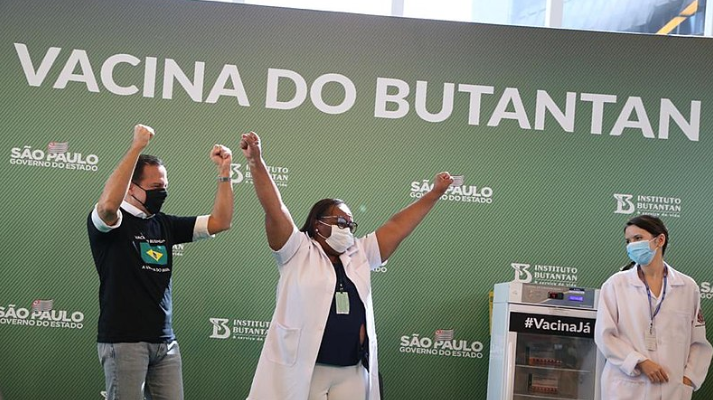
PLoS ONE 16(10):e0259059. https://doi.org/10.1371/journal.pone.0259059. Image credit: Governo do Estado de São Paulo via Wikimedia (licensed under the Creative Commons Attribution 2.0 Generic license)
- Log in to post comments