










































Menstrupedia
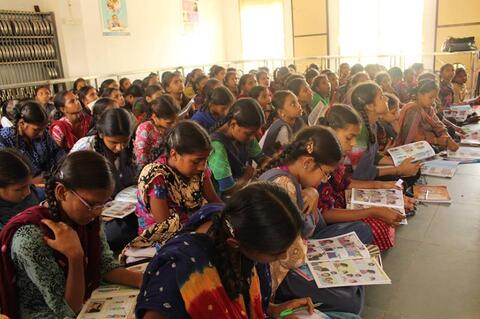
"Conversations with parents and students revealed that the subject is swept under the carpet due to of lack of educational material. As a result, these myths, instead of being busted, are passed on to future generations." - Aditi Gupta, co-founder of Menstrupedia
Launched in 2012, Menstrupedia is an effort to open up the conversation on menstruation in India, where discussion of the topic is taboo. The organisation aims to promote awareness and act as a guide to periods for girls and women, using a comic book, a website, videos, and social media.
Drawing on the entertainment-education approach, the Menstrupedia comic book is meant to be a colourful, fun, and accessible guide to menstruation designed for girls aged nine and above. Having been reviewed by medical professionals to ensure its accuracy, it shows the female anatomy properly to debunk misperceptions about the process. The comic follows the journey of three young girls (Pinky, Jia, and Meera) and their experiences with periods. All the characters and storylines are adapted from real-life experiences that Menstrupedia co-founder Aditi Gupta collected during the research process to create the book. Each character represents a stage of adolescence: girls who haven't started their period yet and want to learn more about them; girls who have just started their period and want advice on how to prepare for them; and girls who have had periods for some time and might be curious about the myths surrounding them. "Myth breaking and period positivity are our strategies, and we wanted to make it a comic book because it's inclusive," Gupta says. "We wanted to do it in a positive and matter-of-fact way to debunk misconceptions, and so that parents and teachers would be comfortable using it. Girls can read it and say, 'Oh, this happened to me too!'" Gupta insists that involving boys early on may help the issue, as she believes that it is only then will they be sensitive.
Heavily subsidised for schools and non-governmental organisations (NGOs), 6,000 schools use Menstrupedia comics (translated into 16 languages, 12 of which are regional). The team is working with 5 different countries - China, Hungary, Bangladesh, Nepal, and Uruguay - where they are locally printed and distributed, and the books are also shipped to 20 countries. It is available for order on the Menstrupedia website. Also there offered for free downloads is "Hello Periods", an educational video that teachers can use to conduct a menstrual awareness workshop. For other Menstrupedia videos and content, visit their YouTube channel and/or Facebook page.
Girls, Health
Especially in India and across South Asia, the reluctance to speak about periods is widespread, resulting in low education and awareness - particularly among the demographic of adolescent girls, of whom India has some 120 million. A study for Menstrual Hygiene Day reported that 1 out of 3 schoolgirls across South Asia was not aware of periods before experiencing one for the first time, and only 2.5% of the same group knew that menstrual blood came from the uterus. When girls in India get their periods, they are considered impure for those 7 days, which can instill a sense of shame.
An estimated 1 in 5 girls in India drops out of school because of menstruation and a lack of toilets. Prime Minister Narendra Modi sought to address these problems in his introduction to the Clean India campaign in 2014, where he advocated for all schools in the country to have separate toilets for girls. Other regional start-ups have sprung into action, such as the social enterprise Binti Period, which creates community projects enabling women to produce sanitary towels sustainably. The stigma was addressed in 2015 by Whisper, a sanitary towel manufacturer, in an award-winning campaign called Touch the Pickle. A key social convention in India prevents girls who are menstruating from touching popular preserved foods, like pickles, because of the belief that the food will spoil. Whisper's advert depicted girls and women actively breaking that taboo. Whisper approached the Menstrupedia founder about buying advertising space in the Menstrupedia comic and became a partner before the book was even created.
Aditi Gupta says: "The amount of international orders we get makes us realize the taboo is everywhere. Our plan is to build an educational infrastructure, not only for girls but for everybody, to talk about periods in a friendly, free way. I know it's going to take decades, but eventually, I want to raise a generation of girls who are period positive when they become mothers. When they raise their own girls, period taboos would just vanish from that generation - they wouldn't even know such a taboo existed."
"How an Indian Comic Book Is Teaching Girls About Their Periods", Time, by Suyin Haynes, December 12 2016, and Menstrupedia website - both accessed on January 26 2017; email from Aditi Gupta to The Communication Initiative on November 28 2019; and "Aditi Gupta, co-founder of Menstrupedia, on trumping taboos", by Nikshubha Garg, Femina, October 31 2019 - accessed on December 2 2019.
- Log in to post comments