










































Male Motivation Campaign for Family Planning
This BCC campaign was implemented in two phases. Phase I used advocacy interventions to build support among religious leaders for family planning. Phase II focused on married men; multimedia interventions were used to promote spousal communication about family planning in order to increase the use of available services. Secondary audiences included women of reproductive age and service providers. The Male Motivation Campaign was launched in three project regions and at the national level.
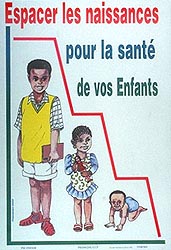
Activities and materials varied for men, women, and religious leaders. For men, the campaign included a radio soap opera entitled La Vie N'est Pas Compliquee, radio programmes in local language, radio spots, an entertainment education cassette using humour in its messages, traditional music contests, community mobilisation events and billboards, posters, brochures, and promotional materials. The tag line on 9,000 posters, half produced in French, half in Malinke, featured the quote "I talk to my wife about family planning. How about you?" Health centres held contests where local artists performed songs conveying family planning messages to about 22,500 people. Rural radio stations broadcast a compilation of winning songs.
Women were addressed through radio programmes, radio spots, and community mobilisation events, while religious leaders viewed a video in their local language showing religious leaders discussing family planning and other reproductive health (RH) issues against the background of Islamic texts. Other strategies included creation of an FP brochure and a poster, and the organisation of religious leaders' conferences for Islamic and Christian leaders.
Service providers used: a counselling poster; an infection prevention poster; a contraceptive sample case; flipcharts on FP, AIDS, childhood disintegrative disorder (CDD), and adolescents; brochures; and a wooden phallus. Health centres received a GATHER poster for improved counselling, an infection prevention poster in French and English, and contraceptive sample cases.
Community mobilisation activities were staged at at 30 rural health centres (2 per prefecture). The events included dances, presentation of the religious leaders' video, question-and-answer sessions, and distribution of campaign materials. Publicity materials produced to support launches and community mobilisation events featured the campaign logo and slogan and included t-shirts, plastic and cloth bags, hats, stickers, water pots, key chains, pens, and cloth wraps. This multi-media campaign was designed to reach as many people as possible with repeated messages on FP.
Health, Population, Family Planning, Gender.
The campaign was built on the P Process: Analysis, strategic design, development/pretesting/production, management/implementation/monitoring, and impact evaluation that influences future changes in strategic design. The analysis portion of the campaign revealed a strong pronatalist attitude among married couples, poor knowledge about FP, little use of contraception, limited spousal communication about FP, and that men were the predominant decision-makers regarding contraceptive use. The goal of the programme was to educate on modern FP methods (particularly men), increase spousal communication with regards to FP, increase favourable attitudes to small family size, and increase contraceptive use. In a population of 8 million, there is a high illiteracy rate: 66% male and 83% female. Preceding and following the campaign period of October 1999 - May 2000, baseline and follow-up surveys were conducted to determine the impact of the programme.
Management Sciences for Health (MSH), Johns Hopkins Bloomberg School of Public Health Center for Communication Programs (JHUCCP), Guinea Ministry of Health, Oulemas de Guinée, Kine-Sud-Video, and Rural Radio/Nzerekore.
Funded by the United States Agency for International Development (USAID).
The Impact of a Male Motivation Campaign on FP Attitudes and Practices in Guinea, prepared by Michael Blake and Stella Babalola, Johns Hopkins University Center for Communications Programs, Baltimore, MD, and provided to The Communication Initiative; and Johns Hopkins Bloomberg School of Public Health Center for Communications Programs website accessed on May 15 2009.
- Log in to post comments