










































Kiting High: New Normal for Children
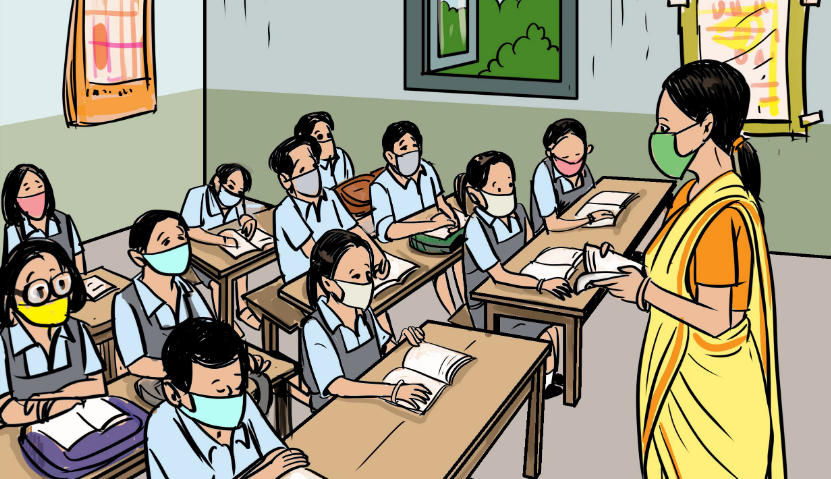
"[T]his is our attempt to share with you some facts about facing and beating COVID-19 in the form of a story. It is our earnest hope that you all will overcome the pandemic by following the New Normal. Let us now take up the story of Bolin, Rashmi and others as they adjust to a changed world..."
In response to the COVID-19 pandemic, schools across India, as in many parts of the world, were closed in mid-March 2020 - affecting millions of children. A May 2021 rapid assessment conducted by the United Nations Children's Fund (UNICEF) in six states of India, including Assam, indicated that, beyond learning shortfalls, school closures have affected students' mental health. As schools reopen in India, this storybook is designed to help children understand COVID-19 and to cope with it.
In developing the resource, UNICEF Assam decided to partner with Dr. Anamika Ray Memorial Trust (ARMT), as ARMT has a young and diverse team of journalists, academicians, and illustrators. The remit was that the information in the storybook must be simple (without any technical jargon) so that it is easy to understand, while also stimulating and intriguing for young readers. Given that illustrations are vital to children's books, great care was taken to ensure that visuals communicate the right messaging and include different contexts (both urban and rural).
In terms of content, the book opens with two cousins - Bolin, from a village, and Rashmi, from the city - explaining to their grandpa how remote schooling (online-, TV-, and radio-based) worked during the pandemic. Bolin explains to Rashmi: "Here we hardly have any power to charge phones, let alone reliable networks!" The book highlights importance of COVID-19 appropriate behaviours to contain the spread of COVID-19 and to facilitate the safe reopening of schools. Since students were exposed to the internet throughout the pandemic, online safety - e.g., luring of children, fake news, identity theft - is a topic touched upon in the storybook. COVID-19-related stigma is also discussed, as is the possibility of future vaccination, including for children, as a prevention strategy.
In creating the storybook, AMRT and UNICEF adopted the "community learning programme" model developed by the Commonwealth of Learning. A message matrix is developed with four parameters: bad behaviours - consequences; good behaviours - benefits. The model is based on formative research: Interviews and focus group discussions (FGDs) were conducted with 40 children in several rural, urban, and remote locations. During this research, they learned that children knew more about COVID-19 than young people, and they were maintaining excellent hygiene. Based on this, they developed the story and its two child protagonists; parents, grandparents, health workers, and teachers are also included in the story.
The book is part of a risk communication and community engagement (RCCE) effort to raise awareness among children and the community, whether urban or rural. Collaboration with the state education programme Samagra Siksha has ensured wide dissemination to schools and teachers across the state; a one-day virtual orientation was conducted for the district officials of Samagra Siksha on using the book. It has been distributed to district officials through WhatsApp for further dissemination to over 4,000 secondary schools in the state. In addition, the book has been disseminated in over 100 tea gardens in Assam through partner organisations. Over 300 teachers of the tea garden schools, 270 community members, and 5,500 adolescents of tea gardens have been reached through this initiative. The organisers have received a request from the tea gardens for a translation in Sadri, the local language.
English, Assamese
27
Behaviour Change Matters, Vol. 8 (November 8 2021), UNICEF C4D India. Image credit: Naba Pratim Das
- Log in to post comments