










































Invisible Children

In the spring of 2003, the young filmmakers behind Invisible Children traveled to Africa and then created the documentary "Invisible Children: Rough Cut," a film that exposes the realities of northern Uganda's night commuters and child soldiers. In addition to the full-length (55-minute) version, a shorter 35-minute version has been developed. The DVD also includes deleted scenes, extras, filmmaker commentary, update on the war, and trailers from Invisible Children. A small booklet is packaged within each DVD box that tells the story of Invisible Children and how people can get involved.
The Invisible Children website provides information about how to access the film, as well as a variety of multimedia materials and ways to learn from and connect with others taking action. There, one is encouraged to "Set up an Invisible Children club. Act as the leader, overseer, motivator, lighthouse. Develop your vision of how to help these children and people will follow your guiding light. Lead them well....Use your time and talent to find creative ways to raise awareness." One can book "roadies" who will visit and screen the film at a school or any community gathering spot, or one can find out how to host a screening on one's own. Organisers encourage people to act on what they have seen in the flim by talking to others, writing letters to those in positions of power, creating artwork ("Stir. Move. Draw. Paint. Trace. Photograph. Lithograph. Sculpt. If the film moves you, show us how. Get your art class or your artistic friends or do it alone. Hang, show, or even sell your work. Take action by having an auction. Express yourself.") People are encouraged to take pictures and videos capturing Invisible-Children-inspired events, and then to post them on the website. Another idea provided here is to organise tournaments, races, dance marathons, benefit concerts, etc. to create awareness and raise funds. Or, one can "[r]aise awareness, financial aid, and beautify the world by creating hats, pins, ties, bags, and t-shirts....Exchange fashion for compassion." Community action is encouraged: "Go to local restaurants or bars and have them do a benefit where on one day, a certain percentage of the proceeds go to the kids in northern Uganda. Empower your local businesses to effect change and give back to others."
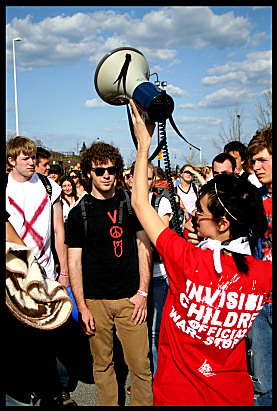
As implied by these action ideas, what started as a movie has grown into a movement - in the form of periodic "big events" drawing together United States youth using their voice for change - mobilised by the Ugandan children's stories. Created to be an experiential event, April 2007's Displace Me used storytelling to personalise a tragedy largely unknown to the international community, creatively bringing awareness to the emergency situation of the displaced. In this nationwide event, more than 68,000 individuals gathered in 15 cities across the United States to experience for one night what it was like to be displaced (like those in northern Uganda). The voices of the participants were heard and actions were seen by national media, members of Congress, and the White House. This event was preceded by the Global Night Commute on April 28 2006, when more than 80,000 people in 126 cities across the United States walked for miles to their city centres and slept in the streets to make a visual call to end night commuting in northern Uganda.
More recently, on April 25 2009, Invisible Children hosted The Rescue, a rally in 100 cities across 10 countries, to bring attention to the plight of the children abducted and forced to fight as soldiers in Central East Africa. Thousands of participants symbolically abducted themselves, leaving their homes at 3 pm and meeting at a designated "abduction site". They dropped off a family photo at the abduction site, symbolically leaving them behind, then marched as a group, on foot, to the event location called the "LRA Camp" while carrying any supplies needed for the night on their backs. This march ranged from 1-3 miles (2-5km), depending on the city, and was done in a single-file line with all participants holding onto a rope. Invisible Children arranged for photographers and videographers to film this symbolic march. Upon arrival at the LRA Camp, they waited to be "rescued" - meaning either that an approved media outlet from a participant's area showed up and covered the event, or one pre-determined cultural or political leader, the "rescuer", arrived. While at the LRA camp, participants wrote letters to political representatives, created art/photo projects, and sought out media attention in an effort to petition governments to develop a strategy and support existing efforts to rescue child soldiers. The follow-up advocacy tour culminated in a lobbying event (June 22-23 2009) called "How It Ends", a platform and path to end the conflict in northern Uganda. Concerned citizens (and some high-profile celebrities and politicians) descended upon Washington, DC, to take part in lobbying trainings, a kick-off rally, hundreds of meetings taking place between Members of Congress and their constituents. The goal was to encourage the passing of a Bill designed to address the crisis in Uganda.
Invisible Children has also galvanised on the voices of musicians - from major rockstars to folk singers in coffee shops - to bring a new kind of awareness and support for northern Uganda. "Check out our current and upcoming tours to see when the IC Band Tour is coming through your area."
Invisible Children's Schools for Schools programme emerged out of the overarching goal to help children in northern Uganda receive a quality education. "After Uganda's Millennium Goal of Universal Primary Education was introduced, many organizations began to focus their efforts on primary schools. The lack of attention given to post-primary schools has made the pursuit of higher education difficult for students and teachers." By holistically rebuilding 10 of the most promising secondary schools in the region, Invisible Children is pursuing an approach to international aid that involves working "from the ground up, creating projects that would encourage community involvement and offer long-term change in the region's education." Organisers brought together a specific group to monitor the project from beginning to end, and to select 10 secondary schools. "As we wanted local ideas and community participation to lead efforts toward effective change, we created development committees for each of the 10 schools....In the beginning, these groups established the list of project priorities for each school within five target areas: water and sanitation, books and supplies, teacher incentives, construction of facilities, and technology." As of this writing, Schools for Schools is in its third round.
The Teacher Exchange - an initiative under the Schools for Schools umbrella - allows international educators to volunteer in northern Ugandan through a six-week summer programme. Educators engage in team teaching, information sharing, and skill-building conferences - all with the purpose of generating collaboration among teachers from around the world. As the Schools for Schools Program works to address problems with space and supplies, the Teacher Exchange provides an opportunity to boost the morale and build the capacity of both the international and Ugandan participants.
Invisible Children's Visible Child Scholarship Program (VCSP) focuses on increased access to post-primary education, improved learning environments, and mentoring from local leaders. The programme is managed and operated entirely by Ugandan nationals. Once accepted into the programme, each student is assigned a mentor - an employed community leader whose purpose is to build a personal relationship with the student and provide professional follow-up for each child. Through these relationships, VCSP mentors ensure academic accountability, encourage scholastic success, foster leadership skills, and provide parental and career-oriented guidance. VCSP mentors receive a variety of training prior to beginning work including psychosocial support, child protection, and trauma counselling. In addition to scholarships and mentoring, VCSP holds community sensitisation seminars that educate school administrators, parents and guardians, and the community about the programme and the need to support students throughout their education. These sensitisation programmes take place through planned community meetings and radio programmes.
Invisible Children's Bracelet Campaign (ICBC) is designed to create jobs for those in Uganda's internally displaced person (IDP) camps while educating and inspiring those who purchase a handmade bracelet. Invisible Children staff work together with community leaders to identify the most vulnerable people in a chosen camp, assessing their personal condition and history, and their family and home situation. Those chosen are trained in bracelet making and supplied weekly with the necessary materials. They create bracelets from reed and recycled wire, and then package them with a short film that tells the story of a child affected by the war. "Our goal isn't to simply offer a product, but a new perspective." ICBC is connected to Invisible Children's Savings and Investment Training Initiative (SITI) curriculum. Through weekly sessions held by a professional trainer, bracelet makers are taught and encouraged to create regular budgets and savings plans, and to invest their savings in sustainable income-generating activities. The programme encourages beneficiaries to start their own small business with the money set aside in their savings accounts.
Children, Rights, Conflict, Education, Economic Development, Development Assistance.
According to Invisible Children: "For 23 years, the government of Uganda and a rebel group called the Lords Resistance Army [LRA], led by a man named Joseph Kony, has engaged in Africa's longest war. In recent years, peace was seemingly within reach, largely due to the Juba Peace Talks that began in July 2006. However, despite a ceasefire signed between the LRA and Ugandan government, efforts toward peace through the Juba Peace Talks were stalled on several occasions by Kony's refusal to sign the final peace agreement....Joseph Kony is the world's first individual indicted by the International Criminal Court [ICC] for crimes against humanity. Since September 2008, hostility in the Orientale province in DR Congo and Western Equatoria in South Sudan has reached a feverish pitch. In apparent desperation and a renewed will to spread terror to DR Congo, the LRA murdered over six hundred and abducted more than one hundred and sixty children to fight amongst its ranks. More than 104,000 Congolese have been displaced since Christmas in attempts to escape the LRA forces....Invisible Children...now believes an international effort to apprehend Kony and rescue his child soldiers is the most viable way to end the most neglected humanitarian emergency in the world today."
- Log in to post comments