










































Fake News or Weak Science? Visibility and Characterization of Antivaccine Webpages Returned by Google in Different Languages and Countries
Brighton and Sussex Medical School (Arif, Mengozzi, Ghezzi); University of Brighton (Al-Jefri); Universidade Federal do Rio Grande do Sul (Bizzi); University of Sydney (Perano, Haq); Université libre de Bruxelles (Goldman, Neunez); Nanyang Technological University (Chua, Smith)
It has often been pointed out that antivaccine information available on the internet has a high prevalence, though the information on the prevalence of antivaccine websites is not consistent. The purpose of this study, therefore, is to analyse the information available to the public, 20 years on from the publication of the 1998 Lancet paper by Wakefield et al., despite subsequent retraction and evidence indicating no causal link between vaccinations and autism. The study does not analyse the impact of online information of vaccination rates or on public health views on vaccines but, rather, provides an approach to monitor vaccine-related information on the web.
Using localised versions of Google, the researchers searched the keywords "vaccines" and "autism" between June and September 2017 in English, French, Italian, Portuguese, Mandarin, and Arabic. They analysed 200 websites for each search engine result page (SERP) and also investigated the visibility, in terms of ranking, given by the search engine to webpages with a negative tone on vaccines.
The results indicate differences in the composition of the antivaccine websites across the world and the footprint left by Wakefield's Lancet paper. Measles, mumps, and rubella (MMR) was the most discussed vaccine, followed by influenza, viral hepatitis, diphtheria-tetanus-pertussis (DTP), poliomyelitis, Haemophilus influenza b and meningococci, and human papillomavirus (HPV). A common feature was the newsworthiness of the topic, with news outlets representing 25-50% of the SERP, followed by unaffiliated websites (blogs, social media) that represented 27-41% and included most of the vaccine-negative websites. Websites from governmental (e.g., national and international public health services, health ministries) or inter-governmental organisations (e.g., the World Health Organization, or WHO) were not highly represented, their frequency ranging from 1.3% (French) to 6.7% (English/Australia).
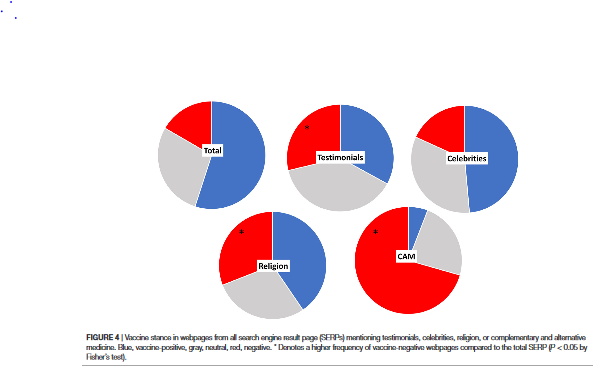
The researchers investigated whether websites contained a testimonial (personal story), mentioned a celebrity, or mentioned CAM. Testimonials were present in around 30% of websites returned by the Australian and French Google searches, but were much less frequent in Italian, Mandarin, Portuguese, and Arabic websites. Many webpages mentioned celebrities in the context of the link between vaccines and autism, with United States (US) President Donald Trump figuring most frequently. Few websites (1-5%) promoted complementary and alternative medicine (CAM), but 50-100% of these were also vaccine-negative - suggesting that CAM users are more exposed to vaccine-negative information. According to the researchers: "The strong association between vaccine-negative stance and CAM, as well as commercial websites often selling 'natural products,' confirms that cultural factors may reinforce an antivaccine stance by the association of vaccines with capitalism, big pharma, and profit.")
Overall, between 12% and 24% of websites had a negative stance on vaccines. As expected, there were no vaccine-negative websites among the government typology, and very few in the professional typology (average of all SERPs, 6.9%). Vaccine-negative views were also infrequent in news websites (averaging 5.2% all SERPs). The frequency of vaccine-negative websites was significantly higher in webpages reporting testimonials (P = 0.0002 by Fisher's test), CAM (P = 0.0001), or religion (P = 0.02) when compared to the total.
Despite retraction of his paper in 2010, Dr. Wakefield is still highly mentioned (a word count found his name recurring 462 times in the Google.com search, 551 in UK, 706 in Australia, 378 in French, 361 in Italian, 21 in Arabic, 195 in Portuguese, and 11 in Mandarin). (The reseachers stress that "the autism-MMR scare was not borne out of an obscure sect but from scientific papers published in respectable and authoritative journals, leading to a widespread concern even among health professionals.")
The researchers assessed whether there was a correlation between the percentage of vaccine-negative webpages and either the safety-related skepticism in the countries analysed or with the uptake of measles vaccination in 2016 (World Bank data). There was no statistically significant correlation using the Spearman-Rank test or the Pearson correlation coefficient (data and results of the statistical analysis are provided in the paper's supplementary material). "This lack of correlation might support the view that the impact of online information on vaccination acceptance may be exaggerated....If we also consider the fact that only a small percentage of parents refuse to vaccinate their children, one could conclude that we should not overestimate the impact of webpages with a vaccine-negative stance."
On the whole, the analysis highlights the need for monitoring the web for information impacting on vaccine uptake. However, there are marked differences in the visibility of websites with a negative stance on vaccines given by the ranking by Google across not only different languages but also in different localised searches in English. Public health authorities, particularly those acting internationally, will need to take these differences into account when designing websites aiming at promoting vaccinations.
The paper also advocates the dissemination of pro-vaccine information on the same websites typologies that perpetuate the "fake science" that vaccines cause autism. "Counteracting disinformation about vaccines by health authorities is part of the solution, but the loss of confidence in vaccines goes far beyond misinformation. Communities, social environment, educational level, are few examples of factors affecting the vaccine confidence. Education, as well as transparency, would be an important aspect to keep in mind when trying to increase vaccine confidence."
Frontiers in Immunology. 9:1215. doi: 10.3389/fimmu.2018.01215.
- Log in to post comments