










































Factors Affecting Complete and Timely Childhood Immunization Coverage in Sindh, Pakistan; A Secondary Analysis of Cross-Sectional Survey Data
Eulji University (Noh); University Medical Centre Groningen, University of Groningen (Noh, Stekelenburg); Jhpiego, Johns Hopkins University (Kim, Akram); Yonsei University (Yoo); National Institutes of Health Clinical Center (Park); Sungshin University (Cheon); College of Medicine and Catholic Institute for Healthcare Management, The Catholic University of Korea (Kwon); Medical Centre Leeuwarden (Stekelenburg)
"Having access to health information could play a pivotal role in improving mothers' awareness regarding full immunization."
Understanding factors that influence immunisation coverage could help healthcare providers and policymakers to develop and provide effective programmes to increase routine immunisation coverage rates in a country like Pakistan, where approximately 400,000 children under 5 years of age die every year from vaccine-preventable diseases. Several studies found that mother and child health (MCH) information sources such as antenatal care (ANC) visits and accessibility to mass media, as well as substantial health inequity according to socioeconomic status, affect immunisation coverage. The purpose of this study was to measure the basic timely childhood immunisation coverage and to identify determinants that influence childhood immunisation coverage in the Pakistani province of Sindh.
The researchers used survey data in 2013 and 2014 from the Maternal and Child Health (MCH) Program Indicator Survey. The outcome measure was full coverage of the basic immunisation schedule from the child's vaccination card. The association of receiving basic immunisation with demographic factors, socioeconomic status, MCH information sources, and perinatal care factors were tested by binary logistic regression.
Among 2,253 children, 1,156 (51.3%) received age-based full basic immunisation; the proportion steadily increased among older age groups. Among the determinants discussed: Higher education level in both father and mother showed higher proportion of full basic immunisation. Women who received MCH information from health professionals, relatives/friends, and media showed a higher proportion of full basic immunisation than those who did not. Women who only visited the ANC clinic 1-2 times showed the lowest proportion of full basic immunisation (40.9%).
To look at one finding in more depth, the source of MCH information had significant impact on the likelihood of full basic immunisation. If health professionals provided information about MCH, the likelihood of full basic immunisation increased (odds ratio (OR) 1.24; 95% confidence interval (CI), 1.02-1.52); however, relatives/friends (OR, 1.38; 95% CI, 1.12-1.71) and media (OR, 1.32; 95% CI, 1.08-1.61) as MCH information source did increase likelihood of full basic immunisation.
The researchers assert that family characteristics should be considered in determining strategies to improve immunisation rates. In this study, the number of living children in the household was associated with successfully completing the basic immunisation. More children mean more exposure to the knowledge about immunisation and more adherence to the schedule because of repeated learning curve and education effect. Parents' low educational level may influence their general health literacy and lessen their ability to properly understand the benefits of timely and complete immunisation and to have better knowledge of vaccine-preventable diseases.
These findings suggest that educational interventions designed to reach less-educated parents may have the potential to improve vaccination coverage in Pakistan, where the overall adult literacy rate was 54.9% between 2008 and 2012. A study was conducted to provide a simple educational intervention (easy to-understand pictorial cards, using very simple language, to convey 3 key messages) designed for low-literate populations in Pakistan. This intervention improved diphtheria, pertussis, and tetanus (DPT)-3/Hepatitis B vaccine completion rates by 39%. Another study in Malaysia also showed the effect of a short educational intervention (an animated movie and lecture using simple understandable language) on improving parents' knowledge of immunisation.
Studies have shown that contact with health facilities is a proxy for interactions with healthcare professionals, which provides an opportunity to receive information about immunisation. Increased contact with the healthcare facility for obtaining ANC would give mothers more opportunity to be informed about child healthcare, including the importance of full immunisation, and to be encouraged by healthcare staff to use healthcare services. The researchers contend that policymakers should assess the obstacles of receiving ANC in Pakistan based on mother's background (e.g., cultural norms/beliefs) and develop strategies to increase ANC check-ups (e.g., increase in number of health facilities/female healthcare professionals), which may ultimately result in an increase in the immunisation rate.
Also, previous studies reported that other persons, such as mothers-in-law, relatives, and friends, played a significant role as a health information source in Pakistan. They helped mothers' birth preparedness and health behaviours, which might lead to increase in full vaccination.
Likewise, access to radio, television, phones, and computers permits women to receive health-related information more easily. However, studies have also identified the risk that social media can contribute to dissemination of rumours, misconceptions, or inaccurate beliefs about vaccination that ultimately lead to higher degrees of vaccine hesitancy and lower immunisation rates. According to the researchers of the present study, further studies should verify the accuracy of information provided by radio, television, phones, and the internet and should develop appropriate television/online programmes to convey accurate information regarding immunisation in Pakistan.
In conclusion: "Mass immunization campaigns to stress the benefits of timely and complete immunization are needed, especially targeting parents in low educational and socioeconomic classes. The activities of mass media and healthcare professionals should be reinforced to improve women's awareness of timely and complete immunization and importance of health care utilization."
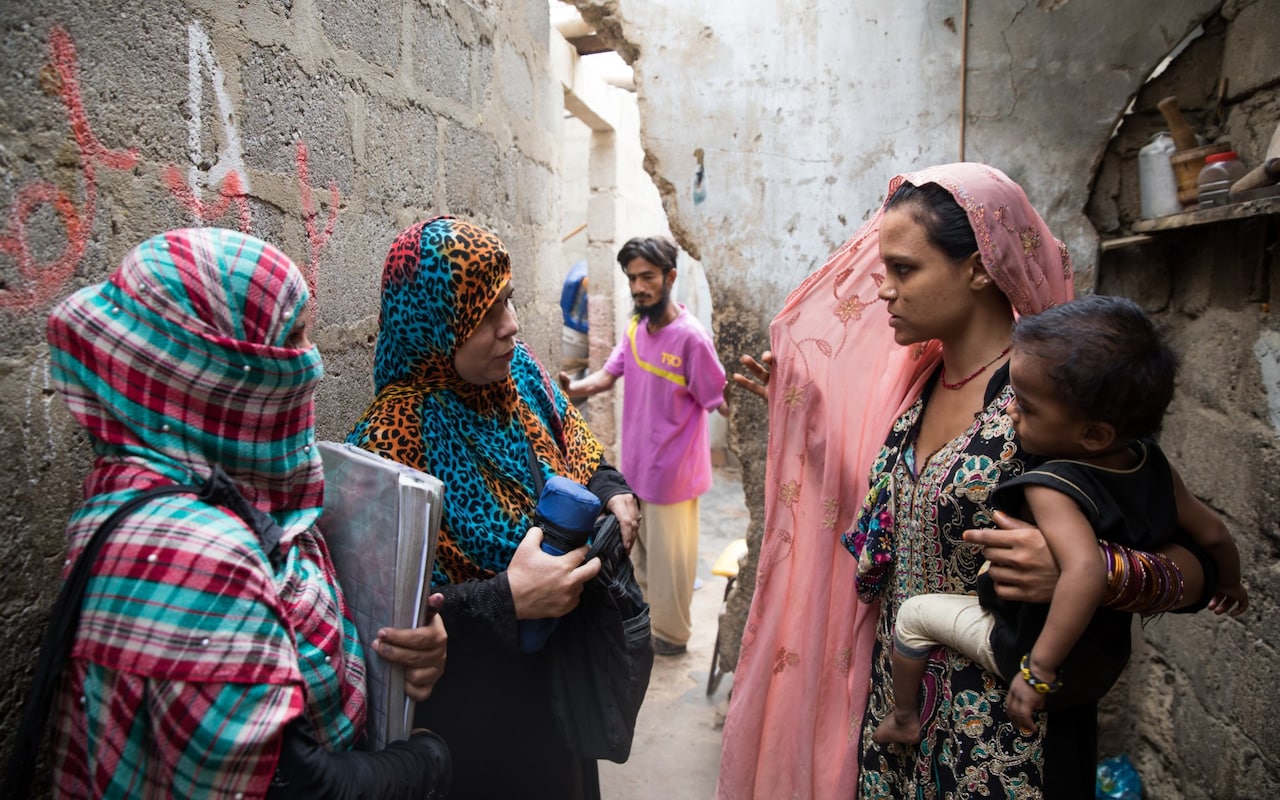
PLoS ONE 13(10): e0206766. https://doi.org/10.1371/journal.pone.0206766. Image credit: Insiya Syed
- Log in to post comments