










































Empowering Communities, Informing Policy: The Potential of Community Radio
femLINKPACIFIC
"Women had long recognised that...in order to play a key role in society and in their development, women needed to be informed on what was going on around them and also have a means to speak on what was happening and have their voices heard - which could only be possible through having their own media. It was this notion of empowerment which gave birth in 2000 to femLINKPACIFIC: Media Initiatives for Women..."
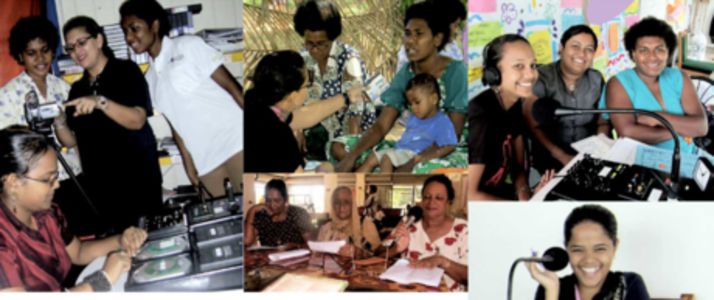
It is this history shaping the strategies and recommendations included in this 20-page handbook on community radio as a tool for enabling women to have a voice on a range of social, economic, and political issues that will help bring about sustainable development and peace. As detailed in the Preface, femLINKPACIFIC was inspired by the work of activists whom it terms "Peacewomen". They developed and enabled the unanimous adoption of United Nations (UN) Security Council resolution 1325, and they sparked the recognition that women's media have a role to play in advocating for women's participation in peace-building and conflict transformation. Thus inspired, in 2004, femLINKPACIFIC established a women's mobile community radio station, femTALK 89.2FM. This radio-station-in-a-suitcase has been taken out to rural and semi-urban women around Fiji, providing them with an opportunity to speak on issues concerning them while also allowing them to suggest how these issues could be resolved. The suitcase radio has also been used as a training tool to empower women to speak to each other and with their communities.
"femLINKPACIFIC believes that once people are able to share their opinions freely and safely, then only can we say that democracy is at work. This is what community radio is all about. It is about giving voice to the voiceless, being a communication channel for the marginalised and demonstrating the possibility of the democratisation of information and communication channels within societies. Most importantly, femTALK 89.2 FM has proved that community radio is able to involve women and to treat them not merely as a target audience, but as participating agents, a valuable source of information and as peace-builders for their community and country....Ultimately, the organisation also believes that through the model of operations it has developed since 2004, including the establishment of the Community Media Centre, they have a positive strategy which can assist to empower more women in target communities articulate their visions for equality, development and peace from local to national level and beyond, using appropriate information-communication technology."
The handbook next moves to articulate why women need their own radio. This section details the People's Communication for Development (PC4D) publication, released in March 2008. This report shares the results of research conducted between 2005 and 2007 by femLINKPACIFIC in partnership with ISIS-International Manila with support from the International Development Research Centre (IDRC). One finding was that, even "in this era of computers, the internet and the 'information super highway', the study found that oral communications such as story telling, popular theatre and face-to-face interaction were 'the most empowering way of sharing information between intermediary groups and the grassroots women'" - and radio was identified as the most accessible communications tool for facilitating this interaction among grassroots women in 4 of the countries studied: Fiji, PNG, India, and the Philippines. Radio was cited for its reach to rural areas, its linguistic flexibility, its interactivity ("talkbalk" sessions), its low cost, its ease of use, and the fact that neither electricity nor literacy is required.
Next, femLINKPACIFIC considers the meaning of community radio, noting that it is characterised by the active participation of the community in creating news, information, entertainment, and culturally relevant material with an emphasis on local issues and concerns. Importantly, community radio is more than just a medium for broadcasting information: "It is an opportunity to further democratise information and communication channels to enable Pacific communities to advocate for their issues, to tell their stories." For example, this medium enables women to lobby for their development needs. But, for this advocacy to be successful, femLINKPACIFIC stress that it needs to start with capacity-building and training for young women and rural women to make the connection with policy-makers through their local programme productions.
Based on femLINKPACIFIC's own experience, the authors outline a series of community radio principles. Key to these reflections is the notion of community radio as a process: "It is not simply about producing radio programmes to put on air; it is about developing your community by using radio." The functions of community radio are as follows:
- Create a diversity of voices and opinions on the air - femTALK 89.2 FM travels out to women and their communities, offering women a safe space to voice and exchange their viewpoints.
- Provide a diversity of programmes and content - Programmes such as the Women's Civil Society Hour, the Market Report, Look at My Abilities, and an interfaith segment, provide an opportunity for representatives from Fiji's broad civil society network to share news and information during the weekend broadcasts - either through pre-recorded or live segments. Interviews from the network of rural correspondents provide rural features for each broadcast, while international segments are downloaded from the internet. Monthly features produced by the Regional Media Centre of the Secretariat of the Pacific Community are also featured.
- Encourage open dialogue and democratic process.
- Encourage participation, sharing of information, and innovation - Since 2001, femLINKPACIFIC's "Not Just Sweet Talk" campaign has become a platform to document the experiences and stories of female candidates, while also being an avenue for local communities to address development priorities. "Pre-broadcast consultations staged with the local government authorities mean women can access local government officials, sometimes for the very first time."
- Give voice to the voiceless - Each broadcast on femTALK 89.2FM is an opportunity to promote the potential that exists within women leaders in local communities to identify critical development priorities as well as advise development programmes.
The next section, titled "So you would like to start your own community radio station" provides concrete tips and advice from femTALK 89.2FM. The first step involves staging a community radio consultation - communicating with and involving as many stakeholders as possible to present your ideas and to seek their partnership. After obtaining the the broadcast licence (details are provided), organisers should consider station programming: "When developing the programme format for femLINKPACIFIC, women and their communities were at the centre of the discussion....In 'mapping our women's network community', femLINKPACIFIC recognised that our best entry point was through the two national women's organisations....By working through the leaders...we were able to reach out and meet women who could participate in our community radio broadcasts....It is a very easy way to get people listening to your station - put them on air and strengthen the participatory approach of consultation....The most important level of community participation in programming is the production of recorded voices. It is the opportunity in which the entire community can be heard and eliminates constraints like closeness to the station, whether they have telephones and so on."
Following up on some details about equipment selection provided in the previous portion of the handbook, femLINKPACIFIC next describes the suitcase radio station concept. Field equipment kits have been developed for femLINKPACIFIC's rural correspondents, broadcast volunteers, and focal points. "Once again the decision to use analogue tape recorders resulted from the need for the equipment to be appropriate and accessible. Each tape recorder can be used by women with limited vision or limited technical skills...The radio station console is also accessible for persons with limited technical experience, and also for persons with visual impairments."
In the latter portions of the handbook, femLINKPACIFIC outlines its vision for a Pacific Islands Community Radio Network where women would have an equal role in the management of a network of community radio stations which link Pacific communities together. This network would enable community radio stations to
- serve as a critical bridge between communities;
- increase the recognition of the role of community radio in the strengthening of democratic processes and peace-building;
- ensure a gender-inclusive approach;
- enable development agencies to access community radio stations to share information about programmes;
- serve as a practical communication platform for the marginalised;
- connect with the development of an information-communication network for conflict prevention and the promotion of the human security framework;
- offer community-based poverty eradication solutions which will be channelled to policy makers in the capital city;
- mainstream content to a broader network of listeners; and
- contribute to the development of a cadre of Pacific island community radio broadcasters drawn from youth networks who will serve as the producers of local content.
femLINKPACIFIC urges that, as part of the proposed implementation plan, clear policy-related frameworks addressing regulatory content and community-based operations are set up. In addition, a policy for the operations of the Community Information Centres will be needed to ensure that these centres operate in an equitable manner. This policy would also ensure that participation in training programmes and the development and production of content is inclusive and reflects the diversities of these communities. Technical support details and a proposed implementation plan are also included here.
Email from Sharon Bhagwan Rolls to The Communication Initiative on November 4 2009.
- Log in to post comments