










































CALLING OUT: How Marginalized Indigenous Women Became Advocates for Digital Inclusion to Secure Sustainable Agricultural Livelihoods in their Community
Summary:
With global mobile phone penetration estimated around 70%, the majority of mobile phone users globally, are men, who tend to have the literacy, financing and efficacy to engage with digital information. For female smallholder farmers in North-West Nigeria, this means they're less likely to seek agricultural extension services, and have knowledge and access to special programs and fair markets, further reducing their earning potential compared to men. SDG target 5.B demands the use of ICT to enhance women's empowerment. Yet, when approached with the idea of buying into tech as a leveller in securing agricultural livelihoods, many women felt a lack of self-efficacy to own and operate a mobile phone on their own. ARDA with support from GenARDIS, aimed to discover how we could sustainably get a community of indigenous, tech-shy rural women smallholders to interact with technology, and the impact on their livelihoods if we granted a community women's listeners' club, a mobile phone to use during their weekly meetings. By endline, we went from only 8% mobile phone ownership to 98% of women in our pilot group owning their personal mobile phones. The women used the granted mobile phone to generate income that enabled them register as a cooperative that began to use ICT to demand for services or women in their community. This project showed women's motivation to use tech can grow if they see the benefits outweigh the difficulty and if they are allowed to determine how they will interact with ICT innovations.
Background/Objectives:
Although majorly active in agriculture, Gbagyi women of Northern Nigeria, are frequently marginalized in accessing limited available agricultural assistance programming. One major reason why is women's low access to information, with many women illiterate and most women at project baseline relying on husbands and churches for agricultural information. The Majelissar Mata Manoma (Women's Meeting Place) project aimed to build capacity of rural women smallholders to access information that would enhance their livelihoods, using technology. The project aimed to study the effects of digital inclusion on a marginalized groups' ability to secure sustainable livelihoods and sustainable community participation in development.
Description of Intervention and/or Methods/Design:
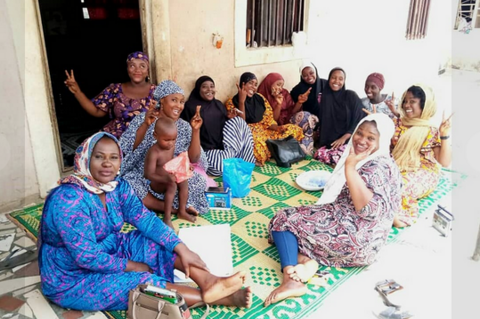
A radio program was initiated in Gbagyi language targeting women smallholders in Gwagwada, Kaduna State, building their capacity over the airwaves on how tech could enhance their agric livelihoods. A women's listeners' club was granted a mobile phone and trained to use it to call into the radio program as well as to connect to extension services via mobile phone for information on climate change adaptation, agricultural support programs and markets. The women were encouraged to figure out ways through their discussion group to maintain the phone line and keep it operational and to use it in any way they as a group felt was appropriate. Focus group discussions were carried out at baseline and endline to determine how women interacted with the mobile phone and how it affected their livelihoods. Key informant interviews were also carried out in the community to determine whether there were any observable differences.
Results/Lessons Learned:
By project endline, virtually all (98%) the women in the listeners' club owned a personal mobile phone compared to just 8% at baseline, overcoming expense and operational barriers they cited at baseline once they saw added value to their livelihoods through access to agric extension services that provided support on climate change adaptation strategies, farmer assistance programs, and markets. The women earned income from the granted phone line by charging peers to make calls to relatives or to agric support services. Realizing that a lot of beneficial information is text-based, the listeners' clubs pressured their local church to organize literacy classes so they could learn to read and access even more information using their phones. Using income from the granted mobile phone, the women organized into a cooperative and registered a Community-Based Organization called the Agbada Association, supporting marginalized women farmers in their community with information and resources.
Discussion/Implications for the Field:
Digital inclusion, by simply increasing women's access to mobile communication, empowered them to increase the sustainability of their livelihoods, and become advocates for themselves and other marginalized women. Tech innovations in SBCC cannot be one-size-fits-all. It's essential that interventions are adaptable and position beneficiaries as collaborators in determining how the technology adapts sustainably to their daily lives. ICT4D is an exciting frontier in SBCC but it needs to build user confidence by providing audience-prioritized, user-friendly solutions rather than fall into the trap of unrelatable innovations that that only serve creative programming agendas.
Abstract submitted by:
Jite Phido - ARDA Development Communication Inc.
With global mobile phone penetration estimated around 70%, the majority of mobile phone users globally, are men, who tend to have the literacy, financing and efficacy to engage with digital information. For female smallholder farmers in North-West Nigeria, this means they're less likely to seek agricultural extension services, and have knowledge and access to special programs and fair markets, further reducing their earning potential compared to men. SDG target 5.B demands the use of ICT to enhance women's empowerment. Yet, when approached with the idea of buying into tech as a leveller in securing agricultural livelihoods, many women felt a lack of self-efficacy to own and operate a mobile phone on their own. ARDA with support from GenARDIS, aimed to discover how we could sustainably get a community of indigenous, tech-shy rural women smallholders to interact with technology, and the impact on their livelihoods if we granted a community women's listeners' club, a mobile phone to use during their weekly meetings. By endline, we went from only 8% mobile phone ownership to 98% of women in our pilot group owning their personal mobile phones. The women used the granted mobile phone to generate income that enabled them register as a cooperative that began to use ICT to demand for services or women in their community. This project showed women's motivation to use tech can grow if they see the benefits outweigh the difficulty and if they are allowed to determine how they will interact with ICT innovations.
Background/Objectives:
Although majorly active in agriculture, Gbagyi women of Northern Nigeria, are frequently marginalized in accessing limited available agricultural assistance programming. One major reason why is women's low access to information, with many women illiterate and most women at project baseline relying on husbands and churches for agricultural information. The Majelissar Mata Manoma (Women's Meeting Place) project aimed to build capacity of rural women smallholders to access information that would enhance their livelihoods, using technology. The project aimed to study the effects of digital inclusion on a marginalized groups' ability to secure sustainable livelihoods and sustainable community participation in development.
Description of Intervention and/or Methods/Design:
A radio program was initiated in Gbagyi language targeting women smallholders in Gwagwada, Kaduna State, building their capacity over the airwaves on how tech could enhance their agric livelihoods. A women's listeners' club was granted a mobile phone and trained to use it to call into the radio program as well as to connect to extension services via mobile phone for information on climate change adaptation, agricultural support programs and markets. The women were encouraged to figure out ways through their discussion group to maintain the phone line and keep it operational and to use it in any way they as a group felt was appropriate. Focus group discussions were carried out at baseline and endline to determine how women interacted with the mobile phone and how it affected their livelihoods. Key informant interviews were also carried out in the community to determine whether there were any observable differences.
Results/Lessons Learned:
By project endline, virtually all (98%) the women in the listeners' club owned a personal mobile phone compared to just 8% at baseline, overcoming expense and operational barriers they cited at baseline once they saw added value to their livelihoods through access to agric extension services that provided support on climate change adaptation strategies, farmer assistance programs, and markets. The women earned income from the granted phone line by charging peers to make calls to relatives or to agric support services. Realizing that a lot of beneficial information is text-based, the listeners' clubs pressured their local church to organize literacy classes so they could learn to read and access even more information using their phones. Using income from the granted mobile phone, the women organized into a cooperative and registered a Community-Based Organization called the Agbada Association, supporting marginalized women farmers in their community with information and resources.
Discussion/Implications for the Field:
Digital inclusion, by simply increasing women's access to mobile communication, empowered them to increase the sustainability of their livelihoods, and become advocates for themselves and other marginalized women. Tech innovations in SBCC cannot be one-size-fits-all. It's essential that interventions are adaptable and position beneficiaries as collaborators in determining how the technology adapts sustainably to their daily lives. ICT4D is an exciting frontier in SBCC but it needs to build user confidence by providing audience-prioritized, user-friendly solutions rather than fall into the trap of unrelatable innovations that that only serve creative programming agendas.
Abstract submitted by:
Jite Phido - ARDA Development Communication Inc.
Source
Approved abstract for the postponed 2020 SBCC Summit in Marrakech, Morocco. Provided by the International Steering Committee for the Summit. Image credit: ARDA via Facebook