










































Countering Online Misinformation Resource Pack
"Social networks, information ecosystems, and other macro-level variables (including the political landscape) that provide crucial social context need to be considered when understanding how people consume information, which sources they trust, and which measures are necessary to address misinformation."
Produced in the context of the COVID-19 "infodemic", this resource pack provides access to various types of resources (tools, reports, toolkits, journal articles, etc.) that can support the development of tactics and plans to counter misinformation. It was compiled by the United Nations Children's Fund (UNICEF) Regional Office for Europe and Central Asia (ECARO) to support advocacy, communication, and behaviour and social change experts, as well as policymakers and health and communication authorities, to counter misinformation and to boost vaccine confidence in the digital space.
The journal articles collected to inform the guidance were mainly searched on PubMed using the following search words and sentences: "misinformation", "disinformation", "how to tackle misinformation", and "vaccine hesitancy".
The first chapter provides a summary of the main findings from this literature review. The evidence-based recommendations for combatting misinformation that emerged, which are elaborated in more detail in the resource pack, include:
- Encourage people to think about accuracy and the sentiments triggered by what they see/read before sharing anything online.
- Promote media and information literacy (of users and journalists) to counter disinformation and help users navigate the digital media environment.
- Encourage the report of misinformation and disinformation.
- Understand the local communication ecosystem.
- Engage with your community to understand their information needs.
- Work with news and social media platforms to make mechanisms behind the production and release of information clear and transparent.
- Explore media and social media regulatory and governance opportunities to prevent the dissemination of unverified information in the digital space.
- Build a resilient information system that can mitigate the spread of harmful misinformation without restricting the free exchange of ideas.
- Foster diversity and sustainability of the news media ecosystem.
- Define mechanisms to track rumours, listen to the community, and monitor the media.
- Define criteria to choose the rumours that require response.
- Define who will find the correct answer to address the rumors and explain why they are incorrect.
- Take actions to increase transparency and efficiency of fact-checking practices.
- Work with domain registrars to act against fraudulent websites.
- Pair scientific evidence with stories that speak to the audience's beliefs and values.
- Tailor information/stories to the audiences' specific needs and preferred channels of media consumption.
- Talk the language of your audience. Be simple and engaging.
- Partner with (trusted) organisations, personalities, experts, and social media influencers for information sharing.
- Magnify the voice of experts.
- Flag information as inaccurate rather than censor it; otherwise, there is a risk that the sharing of misinformation will move to private platforms, such as WhatsApp.
- Set expectations and keep consistency across actors involved in the response and the channels you use to communicate.
- Understand why people are sharing misinformation.
- Benefit from the two-way communication potential of social media and other digital platforms.
- Start the dialogue about a future COVID-19 vaccine.
Recognising the diversity of media and social media landscapes in various countries, UNICEF ECARO notes that the proposed solutions should be contextualised and integrated into a comprehensive strategy to fight misinformation at regional and national levels.
The second chapter provides brief summaries and links to resources - tools, publications (handbooks, reports, factsheets), websites and web pages, articles from websites, and journal articles - on addressing misinformation, disinformation, and infodemics.
The third chapter provides access to more specific resources on vaccine confidence.
27
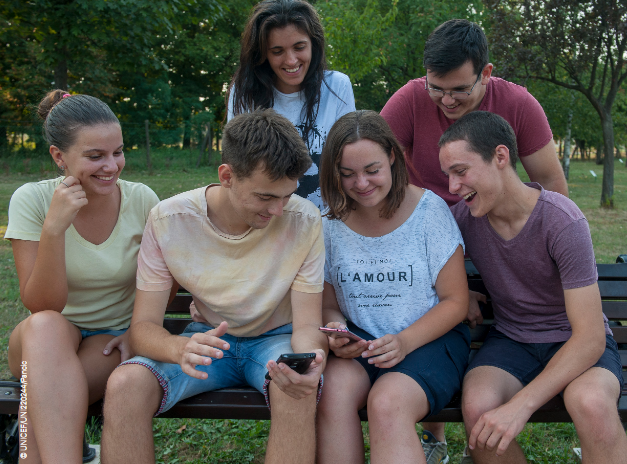
UNICEF ECARO website, July 9 2021. Image credit: © UNICEF/UNI220244/Pancic
- Log in to post comments