










































Community Initiatives in Ecotourism: A Case Study from Sikkm, India
This 8-page paper explores participatory community ecotourism planning as carried out in May 1996 amongst local groups of stakeholders in Yuksam, one site of the Sikkim Biodiversity and Ecotourism Project (SBEP). SBEP is a collaborative initiative designed to conserve the biological diversity of Sikkim, a small Himalayan state in Northeastern India. This paper was one of those presented at the International Seminar on Ecotourism for Forest Conservation and Community Development, in Chiang Mai, Thailand, from January 28-31 1997. This seminar was organised by the Food and Agricultural Organization of the United Nations (FAO) Regional Office for Asia and the Pacific (FAO/RAP) and Regional Community Forestry Training Centre for Asia Pacific (RECOFTC).
As detailed in the paper, ecotourism, with its focus on environmentally sound practices and on generating widespread economic benefits, offers an opportunity for Sikkim to improve the livelihoods of its mountain communities and protect its unique heritage. Recognising this, the Mountain Institute and the Govind Ballabh Pant Institute of Himalayan Environment collaborated to launch SBEP in collaboration with the Travel Agents Association of Sikkim (TAAS), Green Circle (a Sikkimese non-governmental organisation, or NGO), the Khangchendzonga Conservation Committee (a community NGO), and local communities at key tourism sites.
The report explains that at the heart of SBEP are participatory approaches that link enterprise operation with conservation action while merging traditional cultural practices. Working with communities, the private sector, and government, the project seeks to build people's skills, interests, and knowledge to: increase awareness of resource conservation in the communities and private sector; increase economic returns from ecotourism services and enterprises; and contribute to policies that meet ecotourism and conservation goals.
Specifically, SBEP focuses its work in 3 key areas that link conservation with ecotourism enterprises:
- Increasing community and private sector biodiversity conservation initiatives. Activities include: community ecotourism plans covering site-enhancement and trail and site maintenance; natural resource management (NRM) and monitoring, and conservation education; supporting reduction by trekking operators and local lodges of the use of wood as fuel (fuelwood); and supporting local NGOs working in ecotourism and conservation.
- Increasing economic returns from community-based and TAAS ecotourism. Activities include: training in ecotourism services (e.g. for guides, lodge-owners, cooks, porters); supporting new community ecotourism enterprises (e.g. vegetable growing, indigenous foods, fuelwood-saving equipment and short, guided treks); developing marketing strategies for community-based ecotourism and TAAS ecotourism activities; and conducting market research and developing new ecotourism products such as off-season activities and eco-lodge designs.
- Improving and contributing to policy-making on conservation and ecotourism. Activities include: scientific and participatory monitoring of project activities and impacts; applied research on conservation and ecotourism; sharing of research and monitoring findings among policymakers, communities, and the private sector; and promoting public-private sector dialogue through workshops, exchanges, and policy review.
Participants are involved in ecotourism planning, training courses, and conservation management - all of which reportedly use participatory learning tools that build upon "best practices" and Sikkim's natural and cultural heritage. A combination of appreciative inquiry and modified participatory learning and action (PLA) tools provide the basis for planning, implementing, and evaluating community ecotourism activities. This type of participatory research approach involves asking questions such as: What do you value in your community and environment? What excites you most about where you live? What is the most positive vision you have of your environment and community in the future? What do we need to do to realise a vision of the future? The focus is on finding the causes of success and motivation rather than failure as the basis for community planning.
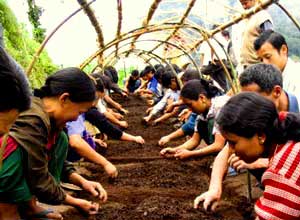
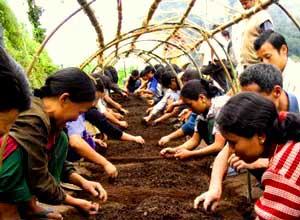
Yuksam has served as the basis for further planning for community ecotourism in other project sites in western Sikkim, and many of the lessons learned have been incorporated into other project activities such as training in ecotourism professions. In May 1996, a team of 5 project staff and 6 local residents worked with local community members to gather information and generate site-specific ideas for linking tourism-related activities to conservation efforts. All participants were asked to "discover" the elements in their environment and community that represent the best of what they have to offer. They were then asked, "What would you like to see in Yuksam ten years from now"? The next phase was to use PLA tools to collect some of the information needed to design a plan for achieving the common dream, one that was inclusive of participants' aspirations and that focused on the issue of increasing income from existing tourists (e.g., by extending the stay of visitors to the area). A preliminary report was prepared by participants and included: a listing of environmental and community attributes; ecotourism resource maps; local stories about sites and history; maps and analysis of the availability and use of forest resources; and socio-economic analysis of tourism benefits. The final step was to identify actions to be taken in the next 3-6 months that would begin to deliver their vision (e.g., training courses for lodge-operators and naturalist guides). Then, in December 1996, a participatory evaluation of activities since the previous May was conducted and a plan developed for 1997. In addition to the use of PLA tools (such as pair-wise ranking and standard ranking to assess activities), narrated stories of community action in conservation were also documented.
According to this report, "[t]he evaluation was very insightful highlighting areas that the project and the community needed to work on (e.g. dissemination of results, the nature and benefits of participation, and the role of community groups and institutions in ensuring widespread and enthusiastic participation). Local communities were concerned that the benefits of participation in project activities were seen to be fair, and that the community itself should visibly participate in the decision-making process. For example, the villagers decided who should attend study tours and how the rest of community might share in the benefits of visiting other sites....A critical element developed by village participants during the use of the methodology was the commitment to an action plan, demonstrating as the villagers say, 'that we should go beyond talk and do something' [e.g., a cleanup of the village by teachers, schoolchildren, and other villagers]."
It was found that the following elements appear to be critical to the community planning methodology:
- A framework of appreciative inquiry needs to be developed which focuses on what is done well, what works among and excites the groups of stakeholders, and what helps participants develop a positive vision of the future. The purpose here is to start identifying the factors that lead to success among stakeholders. Maps, drawings, lists, and discussion all serve to develop and represent people's ideas, and visions.
- A process of participatory learning about the environment, stakeholders, and other groups and communities that informs the design of plans has several advantages, including: engaging a larger section of the population and developing rapport and trust with local people; providing a training function among local communities in community-based conservation and ecotourism planning; generating data which serves as planning information and a baseline for monitoring; and producing documents and information that can be used by the villagers as reference material, guidelines, and promotional material.
- An initial participatory plan of action often emerges out of the participatory learning session, and usually covers these elements: what activity, who is responsible, what is the schedule, what is the level of co-financing, and what are the indicators of success. This plan is presented by the participants to the community for discussion and revision.
- Co-financing by participants is an essential part of project activity implementation. This helps local people decide which activities are most wanted and usually ensures follow-through with project activities.
- Community evaluation of action plans on a periodic basis using participatory indicators and methods, followed by modification and further action plans as required, is essential.
Elaborating on the above findings, the report notes that local communities have responded to and participated very positively in the process of planning and action for conservation and tourism. Noted as crucial: Project staff have been concerned with ensuring that the process avoids being an expert-driven approach. The Village Pradhan from Yuksam stated: "Unlike other officials, SBEP staff came and demonstrated activities instead of just talking. Our community is more aware of biodiversity and its conservation as a result of project activities." Community members have commented that participation in decision-making and planning has been an empowering process. For example, in May, the cleanup of the trekking trail was not identified as an activity to undertake, but by October local villagers felt confident and motivated enough to organise the activity and publish an article about it in the state newspapers. Similar exercises have been carried out at two other sites, Kecheopalri Lake and Tshoka (a settlement along the major trekking trail). One clear sign of sharing of information and knowledge is that Yuksam residents have participated in these activities, fostering greater interaction and linkages between the various settlements in this tourism area and developing the skills of local people in community-based ecotourism planning.
The conclusion of the report notes that ecotourism "appears to lend itself extremely well to the appreciative framework of valuing the positive attributes of the local environment and communities. What was found is that appreciative inquiry provides the type of visionary framework for planning and action, and the process and results of using modified PLA tools can be both informative and empowering."
RECOFTC website and Mountain Institute website - both accessed on May 12 2010.
- Log in to post comments