










































Communication and Natural Resource Management: Experience/Theory [Presentation]
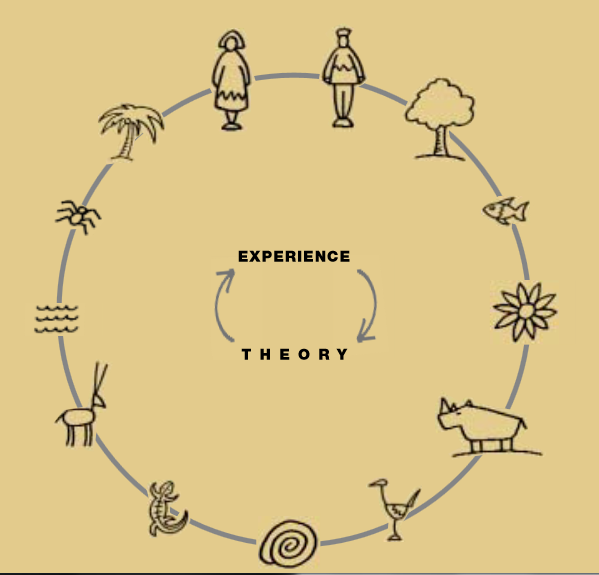
This 106-page book is offered as a tool for people interested in communication and natural resource management who seek a better understanding of how different theories and strategic change principles relate to actual practise. This publication relates a variety of theories and change principles to a series of real initiatives in the field through interactive experiences. Eight experiences are highlighted from different parts of the world and the final section is entitled "Drawing Your Own Conclusions."
The Foreword describes this book as illustrating "how experience is, and can be guided by theory and how theory can be derived from understanding experience. It challenges us to reflect on our own and others’ work by treating theoretical approaches as interchangeable tools within a variety of different communication and natural resource management initiatives. It encourages the readers to learn from each other."
This tool was prepared by The Communication Initiative in collaboration with the Communication for Development Group Extension, Education and Communication Service Research, Extension and Training Division, Sustainable Development Department, and Food and Agriculture Organization of the United Nations.
Table of Contents
Acknowledgements
About the Authors
- Using This Book
- A World of Finite Resources
- Critical Perspectives
- Changing Approaches to Natural Resource Management
- Communication for Development and Social Change
- Insights and Direction
Experience 1
Community Based Natural Resource Management – Namibia
- Theme: Principles and Action
- Learning Objective: To improve participants' understanding of the relationship between differing communication principles for effective change, and the planning and organisation of their actions.
Experience 2
Pastoralist Communication – Kenya
- Theme: Voices and Action
- Learning Objective: To advance participants' understanding of effective communication strategies, where substantive action is sourced in the voice and perspective of the people most affected.
Experience 3
Indigenous Forest Management – Cambodia
- Theme: Issue Analysis for Action
- Learning Objective: To expand participants' skills at analyzing the issues to be addressed by the communication initiative.
Experience 4
Recovering From Conflict – Viet Nam
- Theme: Contextual Analysis for Action
- Learning Objective: To improve participants' skills at analyzing the contexts for change.
Experience 5
Internet Radio – Sri Lanka
- Theme: Culture and Action
- Learning Objective: To expand participants' awareness of the relationship between culture, context and strategy, in developing effective communication initiatives.
Experience 6
Regional Networking – Costa Rica and Nicaragua
- Theme: Behavioural or Social Action
- Learning Objective: To develop participants' ability to understand the relation between individual behaviour change and structural/social obstacles or supports to that change.
Experience 7
Creating Local Organic Markets – Turkey
- Theme: Education or Dialogue for Action
- Learning Objective: To improve participant's ability to understand key differences between approaches emphasising education or dialogue and the programmatic implications of those emphases.
Experience 8
Environmental Education and Communication – El Salvador, The Gambia, Jordan
- Theme: Innovation and Action
- Learning Objective: To heighten participants' critical skills at matching the requirements for action with the context for that action.
- Theme: Planning for Action
- Learning Objective: To prioritise the lessons of the previous 8 experiences and reflect on how they will impact on your own future communication for development - natural resource management work.
Click here to download a PDF version of this document.
FAO wishes to acknowledge the contribution of the Strategic Communication for Sustainable Development Unit (DevCom-SDO) of the World Bank towards the production of this book. DevCom-SDO is a technical group within the Communication for Development Division whose goal is to introduce strategic communication as an integrated component of policies and projects, and to ensure an efficient use of human and financial resources. The Unit is also committed to the promotion of appropriate communication concepts and tools and to capacity building initiatives in the field of strategic communication for natural resource management.

Warren Feek is Director of The Communication Initiative. He has also worked with UNICEF as lead on Health and HIV/AIDS Communication in New York, with The Commonwealth Secretariat as Director of Programmes related to young people, and with a major New Zealand Non Governmental Organization. He is a New Zealander living in Canada with his partner and 3 children.
Chris Morry is Programme Director of The Communication Initiative. He has also worked for Oxfam Canada where he was the Country Representative in Namibia responsible for programmes focused on NGO capacity building, agricultural development and rural health care. He now lives in Canada with his family.
The writing and preparation of this book has been a collaborative effort from the beginning. There are many people who helped us by allowing us to use their experiences in the field, there are others who helped point us towards essential reading and documentation, still others read portions of the document for us and offered advice and useful criticism. We thank all of you for helping make this a better book than it would have been without you while exonerating all of you from any role in its failings.
At FAO we would particularly like to thank Loy Van Crowder and Mario Acunzo who provided great support throughout the process and critical thinking when we needed it. We would also like to thank Denise Gray-Felder, Brian Byrd and their colleagues at the Rockefeller Foundation for their insight on social change in action, Adelaida Trujillo, Raphael Obregon, and Alfonso Gumucio Dagron for reading and commenting on the entire document. It is better for their input though they share no blame for its short commings. Others who provided us with information and/or read and commented on portions of the documents are Brian T. B. Jones, Kitty Warnock, Claire Thompson, Luz Marina Rizo, Juan Carlos Cruz, Lyes Ferroukhi, and Victor Ananias. Thanks also to the World Conservation Union (IUCN) who helped us locate some of the documents used in the book and a special thanks to several people at Kothmale radio who provided us with important updated information on their work, to the team at GreenCOM who provided significant and useful input, to Freedom Nyamubaya for writing and letting us use her poetry, and to all those of you whom we have not mentioned but probably should have.
- Log in to post comments