










































Close the Immunization Gap
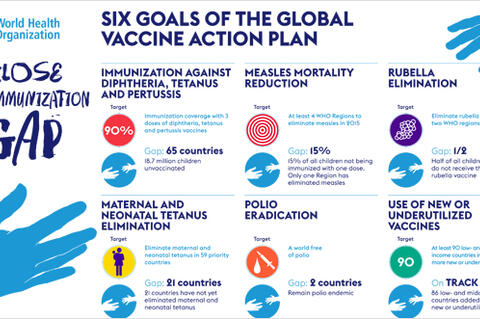
"No child should be denied the right to immunization for unfair reasons, including economic or social causes. All barriers must be overcome." - Dr. Margaret Chan, WHO Director-General
Launched during World Immunization Week 2015, this multiyear World Health Organization (WHO) campaign, built on the theme "Close the Immunization Gap", aims to raise awareness worldwide on the critical importance of full immunisation throughout life. It draws on recommendations from WHO's Strategic Advisory Group of Experts (SAGE) on Immunization on how to address barriers so we can achieve immunisation for all. The campaign places a strong focus on role of global partnership in reaching children, adolescents, and adults living in countries with inadequate coverage and those affected by conflict or other emergencies. Along these lines, Close the Immunization Gap seeks to increase recognition that governments, international organisations, and other development partners need to align their efforts in strengthening leadership and accountability on achieving full immunisation.
As part of this advocacy effort, WHO asks partners and members of the global immunisation community to join in the observation of World Immunization Week by raising awareness locally - tailoring campaign materials and actions to meet local needs. Partners are asked to highlight recent achievements by the global immunisation community, such as: the phased introduction of a new polio vaccination regimen, which represents a critical step towards a polio-free world and the preparation for the globally synchronised withdrawal of type 2 oral polio vaccine (OPV) in 155 countries, thus eradicating type 2 polio virus; elimination of rubella in the Americas; and elimination in Cambodia, India, and Mauritania of tetanus among new mothers and newborn babies. Similarly, partners are urged to draw attention to innovations, including progress on making vaccines against Ebola, malaria, and dengue available. Yet, "[t]he global immunization goals for reaching all individuals and communities through the Decade of Vaccines (2010-2020) can achieve its true potential only if the impressive progress seen in some countries becomes the norm." For example, they are asked to call for action on achieving universal coverage for immunisation against measles, rubella and tetanus.
To facilitate such advocacy, the campaign website for 2016 (April 24-30) includes a 26-page campaign toolkit [PDF] including key messages for staff, partners, media, and the public and information on how to get involved in the campaign and how to organise events. Also available are campaign visual identity, core materials in different formats and languages (e.g., a public service announcement (PSA) for radio), and online resources. The campaign video may be downloaded there and/or viewed below. The website also features a quiz to test one's knowledge on immunisation. Where there are knowledge gaps, fact sheets on immunisation coverage, measles, and poliomyelitis are available; visit the campaign website for all resources.
Three feature stories have been posted on the campaign website showcasing: Nepal's efforts to keep children safe through immunisation a year after a major earthquake; Austria's creative campaign to encourage measles vaccination among unimmunised adults; and looking towards an Ebola-free future as plans step up on how to use an Ebola vaccine in response to an outbreak. To elaborate on one of these experiences, in 2014 the health ministry in Austria launched "a playful but aggressive antimeasles campaign, using highly visible approaches..." For example: "On the evening of 10 January 2014, a group of young people were chatting at a popular hangout in a park near Vienna's Leopold Museum. They turned quiet as the museum lit up. Austria's Federal Ministry of Health had arranged for projection on the museum's walls of a red slogan surrounded by bright red spots. The slogan, Wir schielen schon auf dich, means 'We're looking at you, too.' The crowd started laughing. The red spots were to remind people that measles was "looking" for them and they could soon be covered with a rash, like the museum's walls. But there was a double meaning: Many works by Egon Schiele, the renowned Austrian painter whose last name means 'look' in German, are on display in the Leopold Museum - there to be looked at too."
Immunisation and Vaccines
Global Immunization News (GIN) [PDF], April 2016; and World Immunization Week 2016: Close the Immunization Gap website, May 3 2016.
- Log in to post comments