










































Children, ICT and Development: Capturing the Potential, Meeting the Challenges
IT4D Centre at Royal Holloway, University of London (Kleine, Poveda), Jigsaw Consult (Hollow)
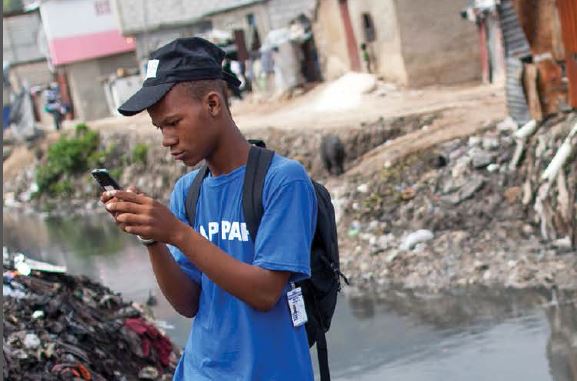
This study on information and communication technologies (ICTs), such as mobile phones, computers, and the internet, examines the ways in which these tools can contribute to child-focused development goals. The United Nations Children's Fund (UNICEF) Office of Research - Innocenti initiated the study in collaboration with the ICT4D [ICT for Development] Centre at Royal Holloway, University of London and Jigsaw Consult. It is a mapping review of recent literature and expert opinion obtained through 35 in-depth interviews.
Themes include:
- access and equity - "the complex socio-political factors which dictate availability and affordability of ICTs for children."
- gender - "the specific challenges for girls in accessing and utilizing ICT."
- the role that intermediaries play - "who controls access to and use of ICTs and the implications for e-health and e-learning,...[including] the role of commercial interests affecting the distribution patterns of ICTs."
- local demand and appropriate design - "the importance of contextualised, user-centred approaches to design. The fifth theme brings together as focal areas: accountability, open data, voice and participation."
- the potential for advances in data collection - "more responsive, adaptive and participatory policy making and programming."
- pilots, scale, and sustainability - "what constitutes a successful child-focused ICT for development programmes."
- the private sector, partnerships, entrepreneurship, and Free and Open Source Software (FOSS) - "perspectives on private sector involvement in child-focused ICT initiatives."
- innovation, evaluation, and failure - "the ongoing need for evidence building and learning through evaluation."
The conclusions and recommendations are organised to answer the following questions:
- "Considering children, where and how can ICTs help with reducing inequality?
- Considering children, where is there a risk that ICTs will increase inequality?
- Where might ICTs offer quick wins for child-focused development objectives?
- How can ICTs contribute to the future of child-focused development efforts?
- How can ICTs be integrated in other child-focused development efforts, especially in regard to innovation and collaboration?
- How have ICT projects been successful, or not, in assisting the most vulnerable and disadvantaged children?
- What do UNICEF’s work and the field of ICT4D have to contribute to one another?"
Responses include the following:
- ICTs can help with reducing inequality, for example on health and education outcomes, but availability, affordability, and skills necessary for use of the technologies must be taken into account, some of which are influenced by societal norms, such as gender. State intervention is likely to be needed where markets are small (not attractive to private enterprise) and accessibility is difficult. "ICTs also help reduce inequality where projects are specifically targeted at the more marginalized, including street children, migrant children, children with disabilities, those living in child-headed households." However, "ICT4D projects will have to make a conscious decision to engage with the relatively more disadvantaged groups if they are to avoid reinforcing existing inequalities."
- "Projects are at significant risk of failure where technology is used for 'quick wins' or trying to 'rush along' changes which have to take place at the social and cultural level. The main reasons for failure are firstly the unintended consequences of fast technological change and secondly unhinging the technical from the social dimension of development."
- After first establishing the needs of the child and identifying the intended impact of the initiative, a thorough stocktaking of the local context is need to establish reliability of electricity and availability and affordability of access need to be assessed, as well as local social norms related to access. Existing solutions need to be sought, and "...it is important to assess the role that intermediaries such as parents, teachers, community health workers, street or social workers play in the lives of children."
- "Good practice points include:
- Use participatory approaches
- Listen to local people
- Spend an extensive amount of time in the local context and with users
- Understand the local context
- Understand the systems you want to integrate with
- Leverage existing technologies (e.g. simple mobiles) and platforms (e.g. Facebook and Mxit) that are already being used
- Understand user needs
- Understand users’ existing skill levels
- Think about interoperability
- Children, ICT and Development: Capturing the potential, meeting the challenges
- Involve users, including women and children
- Use iterative design and be ready to adjust things
- Involve local colleagues
- Design and/or customize for the local context
- Give ownership, have community involved and responsible for part of it
- Scale up from there - where possible
- Consider financial sustainability from the start - this could be via a business model or by getting government buy-in to run a programme as a public service
- Engage with failure and share lessons that will benefit others.
- In particular, on the subject of equity, good practice includes:
- Consider equity issues from the outset
- Consider gender issues throughout
- Consider designing for remote areas first
- Consider disabilities issues."
- In terms of usage of ICT, the report notes success in birth registration programmes and work with migrant children. However, limitations arise with: a focus on a particular device and the promise for a project to become financially self-sustaining. The evaluation of projects, according to interviewees, will need to "move away from binaries of successful or unsuccessful projects and instead move to an approach which is open to ongoing learning... [and to] more iterative project and programme design which integrates monitoring and evaluation as a continuing activity, not simply an end-of-project work package."
- While viewing children as "co-creators of technology and actors in their own future", UNICEF’s role might be to guide "the field of ICT4D to understand how children can be given safe spaces and responsible intermediaries so they can express voice, creativity and action in a way that simultaneously protects them from harm, offline and online."
- Because ICTs are "not some technical sphere separate from people’s lives" but are also "closely linked with social innovation, including process innovation", there is a need to further explore the linkage between socio-technical change processes and social innovation, especially with regard to equity for children.
The UNICEF Office of Research - Innocenti website, August 28 2014. Image credit: ©UNICEF/NYHQ2012-0918/Dormino
- Log in to post comments