










































Building Male Involvement in SRHR: A Basic Model for Male Involvement in Sexual and Reproductive Health and Rights
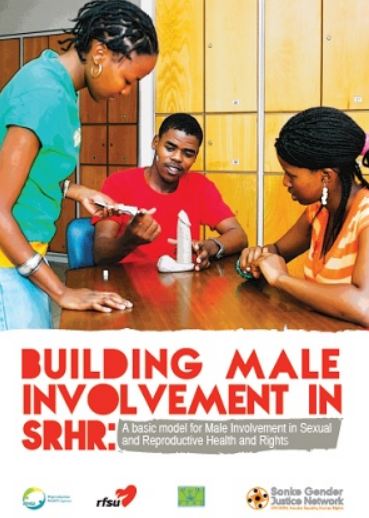
This 32-page publication shares a model for male involvement in sexual and reporoductive health and rights (SRHR) developed by Sonke Gender Justice Network. This model includes a framework, guidance, and concrete recommendations for building male involvement in SRHR. Three intersecting approaches are used: men as clients, men as equal partners, and men as agents of change. The model is intended to improve SRHR outcomes for men, women, girls, and boys, and requires its users to view gender equality as a critical and non-negotiable element of improving sexual and reproductive health.
According to the publication, SRH has generally focused primarily on controlling women’s bodies and reproduction, rather than on ensuring women the choice and freedom to make the decisions appropriate for their life and context, or on how to understand one's SRH needs. As well, little attention has been placed on the specific role of men and boys in SRHR, both for improving their own SRHR as well as their partners' SRHR. Where there has been attention placed on men and boys, it has generally been with the assumption that their SRH needs could be addressed by simply adding extra services on to existing ones traditionally tailored to women.
The model comprises three intersecting components, as described below, which are all critical for building successful male involvement in SRH that is valued by men, women, and their communities.
- Men as equal partners: This includes addressing gender inequality and unfair gender roles, openness on issues of sexuality, and tackling negative features of masculinity. However, the publication points out that men acting as equal partners in isolation, without the other two components described below, is not on its own strong enough for both men and women to gain the most from male involvement in SRHR.
- Men as clients: This includes increasing men’s utilisation of relevant SRH services. The following example is provided. A polygamous man has contracted an STI. He comes in for treatment after he starts to experience painful and uncomfortable symptoms. While this man is taking a positive step by coming to the clinic and should be encouraged to return to the clinic in the future, if he does not choose to tell his multiple partners about the STI, and becomes angered when his service provider suggests he do so, he is not acting as an equal partner. Additionally if, three months later he comes in with the same STI and is treated again, but he still has not spoken to any of his peers about the importance of going to the clinic, he is not an agent of change.
- Men as agents of change: This includes increasing men’s utilisation of relevant SRH services. Example of "men as agents of change" is provided: A man is actively involved in community forums, community radio talks, and workshops around promoting gender equality and the delivery of SRH services. If men are only approached as agents of change, and it is not simultaneously coupled with engaging men as equal partners and as clients, the potential for men to truly be part of improving SRH health outcomes for both men and women will be limited. This man, for example, might be an agent of change, but if he is also found on most night in taverns, getting drunk and making passes at women, and he does not understand the importance and value of treating women well, he is not engaged as an equal partner. Additionally, if many of his peers have heard that he doesn’t use condoms or go to the clinic because "he knows how to do it right", he has also not be engaged as a client.
The following programming guidelines are also provided:
- Link the activities of all three components as much as is possible. Potential impact is reduced if activities relating to 'men as clients', 'men as equal partners', and 'men as change agents' are not linked. This is because each component in isolation from the other two is insufficient in increasing male involvement such that there is benefit for men and women, and done so without negating the interests and needs of women.
- Get the balance right – there is a strong link between effective monitoring and evaluation (M&E) and good project management. If monitoring and evaluation data shows that efforts to mobilise men are moving faster than the ability to work with those change agents on gender equality, then it is important to shift the balance.
- Make the information and education relevant to the local context and youth-user-friendly. While information is imperative, the transition of this information into knowledge is something that requires an internalisation of this information within institutions, peers, and, most importantly, individuals.
- The aim is to empower clients (including youth) to make healthy decisions for themselves. Remember that providers can’t ultimately make these decisions for clients, but can provide them with enough resources and a safe space to come to that clients are capable of making health decisions that are right for them.
- Remember: The ultimate goal in increasing male involvement in SRH is to increase men's accountability not just to themselves, but, more importantly, to women. Engaging men in SRH is intended to promote gender equality, not further compromise it, and ensure that women have the agency, capacity, and safety to access the services they need and want. As such, it is essential that women’s safety and well-being is at the forefront and that interventions do not put women in danger or undermine their right to choose.
Overall, this document is intended to build male involvement in sexual and reproductive health and rights. Authors note that this cannot and should not come at the cost of women’s access to sexual and reproductive health and rights. Women continue to face disproportionate risk related to sexual and reproductive health, such as greater risk for STIs than men, risk of unwanted pregnancy, and consequent decision-making around that pregnancy, and maternal mortality. Embarking on efforts to build male involvement in SRHR must be done cautiously, and must take into account all three components covered in this model. Engaging a multi-pronged approach such as this ensures that men not only learn to take responsibility for their own and their partner's SRH, but do so in a way that does not negate the health and well-being of women and girls.
Men Engage website on February 8 2014.
- Log in to post comments